Integrated Intelligent Energy ›› 2026, Vol. 48 ›› Issue (6): 92-104.doi: 10.3969/j.issn.2097-0706.2026.06.008
• Energy Storage and Peak Regulation Technology • Previous Articles Next Articles
FAN Xiaochao1,2,3( ), ZHOU Kai1,*(), SHI Ruijing1(), ZHANG Zhihao3()
Received:2025-04-08
Revised:2025-12-16
Published:2026-06-25
Contact:
ZHOU Kai
E-mail:297546366@qq.com;1505548230@qq.com;fxc0102@126.com;107552504969@stu.xju.edu.cn
Supported by:CLC Number:
FAN Xiaochao, ZHOU Kai, SHI Ruijing, ZHANG Zhihao. Construction and thermodynamic analysis of an IBC-based atmospheric-pressure SOFC-GT system[J]. Integrated Intelligent Energy, 2026, 48(6): 92-104.
Add to citation manager EndNote|Ris|BibTeX
URL: https://www.hdpower.net/EN/10.3969/j.issn.2097-0706.2026.06.008
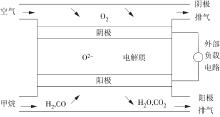
Fig. 1
Reaction principle of SOFC
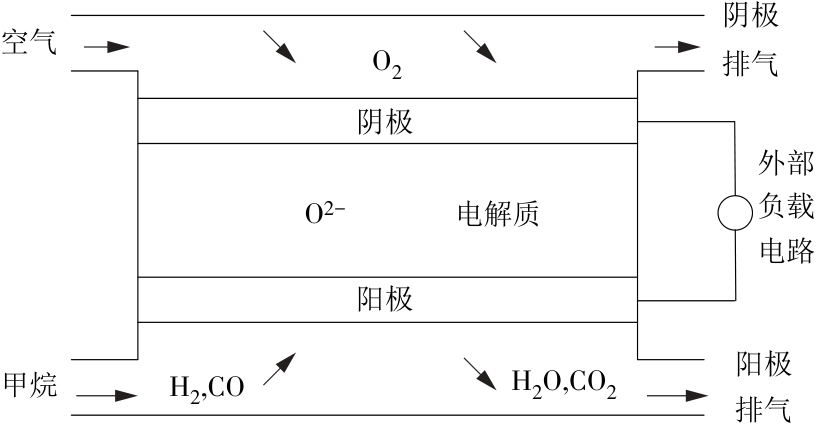
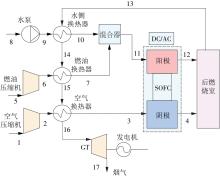
Fig. 2
Conventional SOFC-GT hybrid power generation system
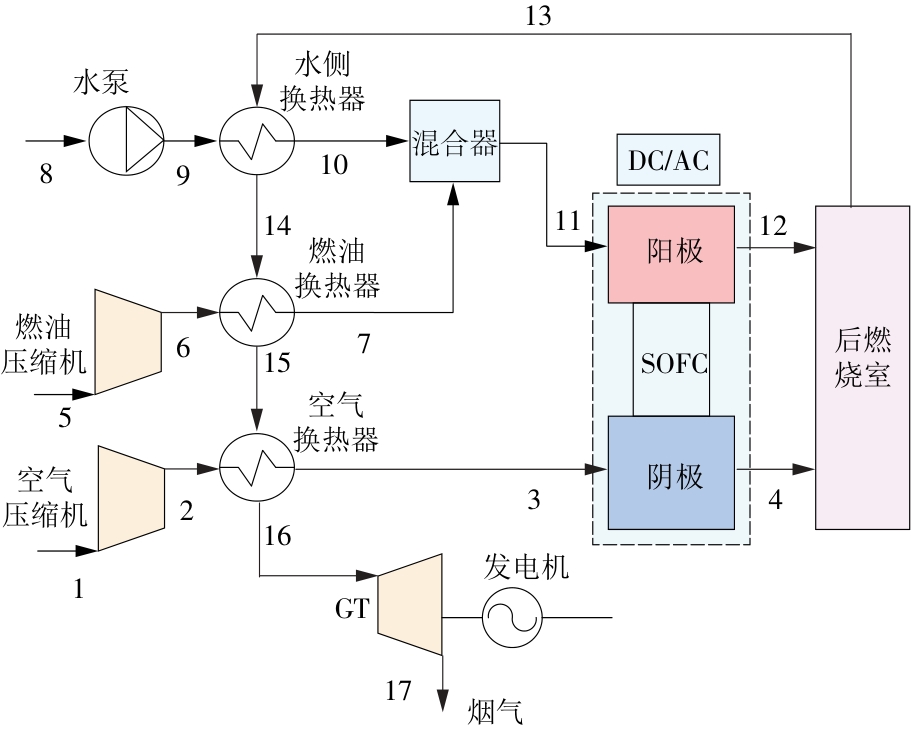
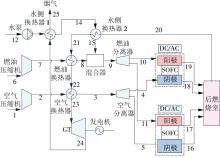
Fig. 3
Paralleled-connected dual-stack SOFC-GT hybrid power generation system
Fig. 4
Series-connected dual-stack SOFC-GT hybrid power generation system
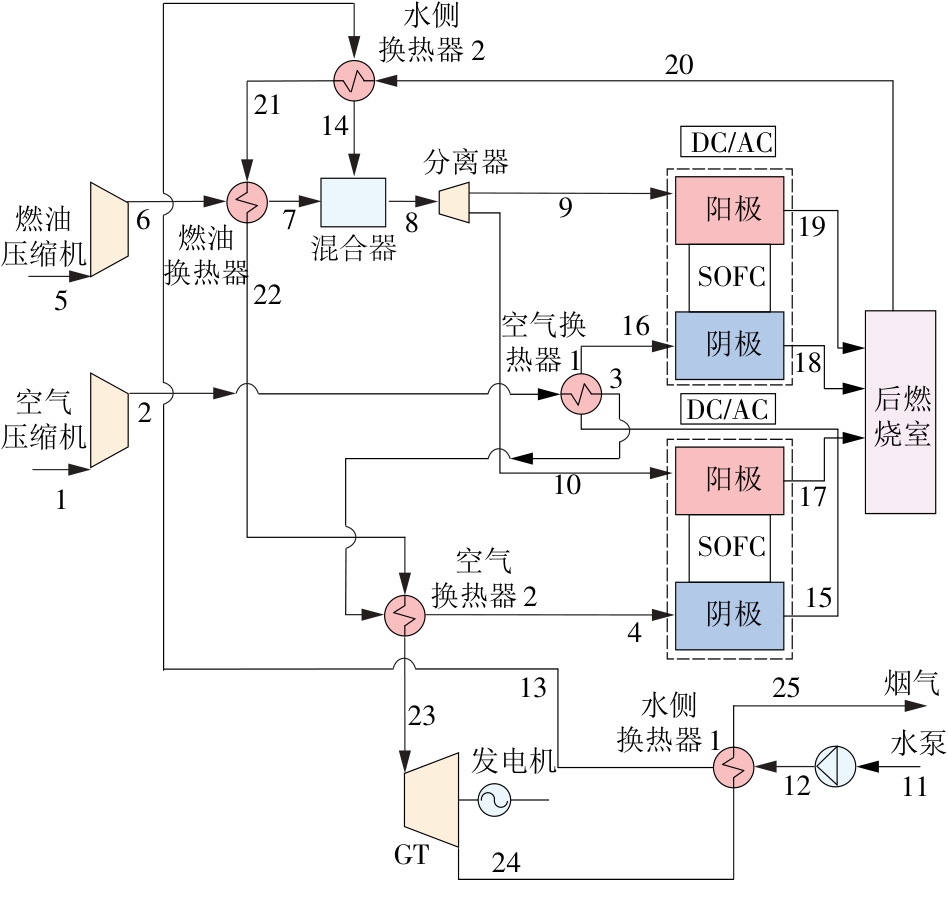
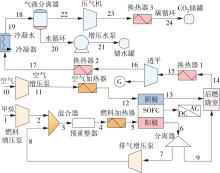
Fig. 5
Basic structure of SOFC-IBC hybrid power generation system
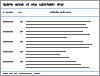
Table 1
Thermodynamic models of each heat exchange componen in SOFC-IBC hybrid power generation system
| 部件 | Pin,cool/kW | Pout,hot/kW | ||
|---|---|---|---|---|
| 燃料加热器 | P1 | |||
| 空气加热器 | P2 | |||
| 换热器1 | P3 | |||
| 换热器2 | P4 | |||
| 冷凝器 | ||||
| 换热器3 | P5 |
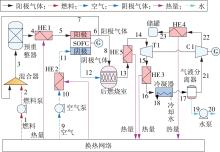
Fig. 6
Simulation structure of atmospheric-pressure SOFC-IBC hybrid power generation system
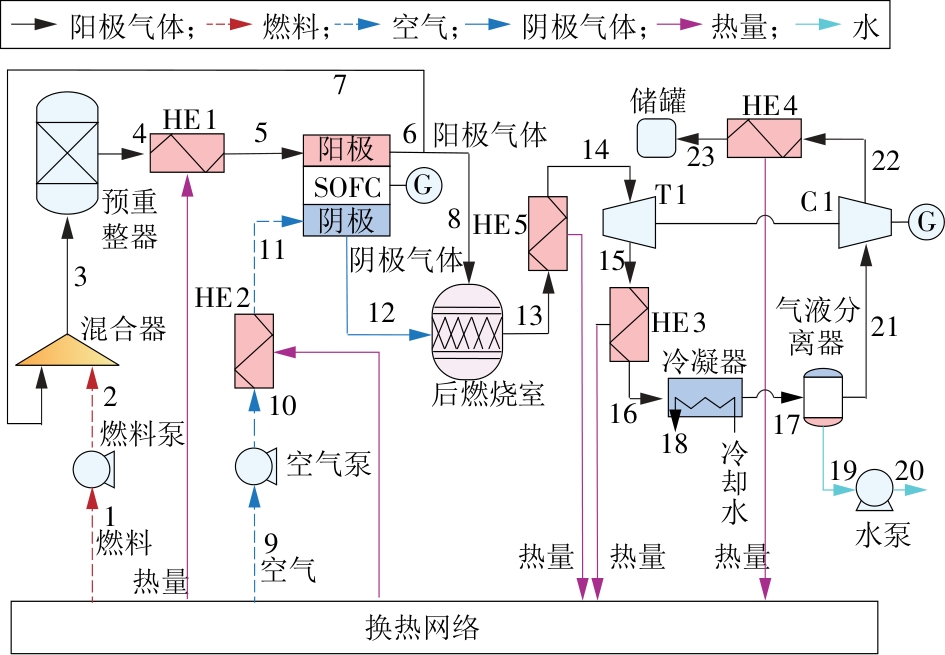
Table 2
Main input parameters of atmospheric-pressure SOFC-IBC hybrid power generation system under rated operating conditions
| 参数 | 数值 | 参数 | 数值 |
|---|---|---|---|
| 环境温度/℃ | 25 | 空气利用系数/% | 35.4 |
| 环境压力/kPa | 101 | S/C | 2.55 |
| SOFC运行压力/kPa | 102 | DC-AC转换效率/% | 92 |
| 阴、阳极入口温度/℃ | 700 | 100 | |
| SOFC活化面积/m2 | 96.1 | 阳极排气再循环比例/% | 61.07 |
| ncell | 1 152 | 85 | |
| 燃料摩尔流量/(kmol∙h-1) | 1.07 | 85 | |
| 空气入口温度/℃ | 25 | 透平机械效率/% | 99 |
| 燃料入口温度/℃ | 25 | 压气机机械效率/% | 99 |
| 空气入口压力/bar | 1.01 | 水泵效率/% | 80 |
| 燃料入口压力/bar | 1.01 | 水泵驱动效率/% | 95 |
| 入口空气组分 | 21%O2;79%N2 | 冷凝器压损系数 | 0.003 7 |
| 入口燃料组分 | 100%CH4 | 压气机出口压力/kPa | 101 |
| 纯氧入口温度/℃ | 25 | IBC发电效率/% | 99 |
| 燃料利用率/% | 85 |
Table 3
Thermodynamic performance output results of atmospheric-pressure SOFC-IBC simulation system output stream
| 流股 | t/℃ | p/kPa | qm/(kg·h-1) | E/kW | x | ||||||
|---|---|---|---|---|---|---|---|---|---|---|---|
| CH4 | N2 | CO | H2 | H2O | CO2 | O2 | |||||
| 1 | 25.00 | 101 | 17.17 | 0 | 1.00 | 0 | 0 | 0 | 0 | 0 | 0 |
| 2 | 25.33 | 102 | 17.17 | 0 | 1.00 | 0 | 0 | 0 | 0 | 0 | 0 |
| 3 | 724.76 | 102 | 135.39 | 28.66 | 0.18 | 0 | 0.06 | 0 | 0.45 | 0.21 | 0 |
| 4 | 527.86 | 102 | 135.39 | 17.49 | 0.11 | 0 | 0.05 | 0.28 | 0.31 | 0.24 | 0 |
| 5 | 700.00 | 102 | 135.39 | 26.64 | 0.11 | 0 | 0.05 | 0.28 | 0.31 | 0.24 | 0 |
| 6 | 911.53 | 102 | 193.60 | 51.54 | 0 | 0 | 0.08 | 0.12 | 0.54 | 0.26 | 0 |
| 7 | 911.53 | 102 | 118.22 | 31.48 | 0 | 0 | 0.08 | 0.12 | 0.54 | 0.26 | 0 |
| 8 | 911.53 | 102 | 75.37 | 20.07 | 0 | 0 | 0.08 | 0.12 | 0.54 | 0.26 | 0 |
| 9 | 25.00 | 101 | 705.97 | 0 | 0 | 0.79 | 0 | 0 | 0 | 0 | 0.21 |
| 10 | 25.40 | 102 | 705.97 | 0.06 | 0 | 0.79 | 0 | 0 | 0 | 0 | 0.21 |
| 11 | 700.00 | 102 | 705.97 | 68.63 | 0 | 0.79 | 0 | 0 | 0 | 0 | 0.21 |
| 12 | 911.53 | 102 | 647.76 | 95.44 | 0 | 0.85 | 0 | 0 | 0 | 0 | 0.15 |
| 13 | 1 093.51 | 102 | 723.13 | 148.76 | 0 | 0.76 | 0 | 0 | 0.08 | 0.04 | 0.12 |
| 14 | 936.06 | 102 | 723.13 | 117.71 | 0 | 0.76 | 0 | 0 | 0.08 | 0.04 | 0.12 |
| 15 | 647.17 | 25 | 723.13 | 41.84 | 0 | 0.76 | 0 | 0 | 0.08 | 0.04 | 0.12 |
| 16 | 226.72 | 25 | 723.13 | -13.25 | 0 | 0.76 | 0 | 0 | 0.08 | 0.04 | 0.12 |
| 17 | 40.00 | 25 | 723.13 | -23.54 | 0 | 0.76 | 0 | 0 | 0.08 | 0.04 | 0.12 |
| 19 | 25 | ||||||||||
| 20 | 101 | ||||||||||
| 21 | 40.00 | 25 | 723.13 | -23.54 | 0 | 0.76 | 0 | 0 | 0.08 | 0.04 | 0.12 |
| 22 | 210.78 | 101 | 723.13 | 9.68 | 0 | 0.76 | 0 | 0 | 0.08 | 0.04 | 0.12 |
| 23 | 126.78 | 101 | 723.13 | 3.79 | 0 | 0.76 | 0 | 0 | 0.08 | 0.04 | 0.12 |
Table 4
Sensitivity analysis of key parameters (with total efficiency as the objective)
| 参数 | 取值范围 | 总效率变化率(每变化1%)/% | 敏感性排序 |
|---|---|---|---|
| 后燃烧室效率 | 0.90~0.95 | 0.45 | 1 |
| 压气机压比 | 15~25 | 0.32 | 2 |
| 涡轮膨胀比 | 12~20 | 0.28 | 3 |
| 机械传动效率 | 0.97~0.99 | 0.15 | 4 |
Table 5
Exergy output results of atmospheric-pressure SOFC-IBC hybrid power generation system
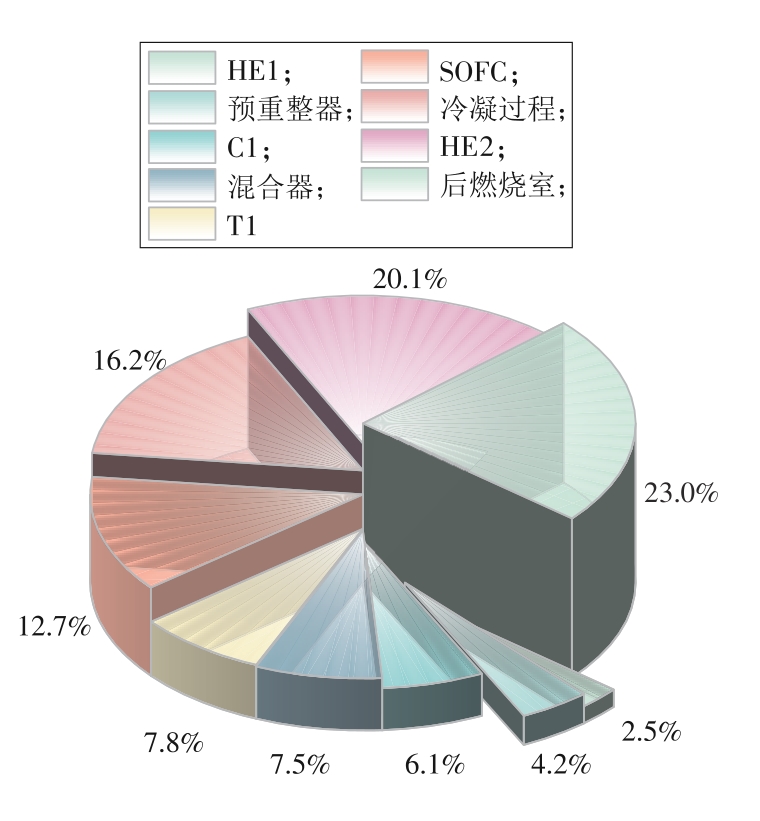
| 部件 | 燃料㶲/kW | 产品㶲/kW | 㶲损失/kW | 㶲效率/% |
|---|---|---|---|---|
| 燃料泵 | 247.19 | 247.19 | 0 | 100.00 |
| 混合器 | 359.29 | 354.52 | 4.77 | 98.67 |
| 预重整器 | 354.52 | 351.84 | 2.67 | 99.25 |
| HE1 | 505.20 | 503.63 | 1.58 | 99.69 |
| SOFC | 430.49 | 422.42 | 8.07 | 98.12 |
| 空气泵 | 0.96 | 0.94 | 0.02 | 97.92 |
| HE2 | 204.30 | 191.56 | 12.74 | 93.76 |
| 后燃烧室 | 167.93 | 153.36 | 14.57 | 91.32 |
| T1 | 122.31 | 117.38 | 4.93 | 95.97 |
| C1 | 18.14 | 14.28 | 3.85 | 78.75 |
| 冷凝过程 | -8.65 | -18.92 | 10.27 | 45.72 |
| 总系统 | 285.22 | 173.53 | 63.48 | 60.84 |
Table 6
Output results of atmospheric-pressure SOFC-IBC hybrid power generation system under given operating conditions
| 参数 | 数值 |
|---|---|
| SOFC输出电压/V | 0.78 |
| SOFC电流密度/(A∙m-2) | 2 029.22 |
| SOFC发电量/kW | 140 |
| 冷凝析出水量/(kg∙h-1) | 0 |
| 透平1膨胀做功量/kW | 70.94 |
| 压气机1功耗/kW | 37.07 |
| 水泵耗功/kW | 0 |
| IBC系统总输出功率/kW | 33.53 |
| SOFC交流发电效率/% | 58.78 |
| 系统总效率/% | 72.86 |
| 系统总㶲损失/kW | 63.48 |
| 系统总㶲效率/% | 60.84 |
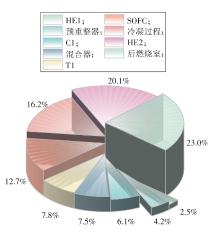
Fig. 7
Distribution of exergy loss of main components in atmospheric-pressure SOFC-IBC hybrid power generation system
| [1] | FANX C, SUN J Q, ZHANG W W, et al. Modeling and simulation analysis of capacity optimization configuration for low-carbon energy systems in oxygen-enriched coal-fired power plants using wind power for oxygen production[J]. Renewable and Sustainable Energy Reviews, 2026, 232: 1-31. |
| [2] |
窦真兰, 李佳文, 张春雁, 等. 固体氧化物电解池时空分布式参数建模[J]. 综合智慧能源, 2024, 46(7): 53-62.
doi: 10.3969/j.issn.2097-0706.2024.07.007 |
|
DOU Zhenlan, LI Jiawen, ZHANG Chunyan, et al. Spatiotemporal distributed parameter modeling of solid oxide electrolysis cells[J]. Integrated Intelligent Energy, 2024, 46(7): 53-62.
doi: 10.3969/j.issn.2097-0706.2024.07.007 |
|
| [3] |
杨磊, 王睿, 马丽丽, 等. 钙和铁共掺杂PrBaCo2O5+δ作为固体氧化物燃料电池阴极的研究[J]. 综合智慧能源, 2024, 46(7): 47-52.
doi: 10.3969/j.issn.2097-0706.2024.07.006 |
|
YANG Lei, WANG Rui, MA Lili, et al. Research on Ca and Fe co-doped PrBaCo2O5+δ as a cathode material of solid oxide fuel cells[J]. Integrated Intelligent Energy, 2024, 46(7): 47-52.
doi: 10.3969/j.issn.2097-0706.2024.07.006 |
|
| [4] |
王卓, 田松峰, 翟启超, 等. 基于SOFC的近零碳排放联合循环动力系统热力性能研究[J]. 动力工程学报, 2024, 44(12): 1960-1971.
doi: 10.19805/j.cnki.jcspe.2024.230650 |
|
WANG Zhuo, TIAN Songfeng, ZHAI Qichao, et al. Research on thermal performance of near zero carbon emission combined cycle power system based on SOFC[J]. Journal of Chinese Society of Power Engineering, 2024, 44(12): 1960-1971.
doi: 10.19805/j.cnki.jcspe.2024.230650 |
|
| [5] |
FAHEEM H H, ABBAS S Z, TABISH A N, et al. A review on mathematical modelling of direct internal reforming-solid oxide fuel cells[J]. Journal of Power Sources, 2022, 520: 230857.
doi: 10.1016/j.jpowsour.2021.230857 |
| [6] | 钟财富. 国内外分布式燃料电池发电应用现状及前景分析[J]. 中国能源, 2021, 43(2): 34-37, 73. |
| ZHONG Caifu. Application status and prospect analysis of distributed fuel cell power generation at home and abroad[J]. Energy of China, 2021, 43(2): 34-37, 73. | |
| [7] | 施浩波. 基于燃气轮机/燃料电池联合发电的分布式发电系统建模仿真研究[D]. 北京: 中国电力科学研究院, 2011. |
| SHI Haobo. Study on modeling and simulation for distributed generation system based on gas turbin/fuel cell combined generation[D]. Beijing: China Electric Power Research Institute, 2011. | |
| [8] | YU J G, WANG Y Z, XU L, et al. Development and investigation on the study state of solid oxide fuel cell and hybrid power system[C]// 2009 International Conference on Sustainable Power Generation and Supply. IEEE, 2009: 1-5. |
| [9] | 刘洋, 韩吉田, 游怀亮. 基于SOFC/GT和跨临界CO2动力/制冷循环的冷热电联供系统性能[J]. 东南大学学报(自然科学版), 2019, 49(6): 1072-1080. |
| LIU Yang, HAN Jitian, YOU Huailiang. Performance of CCHP system based on SOFC/GT and transcritical CO2 power/refrigeration cycles[J]. Journal of Southeast University (Natural Science Edition), 2019, 49(6): 1072-1080. | |
| [10] | 郭尧, 庞宏, 王蕾, 等. 基于SOFC-GT-SCO2RBC的联合循环系统热力性能[J]. 洁净煤技术, 2023, 29(S2): 328-336. |
| GUO Yao, PANG Hong, WANG Lei, et al. Thermodynamics performance of combined cycle system based on SOFC-GT-SCO2 RBC[J]. Clean Coal Technology, 2023, 29(S2): 328-336. | |
| [11] | 谢俊恩. 基于逆向布雷顿循环的SOFC-GT混合发电系统性能分析[D]. 哈尔滨: 哈尔滨工业大学, 2025. |
| XIE Jun'en. Performance analysis of an SOFC-GT hybrid power generation system based on the reverse brayton cycle[D]. Harbin: Harbin Institute of Technology, 2025. | |
| [12] |
BUONOMANO A, CALISE F, D'ACCADIA M D, et al. Hybrid solid oxide fuel cells-gas turbine systems for combined heat and power: A review[J]. Applied Energy, 2015, 156: 32-85.
doi: 10.1016/j.apenergy.2015.06.027 |
| [13] |
TSUJIKAWA Y, KANEKO K, SUZUKI J. Proposal of the atmospheric pressure turbine (APT) and high temperature fuel cell hybrid system[J]. JSME International Journal Series B, 2004, 47(2): 256-260.
doi: 10.1299/jsmeb.47.256 |
| [14] |
FACCHINETTI E, FAVRAT D, MARECHAL F. Innovative hybrid cycle solid oxide fuel cell-inverted gas turbine with CO2 Separation[J]. Fuel Cells, 2011, 11(4): 565-572.
doi: 10.1002/fuce.v11.4 |
| [15] |
FACCHINETTI E, GASSNER M, D'AMELIO M, et al. Process integration and optimization of a solid oxide fuel cell-gas turbine hybrid cycle fueled with hydrothermally gasified waste biomass[J]. Energy, 2012, 41(1): 408-419.
doi: 10.1016/j.energy.2012.02.059 |
| [16] | 王巍, 薛利超, 黄钟岳, 等. APGC燃机与燃料电池复合发电系统性能分析[J]. 大连理工大学学报, 2009, 49(3): 349-352. |
| WANG Wei, XUE Lichao, HUANG Zhongyue, et al. Performance analysis of APGC gas turbine and SOFC hybrid power system[J]. Journal of Dalian University of Technology, 2009, 49(3): 349-352. | |
| [17] |
CARDENAS DE LA CRUZ C T, HERZ G, REICHELT E, et al. Modeling of a novel atmospheric SOFC/GT hybrid process and comparison with state‐of‐the‐art SOFC system concepts[J]. Fuel Cells, 2020, 20(5): 608-623.
doi: 10.1002/fuce.v20.5 |
| [18] | 马秦慧, 陈钢, 范光涛, 等. 多工况下固体氧化物燃料电池短堆变载特性研究[J]. 热力发电, 2025, 54(3): 12-21. |
| MA Qinhui, CHEN Gang, FAN Guangtao, et al. Study on variable load characteristics of a solid oxide fuel cell stack under multiple operating conditions[J]. Thermal Power Generation, 2025, 54(3): 12-21. | |
| [19] |
孙浩哲, 张辉, 盛明珺, 等. 基于SOFC/GT和掺氢天然气的综合能源系统性能研究及经济性分析[J]. 动力工程学报, 2024, 44(9): 1493-1502.
doi: 10.19805/j.cnki.jcspe.2024.240266 |
|
SUN Haozhe, ZHANG Hui, SHENG Mingjun, et al. Performance study and economic analysis of integrated energy systems based on SOFC/GT and hydrogen-blended natural gas[J]. Journal of Chinese Society of Power Engineering, 2024, 44(9): 1493-1502.
doi: 10.19805/j.cnki.jcspe.2024.240266 |
|
| [20] |
AZIZI MALI, BROUWER J. Progress in solid oxide fuel cell-gas turbine hybrid power systems: System design and analysis, transient operation, controls and optimization[J]. Applied Energy, 2018, 215: 237-289.
doi: 10.1016/j.apenergy.2018.01.098 |
| [21] | EISAVI B, CHITSAZ A, HOSSEINPOUR J, et al. Thermo-environmental and economic comparison of three different arrangements of solid oxide fuel cell-gas turbine (SOFC-GT) hybrid systems[J]. Energy Conversion and Management, 2018, 168: 343-356. |
| [22] | VAN HERLE J, MARÉCHAL F, LEUENBERGER S, et al. Process flow model of solid oxide fuel cell system supplied with sewage biogas[J]. Journal of Power Sources, 2004, 131(1/2): 127-141. |
| [23] |
MILEWSKI J, MILLER A, SAŁACIŃSKI J. Off-design analysis of SOFC hybrid system[J]. International Journal of Hydrogen Energy, 2007, 32(6): 687-698.
doi: 10.1016/j.ijhydene.2006.08.007 |
| [24] |
ZHAO H B, LU R H, ZHANG T H. Thermodynamic and economic performance study of SOFC combined cycle system using biomass and LNG coupled with CO2 recovery[J]. Energy Conversion and Management, 2023, 280:116817.
doi: 10.1016/j.enconman.2023.116817 |
| No related articles found! |
| Viewed | ||||||
|
Full text |
|
|||||
|
Abstract |
|
|||||