Integrated Intelligent Energy ›› 2025, Vol. 47 ›› Issue (10): 60-68.doi: 10.3969/j.issn.2097-0706.2025.10.007
• New Energy and Energy Storage System Optimization • Previous Articles Next Articles
HUANG Ziqi( ), WU Zhicong(), XU Gang*(), GE Shiyu(), CHEN Heng()
Received:2024-10-23
Revised:2024-12-16
Published:2025-05-28
Contact:
XU Gang
E-mail:19030821131@163.com;wuzc_ncepu@163.com;xgncepu@163.com;GSY_Ncepu@163.com;heng@ncepu.edu.cn
Supported by:CLC Number:
HUANG Ziqi, WU Zhicong, XU Gang, GE Shiyu, CHEN Heng. Optimization analysis of a cogeneration system based on methanol synthesis and gas turbine combined cycle[J]. Integrated Intelligent Energy, 2025, 47(10): 60-68.
Add to citation manager EndNote|Ris|BibTeX
URL: https://www.hdpower.net/EN/10.3969/j.issn.2097-0706.2025.10.007
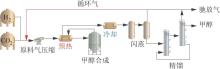
Fig.1
Methanol synthesis system
Table 1
Purge gas parameters
| 项目 | 摩尔分数/% | 能量占比①/% |
|---|---|---|
| H2 | 32.91 | 1.16 |
| CO | 1.21 | 0.05 |
| CO2 | 30.56 | |
| CH3OH | 34.10 | 3.16 |
| H2O | 1.22 |
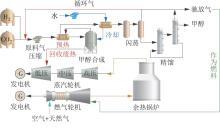
Fig.2
GTCC-integrated methanol synthesis optimization system
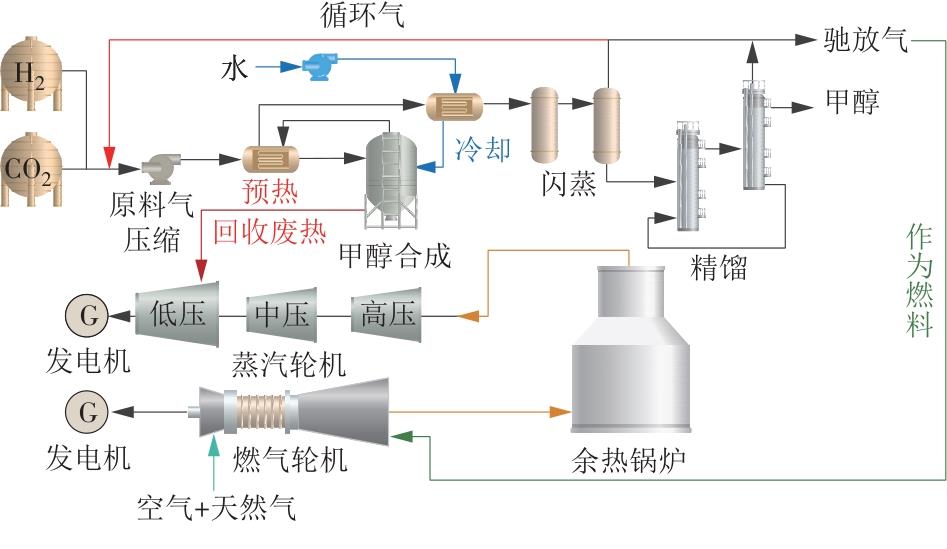
Table 2
Composition of feed gas and recycle gas
| 项目 | 原料气 | 循环气 | |
|---|---|---|---|
| H2 | CO2 | ||
| H2摩尔分数 | 1.000 | 0 | 0.757 |
| CO2摩尔分数 | 0 | 1.000 | 0.208 |
| CO摩尔分数 | 0 | 0 | 0.027 |
| H2O摩尔分数 | 0 | 0 | 0.001 |
| CH3OH摩尔分数 | 0 | 0 | 0.006 |
| 温度/℃ | 50.000 | 14.000 | 44.455 |
| 压力/MPa | 3.0 | 5.0 | 4.5 |
| 摩尔流量/(kmol·h-1) | 10 380.00 | 3 460.00 | 51 718.78 |
Table 3
Purge gas properties in methanol synthesis system
| 项目 | 数值 |
|---|---|
| 温度/℃ | 49.46 |
| 压力/MPa | 0.1 |
| CH2OH摩尔流量/(kmol·h-1) | 124.31 |
| H2摩尔流量/(kmol·h-1) | 119.97 |
| CO摩尔流量/(kmol·h-1) | 111.39 |
| CO2摩尔流量/(kmol·h-1) | 4.40 |
| H2O摩尔流量/(kmol·h-1) | 4.46 |
| 低热值/(MJ·kg-1) | 19.95 |
Table 4
Key parameters of GTCC-integrated methanol synthesis system
| 项目 | 数值 |
|---|---|
| 环境温度/℃ | 25 |
| 压力/MPa | 0.1 |
| 空气压缩机压比 | 25.8 |
| 压气机多变效率/% | 88 |
| 燃烧室燃气出口温度/℃ | 1 515 |
| 燃气轮机排气温度/℃ | 654 |
| 燃气轮机等熵效率/% | 92 |
| 汽轮机高压缸等熵效率/% | 85 |
| 汽轮机中压缸等熵效率/% | 85 |
| 汽轮机低压缸等熵效率/% | 85 |
| 汽轮机高压缸进汽温度/℃ | 615 |
| 再热温度/℃ | 92.2 |
| 发电效率/% | 57.28 |
Table 5
Model accuracy validation
| 项目 | 文献数据[ | 本文数据 | 相对误差/% |
|---|---|---|---|
| 甲醇产量/(t·h-1) | 104.38 | 104.44 | 0.06 |
| 甲醇纯度/% | 99.92 | 99.94 | 0.02 |
| GTCC系统发电净输出功率/MW | 526.14 | 525.07 | 0.20 |
| GTCC系统发电效率/% | 57.62 | 57.28 | 0.59 |
Table 6
Overall performance improvement
| 参数 | 甲醇合成系统 | 甲醇合成集成GTCC优化系统 | 性能提升情况 |
|---|---|---|---|
| 入口氢气质量流量/(t·h-1) | 20.92 | 20.92 | 0 |
| 入口氢气总能量/MW | 697.49 | 697.49 | 0 |
| 压缩机功耗/MW | 11.33 | 12.84 | 1.51 |
| 甲醇产量/(t·h-1) | 104.38 | 104.38 | 0 |
| 出口甲醇总能量/MW | 577.01 | 577.01 | 0 |
| GTCC发电功率增量/MW | 0 | 26.30 | 26.30 |
| 甲醇合成能效/% | 81.40 | 84.93 | 3.53 |
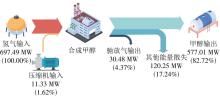
Fig.3
Energy flow diagram of the methanol synthesis system
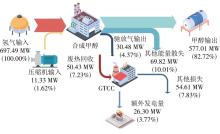
Fig.4
Energy flow diagram of the GTCC-integrated methanol synthesis optimization system
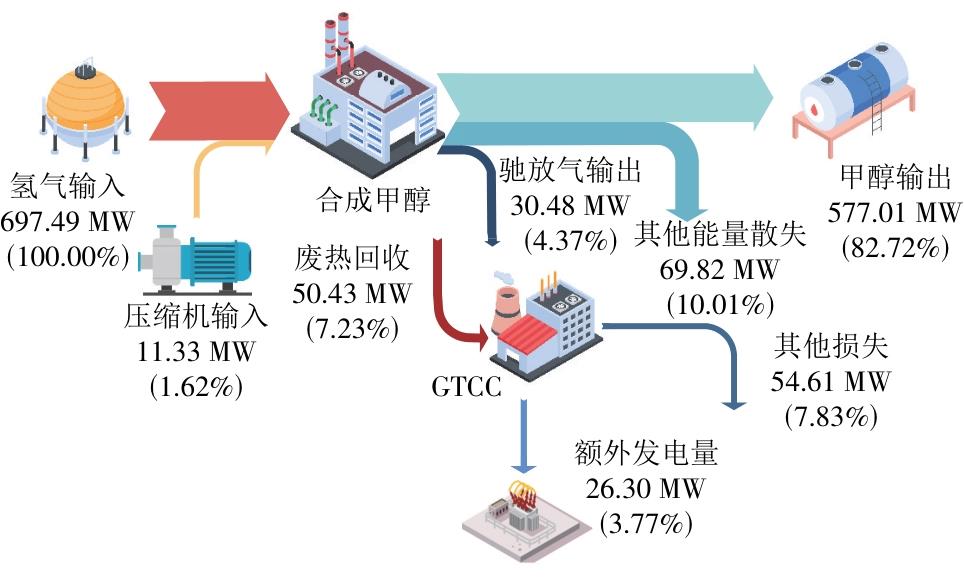
Table 7
Exergy analysis of different systems
| 项目 | 甲醇合成系统 | 甲醇合成集成GTCC优化系统 | 变化量 |
|---|---|---|---|
| 氢气输入㶲/MW | 669.59 | 669.59 | 0 |
| 电能输入㶲/MW | 11.33 | 12.84 | 1.51 |
| 小计/MW | 680.92 | 682.43 | 1.51 |
| 甲醇输出㶲/MW | 594.32 | 594.32 | 0 |
| GTCC发电功率增量/MW | 0 | 26.30 | 26.30 |
| 小计/MW | 594.32 | 620.61 | 26.30 |
| 驰放气㶲损/MW | 29.82 | 0 | -29.82 |
| 甲醇合成器㶲损/MW | 39.72 | 39.72 | 0 |
| 压缩机㶲损/MW | 2.38 | 2.47 | 0.09 |
| 精馏塔㶲损/MW | 9.37 | 9.37 | 0 |
| 换热器㶲损/MW | 15.28 | 6.45 | -8.83 |
| GTCC㶲损/MW | 0 | 40.95 | 40.95 |
| 废热㶲损/MW | 22.17 | 14.03 | -8.14 |
| 小计/MW | 161.81 | 158.72 | -6.87 |
| 㶲效率/% | 87.28 | 90.94 | 3.66 |
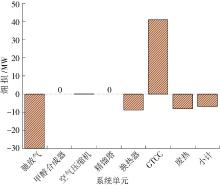
Fig.5
Exergy destruction changes of the main components
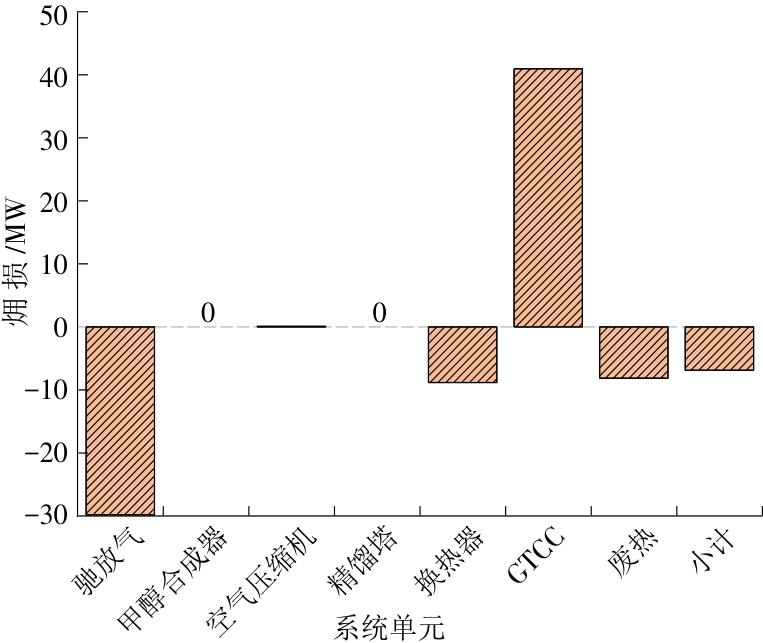
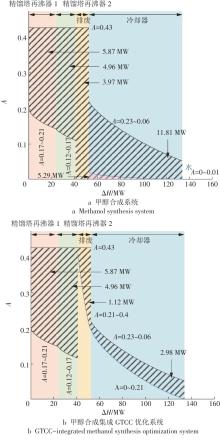
Fig.6
EUD analysis
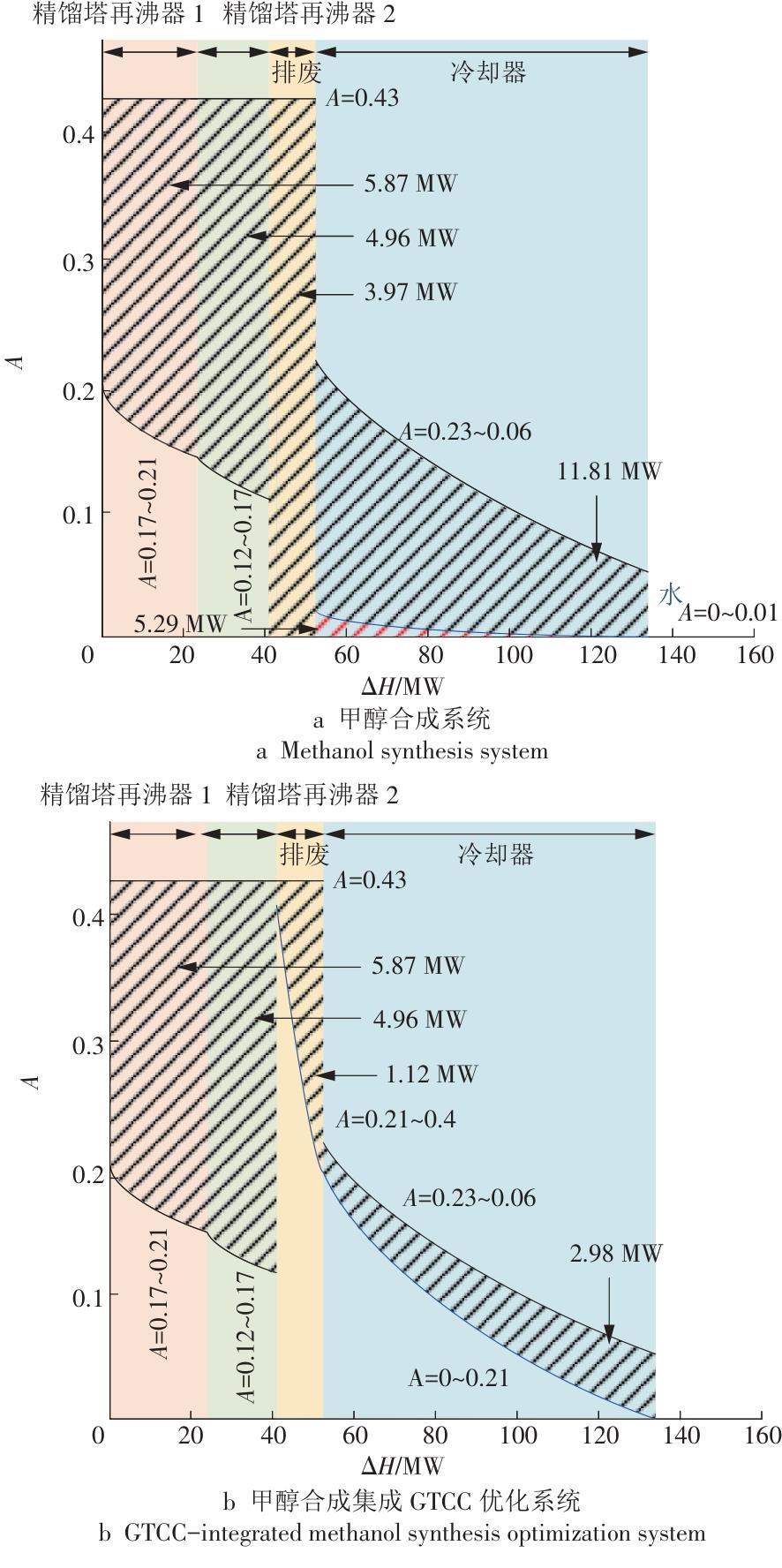
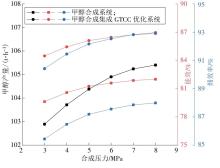
Fig.7
Effect of the synthesis pressure
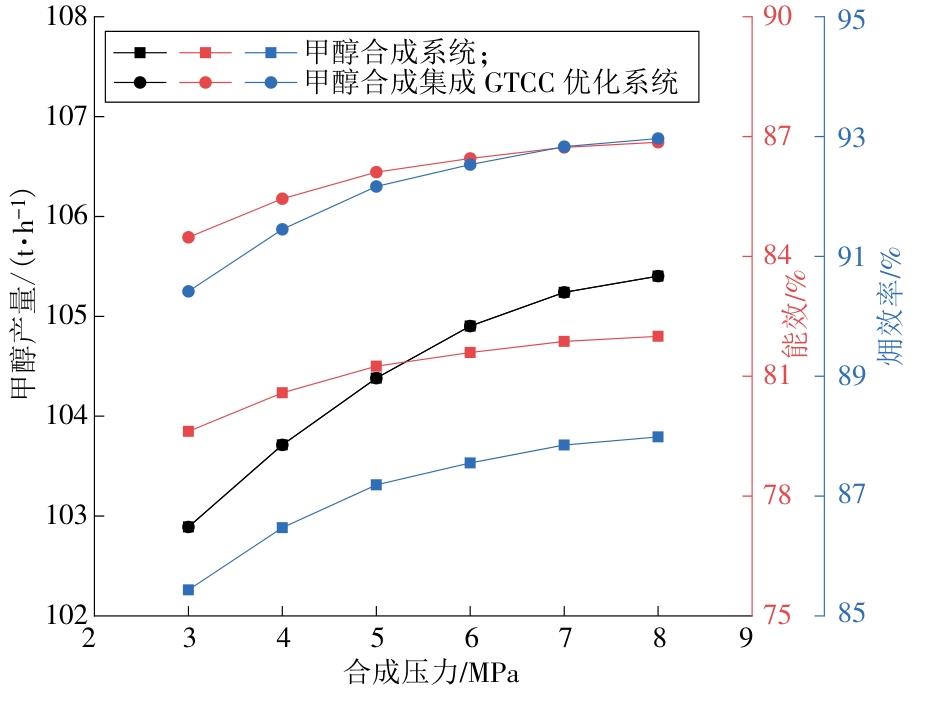
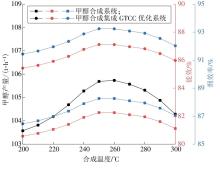
Fig.8
Effect of the synthesis temperature
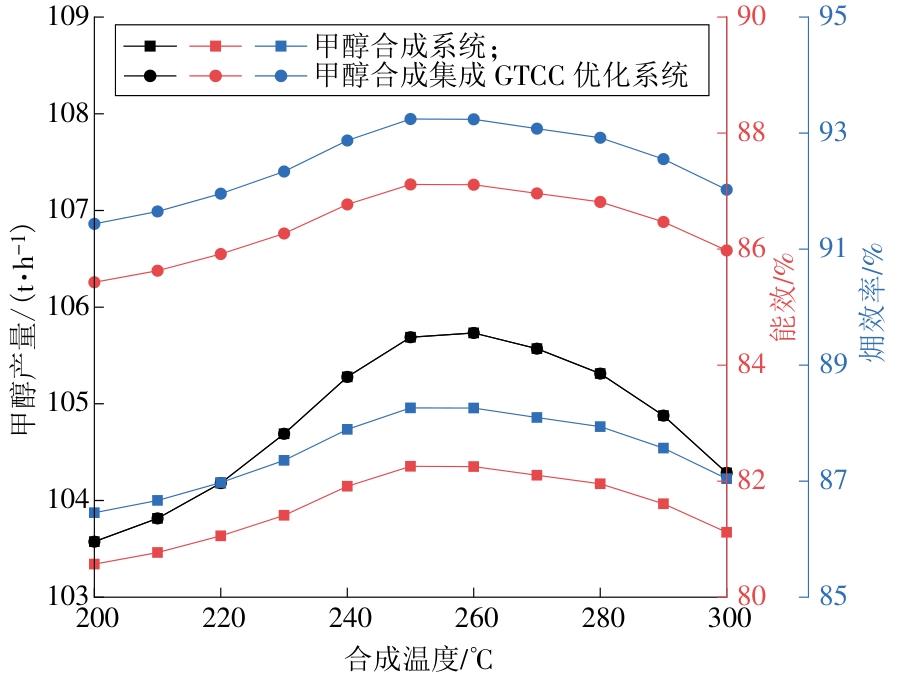
Fig.9
Effect of the split ratio
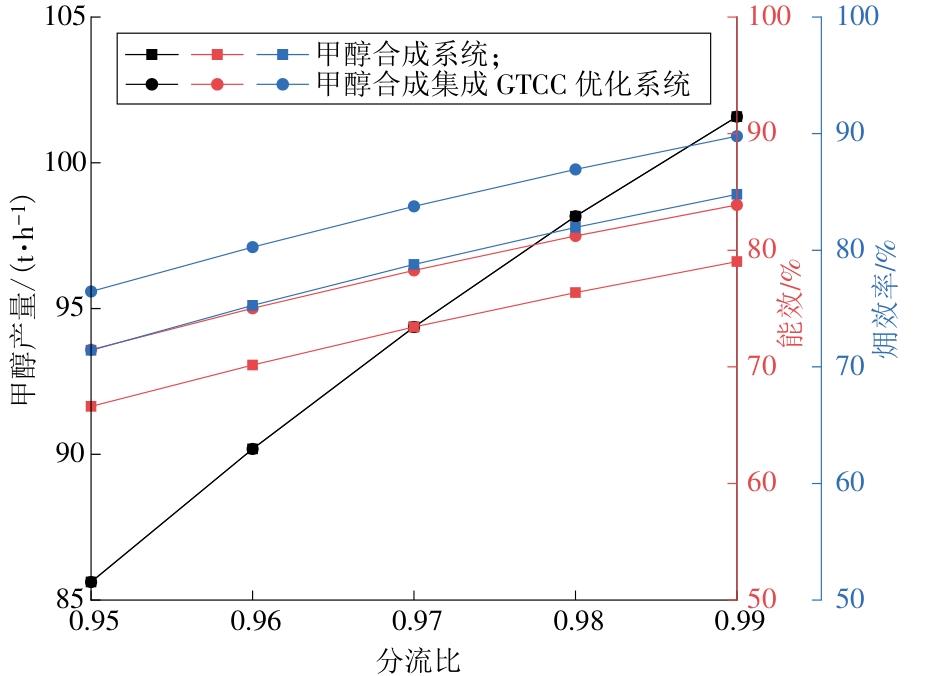
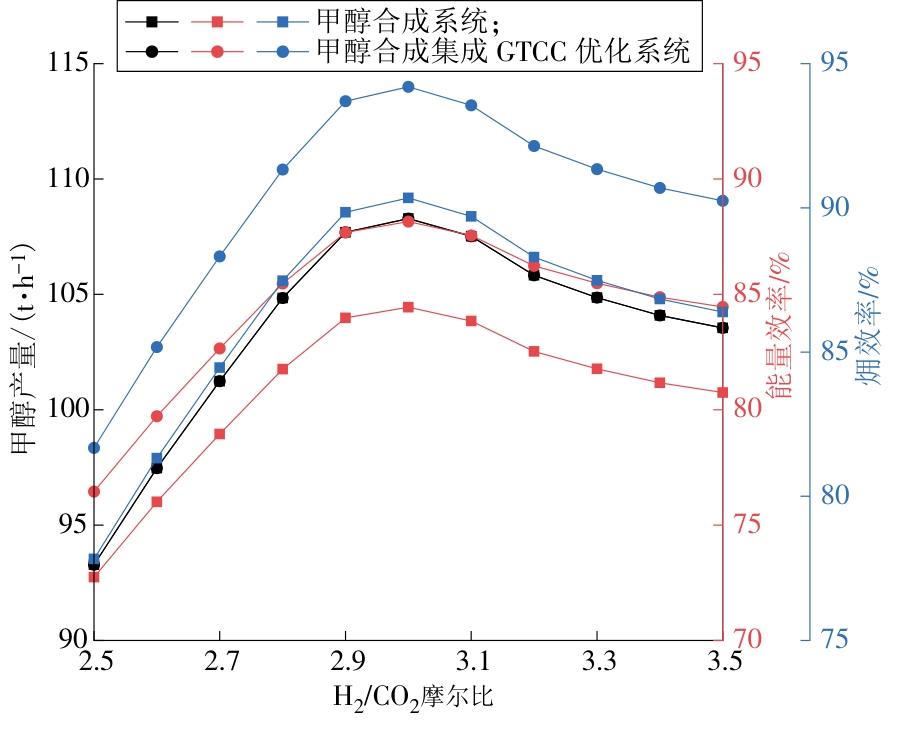
Fig.10
Effect of the H2/CO2 molar ratio
| [1] | 肖先勇, 郑子萱. “双碳” 目标下新能源为主体的新型电力系统: 贡献、关键技术与挑战[J]. 工程科学与技术, 2022, 54(1): 47-59. |
| XIAO Xianyong, ZHENG Zixuan. New power systems dominated by renewable energy towards the goal of emission peak and carbon neutrality: Contribution, key techniques, and challenges[J]. Advanced Engineering Sciences, 2022, 54(1): 47-59. | |
| [2] |
赵国涛, 钱国明, 孙艳兵, 等. 碳逸会计在综合能源系统低碳性评价中的应用[J]. 综合智慧能源, 2023, 45(6): 73-80.
doi: 10.3969/j.issn.2097-0706.2023.06.010 |
|
ZHAO Guotao, QIAN Guoming, SUN Yanbing, et al. Application of carbon-escape accounting system in integrated energy systems' low-carbon evaluation[J]. Integrated Intelligent Energy, 2023, 45(6): 73-80.
doi: 10.3969/j.issn.2097-0706.2023.06.010 |
|
| [3] | 王玉亭, 张钟, 张淇钧, 等. 基于电解水制氢和生物质电厂的电与甲醇联产系统[J]. 科技和产业, 2022, 22(5): 288-294. |
| WANG Yuting, ZHANG Zhong, ZHANG Qijun, et al. Electricity and methanol co-production system based on hydrogen production by electrolysis of water and biomass power plants[J]. Science Technology and Industry, 2022, 22(5): 288-294. | |
| [4] |
江婷, 赵雅姣. 基于燃气分布式的综合能源系统碳减排分析[J]. 综合智慧能源, 2022, 44(9): 27-32.
doi: 10.3969/j.issn.2097-0706.2022.09.004 |
|
JIANG Ting, ZHAO Yajiao. Carbon emission reduction analysis for gas-based distributed integrated energy systems[J]. Integrated Intelligent Energy, 2022, 44(9): 27-32.
doi: 10.3969/j.issn.2097-0706.2022.09.004 |
|
| [5] | HERDEM M S, SINAKI M Y, FARHAD S, et al. An overview of the methanol reforming process: Comparison of fuels, catalysts, reformers, and systems[J]. International Journal of Energy Research, 2019, 43(10): 5076-5105. |
| [6] | ZHAO S, SUN Z Q. Hydrogen generation from methanol reforming for fuel cell applications: A review[J]. Journal of Central South University, 2020, 27(4): 1074-1103. |
| [7] | ABDIN Z, TANG C G, LIU Y, et al. Large-scale stationary hydrogen storage via liquid organic hydrogen carriers[J]. iScience, 2021, 24(9): 102966. |
| [8] | ZHAO Y J, LIU Q, DUAN Y Y, et al. A multi-dimensional feasibility analysis of coal to methanol assisted by green hydrogen from a life cycle viewpoint[J]. Energy Conversion and Management, 2022, 268: 115992. |
| [9] |
李贵贤, 曹阿波, 孟文亮, 等. 耦合固体氧化物电解槽的CO2制甲醇过程设计与评价研究[J]. 化工学报, 2023, 74(7): 2999-3009.
doi: 10.11949/0438-1157.20230519 |
| LI Guixian, CAO Abo, MENG Wenliang, et al. Process design and evaluation of CO2 to methanol coupled with SOEC[J]. CIESC Journal, 2023, 74(7): 2999-3009. | |
| [10] | WANG D L, MENG W L, ZHOU H R, et al. Green hydrogen coupling with CO2 utilization of coal-to-methanol for high methanol productivity and low CO2 emission[J]. Energy, 2021, 231: 120970. |
| [11] | SAFDER U, LOY-BENITEZ J, YOO C K. Techno-economic assessment of a novel integrated multigeneration system to synthesize e-methanol and green hydrogen in a carbon-neutral context[J]. Energy, 2024, 290: 130104. |
| [12] | PARIGI D, GIGLIO E, SOTO A, et al. Power-to-fuels through carbon dioxide re-utilization and high-temperature electrolysis: A technical and economical comparison between synthetic methanol and methane[J]. Journal of Cleaner Production, 2019, 226: 679-691. |
| [13] | WU Z, XU G, ZHANG W T, et al. Thermodynamic and economic analysis of a new methanol steam reforming system integrated with CO2 heat pump and cryogenic separation system[J]. Energy, 2023, 283: 128501. |
| [14] | NAZERIFARD R, KHANI L, MOHAMMADPOURFARD M, et al. Design and thermodynamic analysis of a novel methanol, hydrogen, and power trigeneration system based on renewable energy and flue gas carbon dioxide[J]. Energy Conversion and Management, 2021, 233: 113922. |
| [15] | XIN T T, XU C, LIU Y H, et al. Thermodynamic analysis of a novel zero carbon emission coal-based polygeneration system incorporating methanol synthesis and allam power cycle[J]. Energy Conversion and Management, 2021, 244: 114441. |
| [16] | GE Website. H-class gas turbines[EB/OL]. (2023-08-09)[2024-10-20]. https://www.ge.com/gas-power/products/gas-turbines/h-class-gas-turbines. |
| [17] | WU Z C, XU G, GE S Y, et al. An efficient methanol pre-reforming gas turbine combined cycle with integration of mid-temperature energy upgradation and CO2 recovery: Thermodynamic and economic analysis[J]. Applied Energy, 2024, 358: 122599. |
| [18] | ZARE AAD, YARI M, NAMI H, et al. Low-carbon hydrogen, power and heat production based on steam methane reforming and chemical looping combustion[J]. Energy Conversion and Management, 2023, 279: 116752. |
| [19] | GU Y, WANG D F, CHEN Q Q, et al. Techno-economic analysis of green methanol plant with optimal design of renewable hydrogen production: A case study in China[J]. International Journal of Hydrogen Energy, 2022, 47(8): 5085-5100. |
| [20] | SHEN Z W, QU Q P, CHEN M L, et al. Advancements in methanol distillation system: A comprehensive overview[J]. Chemical Engineering Research and Design, 2023, 199: 130-151. |
| [21] | DALENA F, SENATORE A, MARINO A, et al. Methanol production and applications: An overview[J]. Methanol,2018:3-28. |
| [22] | 赵杨, 沙立成, 雷一鸣, 等. 北京电网燃气-蒸汽联合循环机组调峰运行特性[J]. 华北电力技术, 2015(2): 60-65. |
| ZHAO Yang, SHA Licheng, LEI Yiming, et al. Analysis on peak load regulation characteristics of the gas-steam combined cycle units in Beijing grid[J]. North China Electric Power, 2015(2): 60-65. | |
| [23] | HUANG H, YANG S Y, CUI P Z. Design concept for coal-based polygeneration processes of chemicals and power with the lowest energy consumption for CO2 capture[J]. Energy Conversion and Management, 2018, 157: 186-194. |
| [24] | 张世红, 何林, 孙威. 天然气催化燃烧理论和应用[J]. 化工进展, 2009, 28(S1): 115-117. |
| ZHANG Shihong, HE Lin, SUN Wei. Theory and application of catalytic combustion of natural gas[J]. Chemical Industry and Engineering Progress, 2009, 28(S1): 115-117. | |
| [25] | AGAHZAMIN S, MIRVAKILI A, RAHIMPOUR M R. Investigation and recovery of purge gas streams to enhance synthesis gas production in a mega methanol complex[J]. Journal of CO2 Utilization, 2016, 16: 157-168. |
| [26] | WU Z C, ZHANG Z Y, XU G, et al. Thermodynamic and economic analysis of a new methanol synthesis system coupled with a biomass integrated gasification combined cycle[J]. Energy, 2024, 300: 131647. |
| [27] | HAYDARY J. Chemical process design and simulation: Aspen Plus and Aspen Hysys applications[M]. John Wiley and Sons, 2019. |
| [28] | 王琳琳. 基于Aspen Plus对甲醇合成过程的模拟研究[D]. 呼和浩特: 内蒙古大学, 2017. |
| WANG Linlin. Simulation of methanol synthesis process based on aspen plus[D]. Hohhot: Inner Mongolia University, 2017. | |
| [29] |
徐钢, 张钟, 吴志聪, 等. 基于绿氢和生物质富氧燃烧技术的零碳甲醇合成系统[J]. 动力工程学报, 2022, 42(10): 925-932.
doi: 10.19805/j.cnkij.cspe.2022.10.006 |
|
XU Gang, ZHANG Zhong, WU Zhicong, et al. Zero carbon methanol synthesis system based on green hydrogen and biomass oxygen enriched combustion technology[J]. Journal of Chinese Society of Power Engineering, 2022, 42(10): 925-932.
doi: 10.19805/j.cnkij.cspe.2022.10.006 |
|
| [30] | KOTAS T J. Exergy concepts for thermal plant first of two papers on exergy techniques in thermal plant analysis[J]. International Journal of Heat and Fluid Flow, 1980, 2(3): 105-114. |
| [31] | ISHIDA M, KAWAMURA K. Energy and exergy analysis of a chemical process system with distributed parameters based on the enthalpy-direction factor diagram[J]. Industrial and Engineering Chemistry Process Design and Development, 1982, 21(4): 690-695. |
| [32] | JIN H G, ISHIDA M. A novel gas turbine cycle with hydrogen-fueled chemical-looping combustion[J]. International Journal of Hydrogen Energy, 2000, 25(12): 1209-1215. |
| [1] | NIE Xueying, CHENG Maosong, ZUO Xiandi, DAI Zhimin. Capacity optimization of wind-solar-nuclear-energy storage hybrid system considering wind and solar energy consumption [J]. Integrated Intelligent Energy, 2025, 47(1): 51-61. |
| [2] | YE Fei, ZHONG Xiaojing, GUAN Qianfeng. Research on network attack modeling, evolution and response cost of power cyber physical systems [J]. Integrated Intelligent Energy, 2024, 46(5): 58-64. |
| [3] | LI Yimin, DONG Haiying, DING Kun, WANG Jinyan. Multi-stage optimal allocation of energy storage considering long-term load probability prediction [J]. Integrated Intelligent Energy, 2024, 46(2): 19-27. |
| [4] | HUANG Yinheng, LI Meng, PANG Yi, LIANG Yin, JIN Zengfeng, WANG Jinzhu. Research on optimization method for capacity allocation and scheduling strategy of regional integrated energy systems [J]. Integrated Intelligent Energy, 2023, 45(6): 34-41. |
| Viewed | ||||||
|
Full text |
|
|||||
|
Abstract |
|
|||||