Integrated Intelligent Energy ›› 2026, Vol. 48 ›› Issue (5): 83-94.doi: 10.3969/j.issn.2097-0706.2026.05.009
• Integrated Energy System Analysis and Evaluation • Previous Articles
CUI Yarua,b( ), LU Yuanweia,b,*(), WANG Zixuana,b(), YANG Hana,b(), WU Yutinga,b()
Received:2026-01-09
Revised:2026-02-26
Published:2026-04-14
Contact:
LU Yuanwei
E-mail:cuiyaru@emails.bjut.edu.cn;luyuanwei@bjut.edu.cn;zixuanwang@emails.bjut.edu.cn;yanghan@bjut.edu.cn;wuyuting@bjut.edu.cn
Supported by:CLC Number:
CUI Yaru, LU Yuanwei, WANG Zixuan, YANG Han, WU Yuting. Economic efficiency analysis of operation strategies for the solar-coal peak-shaving system with steam extraction and molten salt thermal energy storage based on wind and solar power integration amount[J]. Integrated Intelligent Energy, 2026, 48(5): 83-94.
Add to citation manager EndNote|Ris|BibTeX
URL: https://www.hdpower.net/EN/10.3969/j.issn.2097-0706.2026.05.009
Table 1
Thermal parameters of a 600 MW unit under typical operating conditions
| 热力指标 | 工况 | ||
|---|---|---|---|
| 100%THA | 75%THA | 50%THA | |
| 额定功率/MW | 600.18 | 450.19 | 300.03 |
| 主蒸汽流量/(t·h-1) | 1 844.00 | 1 369.50 | 894.30 |
| 主蒸汽压力/MPa | 16.67 | 14.40 | 9.77 |
| 主蒸汽温度/℃ | 538.00 | 538.00 | 538.00 |
| 再热蒸汽流量/(t·h-1) | 1 582.81 | 1 203.63 | 804.23 |
| 再热蒸汽压力/MPa | 3.41 | 2.60 | 1.71 |
| 给水温度/℃ | 276.00 | 257.42 | 235.50 |
Table 2
Comparison between design values and simulation values for key parameters of coal-fired units
| 参数 | 100%THA | 75%THA | 50%THA | ||||||
|---|---|---|---|---|---|---|---|---|---|
| 设计值 | 模拟值 | 误差/% | 设计值 | 模拟值 | 误差/% | 设计值 | 模拟值 | 误差/% | |
| 发电功率/MW | 600.18 | 600.33 | 0.02 | 450.21 | 450.73 | 0.12 | 300.03 | 299.74 | 0.10 |
| 主蒸汽流量/(t·h-1) | 1 848.78 | 1 844.00 | 0.26 | 1 350.31 | 1 369.50 | 1.42 | 900.11 | 894.30 | 0.65 |
| 主蒸汽压力/MPa | 16.67 | 16.67 | 0.00 | 14.40 | 14.40 | 0.00 | 9.77 | 9.77 | 0.00 |
| 再热蒸汽流量/(t·h-1) | 1 576.13 | 1 582.81 | 0.42 | 1 173.44 | 1 203.63 | 2.57 | 789.27 | 804.23 | 1.90 |
| 再热蒸汽压力/MPa | 3.41 | 3.41 | 0.00 | 2.56 | 2.60 | 1.39 | 1.75 | 1.71 | 2.10 |
| #1抽汽温度/℃ | 276.07 | 276.09 | 0.01 | 256.26 | 257.42 | 0.45 | 232.84 | 232.84 | 0.00 |
| #2抽汽温度/℃ | 245.44 | 245.44 | 0.00 | 228.95 | 230.02 | 0.47 | 208.45 | 208.44 | 0.00 |
| #3抽汽温度/℃ | 210.91 | 211.96 | 0.49 | 198.2 | 199.15 | 0.48 | 180.76 | 180.75 | 0.01 |
| #4抽汽温度/℃ | 178.34 | 178.33 | 0.01 | 166.68 | 167.47 | 0.47 | 151.9 | 151.88 | 0.01 |
| #5抽汽温度/℃ | 154.99 | 154.97 | 0.01 | 144.56 | 145.27 | 0.49 | 131.28 | 131.25 | 0.02 |
| #6抽汽温度/℃ | 121.66 | 121.62 | 0.03 | 113.05 | 113.65 | 0.53 | 102.07 | 102.00 | 0.07 |
| #7抽汽温度/℃ | 89.52 | 89.42 | 0.11 | 82.42 | 82.91 | 0.60 | 73.47 | 73.30 | 0.23 |
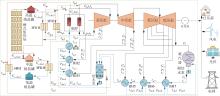
Fig.1
Integrated wind-solar-thermal power supply system
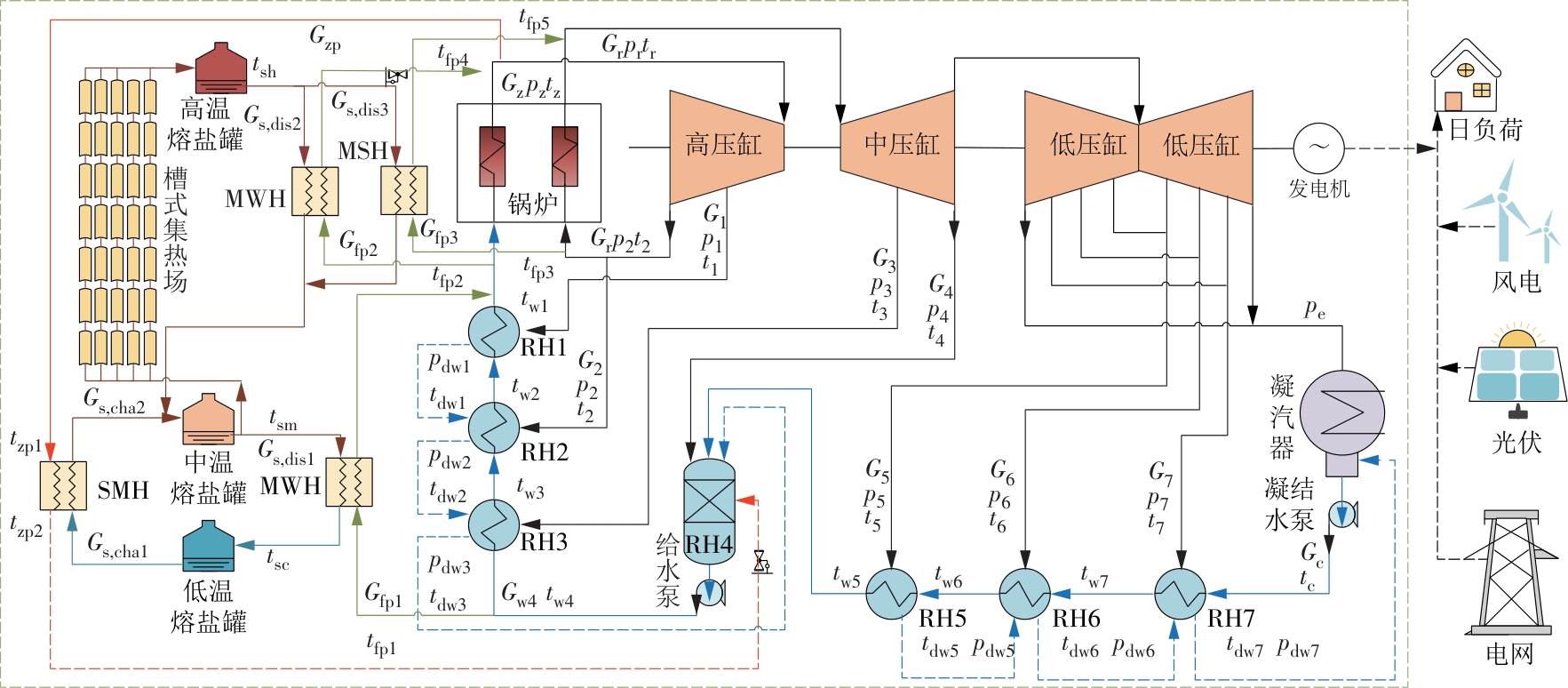
Table 3
Initial design parameters of peak-shaving system
| 参数 | 设定值 | 参数 | 设定值 |
|---|---|---|---|
| 高温熔盐温度/℃ | 560.00 | tzp1/℃ | 538.00 |
| 中温熔盐温度/℃ | 328.00 | tzp2/℃ | 189.00 |
| 低温熔盐温度/℃ | 184.00 | tfp1/℃ | 175.97 |
| 主蒸汽抽汽量/(t·h-1) | 169.02 | tfp2/℃ | 263.76 |
| 光汽储热比 | 3 | tfp3/℃ | 322.50 |
| 储热基准工况 | 50%THA | tfp4/℃ | 538.00 |
| 释热基准工况 | 75%THA | tfp5/℃ | 538.00 |
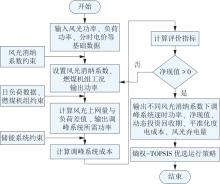
Fig. 2
Flowchart of economic model of operation strategies for peak-shaving system
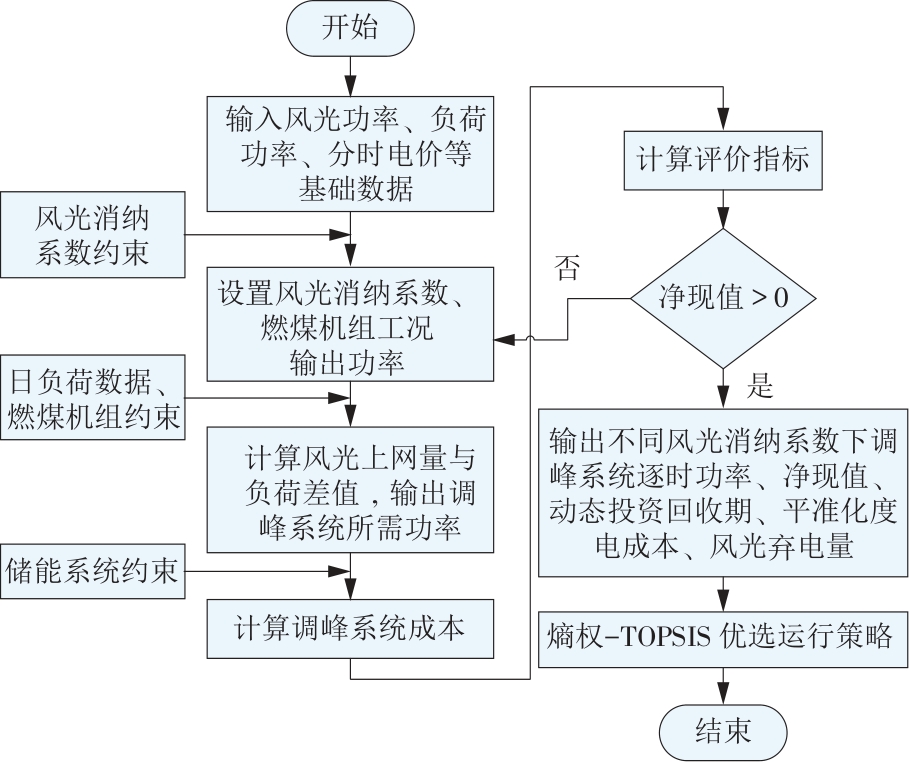
Fig.3
Predicted wind,solar power and daily load power curves
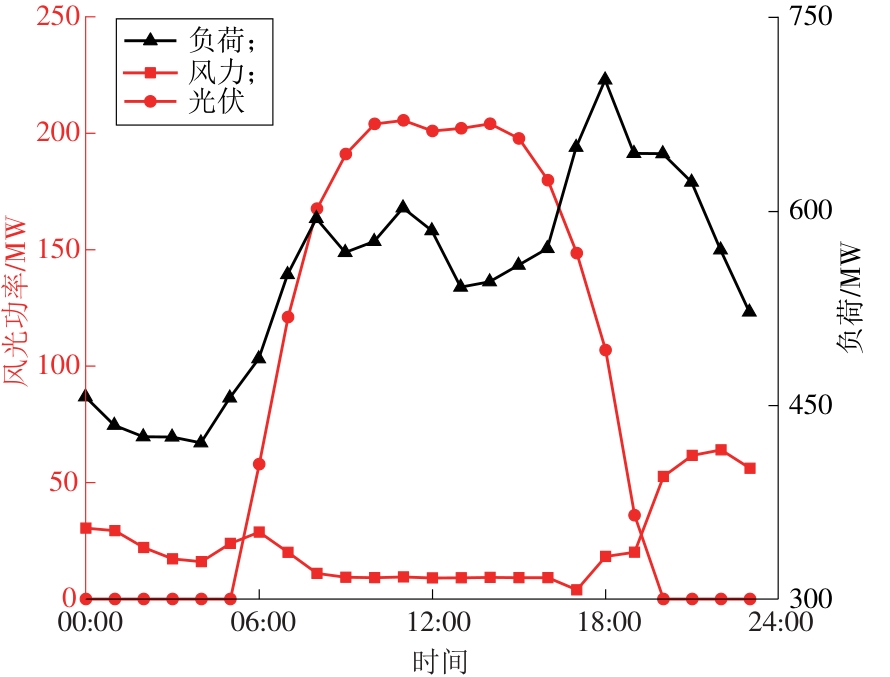
Table 4
Time-of-use electricity prices 元/(kW·h)
| 时间 | 上网电价 |
|---|---|
| 00:00 — 04:00 | 0.205 |
| 04:00 —06:00 | 0.427 |
| 06:00 — 08:00 | 0.717 |
| 08:00 — 11:00 | 0.427 |
| 11:00 — 16:00 | 0.205 |
| 16:00 — 18:00 | 0.427 |
| 18:00 — 22:00 | 0.717 |
| 22:00 — 24:00 | 0.427 |
Table 5
Operation strategies for peak-shaving system
| 运行策略时间 | 策略1 | 策略2 | 策略3 | 策略4 | 策略5 | 策略6 | 策略7 |
|---|---|---|---|---|---|---|---|
| 00:00 | 50%THA | 释热 | 释热 | 释热 | 释热 | 75%THA | 75%THA |
| 01:00 | 50%THA | 释热 | 释热 | 50%THA | 75%THA | 75%THA | 50%THA |
| 02:00 | 50%THA | 释热 | 75%THA | 释热 | 75%THA | 75%THA | 75%THA |
| 03:00 | 75%THA | 75%THA | 75%THA | 释热 | 75%THA | 75%THA | 75%THA |
| 04:00 | 释热 | 释热 | 释热 | 释热 | 释热 | 释热 | 释热 |
| 05:00 | 75%THA | 释热 | 释热 | 释热 | 释热 | 释热 | 释热 |
| 06:00 | 50%THA | 抽汽储热 | 抽汽储热 | 抽汽储热 | 抽汽储热 | 抽汽储热 | 抽汽储热 |
| 07:00 | 释热 | 抽汽储热 | 抽汽储热 | 抽汽储热 | 抽汽储热 | 抽汽储热 | 抽汽储热 |
| 08:00 | 75%THA | 抽汽储热 | 抽汽储热 | 抽汽储热 | 抽汽储热 | 抽汽储热 | 抽汽储热 |
| 09:00 | 75%THA | 抽汽储热+光热 储热 | 抽汽储热 | 抽汽储热 | 抽汽储热 | 释热 | 释热 |
| 10:00 | 75%THA | 抽汽储热+光热 储热 | 释热 | 50%THA+光热储热 | 释热 | 释热 | 释热 |
| 11:00 | 75%THA+光热 储热 | 75%THA+光热 储热 | 释热 | 释热 | 释热 | 75%THA+光热 储热 | 75%THA |
| 12:00 | 75%THA+光热 储热 | 释热 | 75%THA+光热储热 | 释热 | 75%THA+光热储热 | 75%THA+光热 储热 | 50%THA+光热 储热 |
| 13:00 | 50%THA | 释热 | 75%THA+光热储热 | 75%THA+光热 储热 | 75%THA+光热储热 | 50%THA+光热 储热 | 50%THA+光热 储热 |
| 14:00 | 50%THA | 75%THA+光热 储热 | 75%THA+光热储热 | 50%THA+光热 储热 | 75%THA+光热储热 | 50%THA | 50%THA+光热 储热 |
| 15:00 | 75%THA | 75%THA+光热 储热 | 50%THA+光热储热 | 50%THA+光热 储热 | 50%THA+光热储热 | 50%THA | 50%THA |
| 16:00 | 75%THA | 释热 | 50%THA | 50%THA | 50%THA | 50%THA | 50%THA |
| 17:00 | 释热 | 释热 | 释热 | 释热 | 释热 | 释热 | 释热 |
| 18:00 | 释热 | 释热 | 释热 | 释热 | 释热 | 释热 | 释热 |
| 19:00 | 释热 | 释热 | 释热 | 释热 | 释热 | 释热 | 释热 |
| 20:00 | 释热 | 释热 | 释热 | 释热 | 释热 | 释热 | 释热 |
| 21:00 | 50%THA | 释热 | 释热 | 释热 | 释热 | 释热 | 释热 |
| 22:00 | 抽汽储热 | 释热 | 释热 | 50%THA | 释热 | 75%THA | 50%THA |
| 23:00 | 抽汽储热 | 释热 | 50%THA | 50%THA | 释热 | 50%THA | 50%THA |
Table 6
Wind and solar power integration coefficients under different operation strategies
| 项目 | 运行策略 | ||||||
|---|---|---|---|---|---|---|---|
| 1 | 2 | 3 | 4 | 5 | 6 | 7 | |
| 风电消纳系数k1 | 6 | 3 | 4 | 5 | 3 | 4 | 5 |
| 光伏发电消纳系数k2 | 1 | 3 | 3 | 3 | 4 | 4 | 4 |
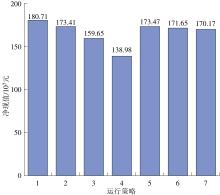
Fig.4
Changes in net present values under different operation strategies
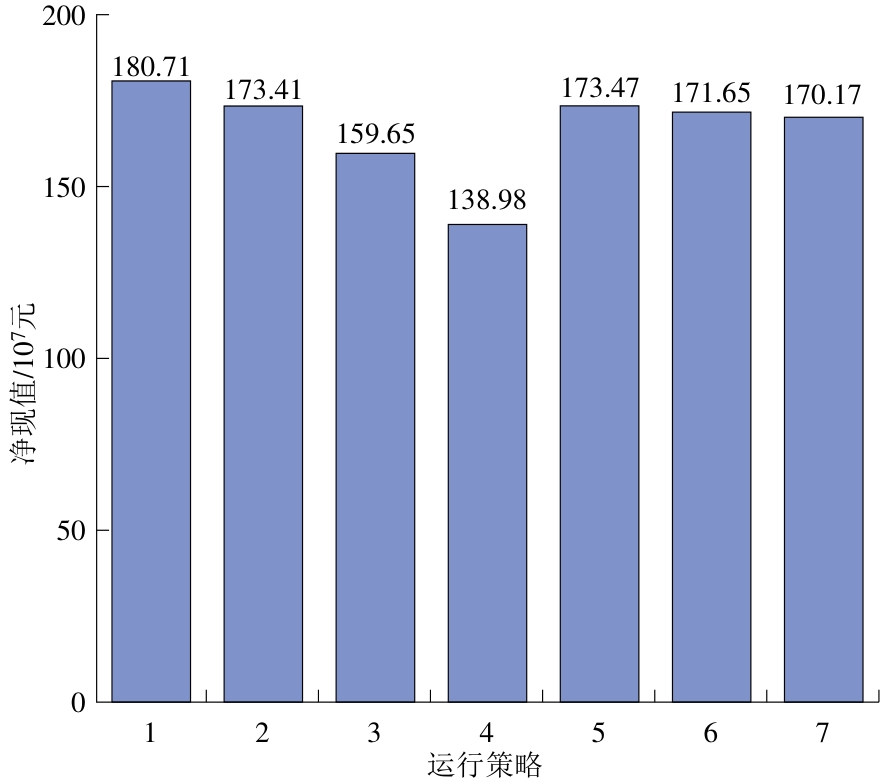
Fig.5
Changes in cash flow and investment costs under different operation strategies
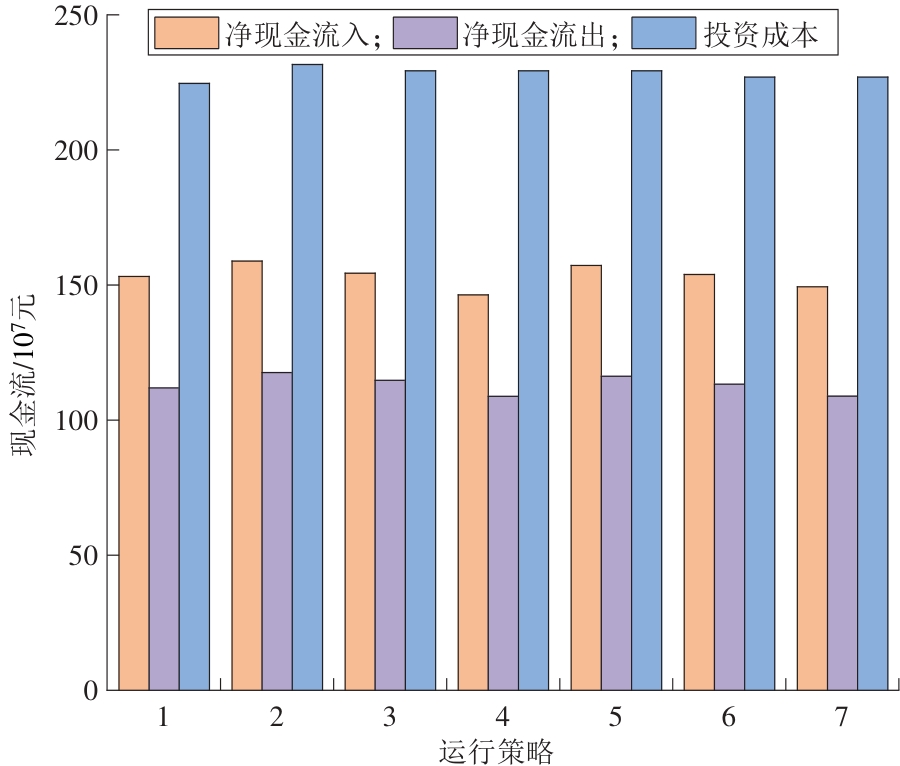
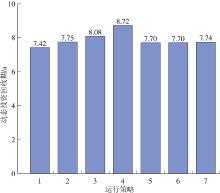
Fig.6
Changes in dynamic payback period under different operation strategies
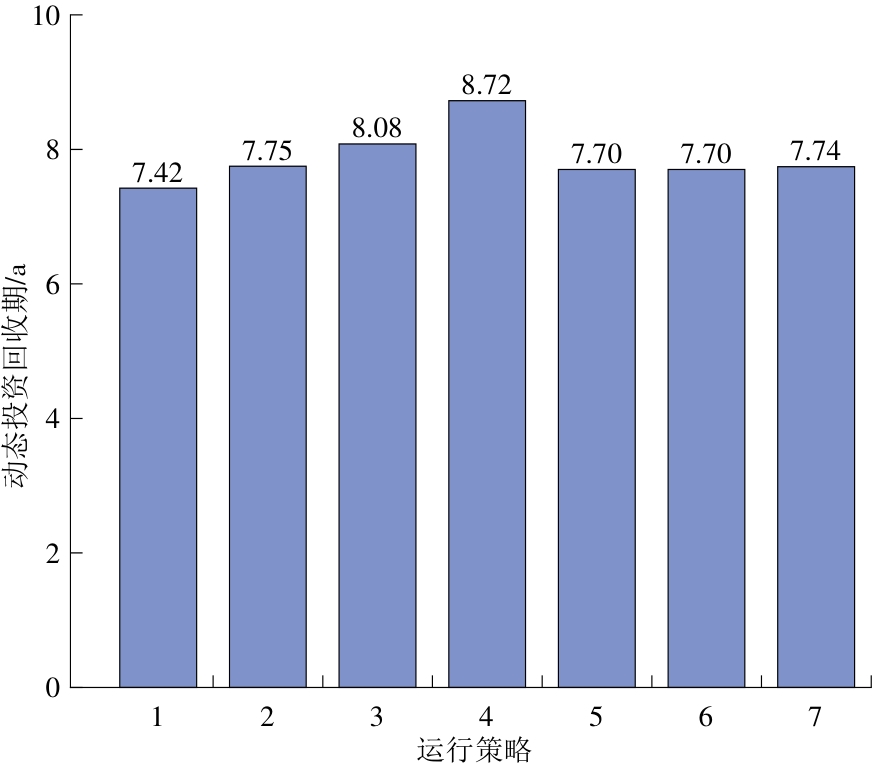
Fig.7
Changes in levelized cost of electricity under different operation strategies
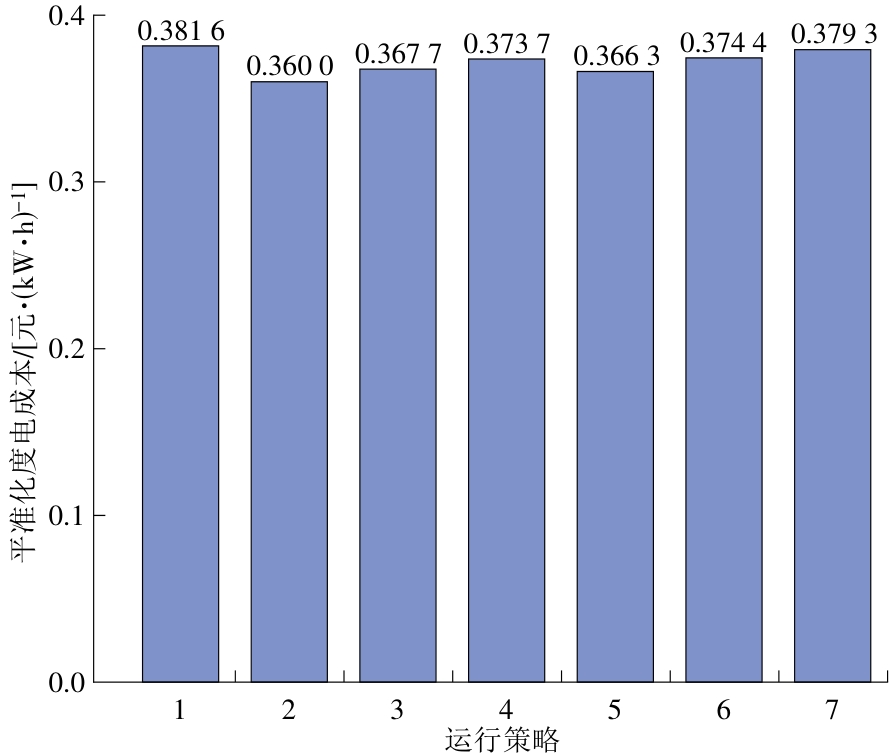
Fig.8
Changes in peak-shaving system power generation under different operation strategies
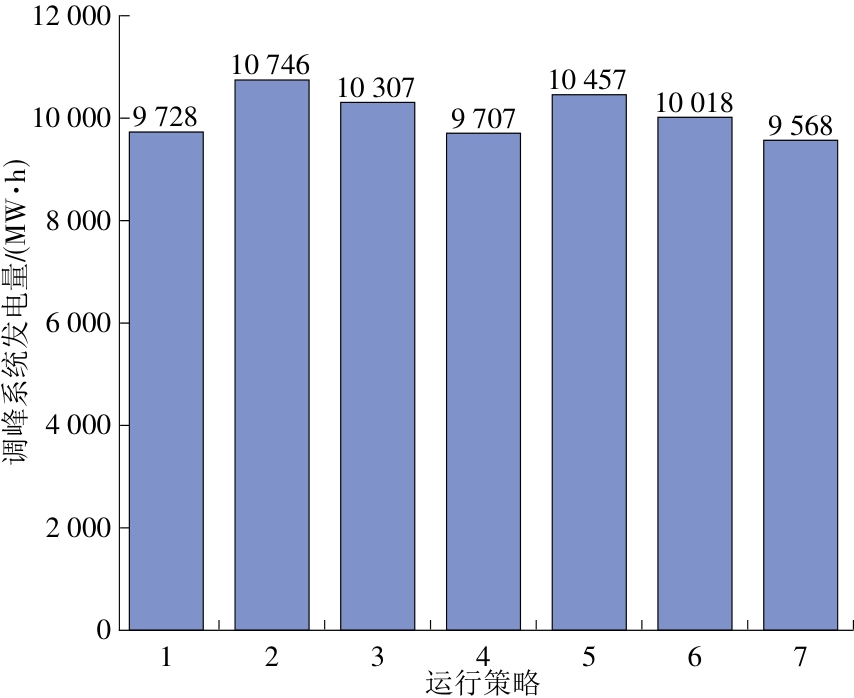
Fig.9
Changes in wind and solar power curtailment under different operation strategies
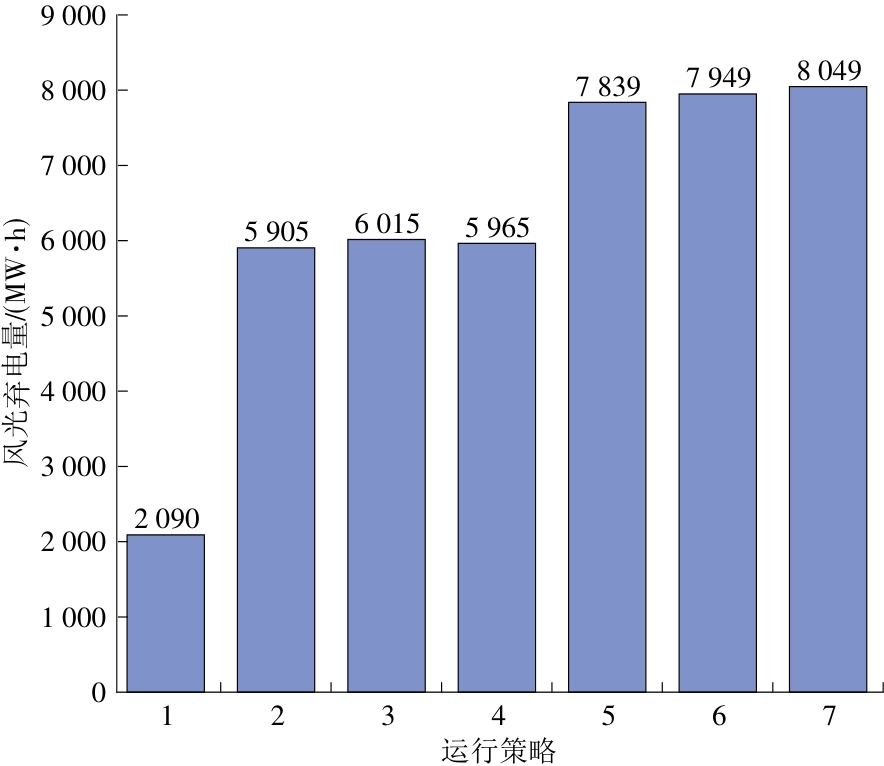
Table 7
Selection of optimal operation strategy
| 运行策略 | 净现值/107元 | 动态投资回收期/a | 平准化度电成本/[元·(kW·h)-1] | 风光弃电量/(MW·h) | 得分 |
|---|---|---|---|---|---|
| 1 | 180.71 | 7.424 | 0.382 | 2 090 | 0.28 |
| 2 | 173.41 | 7.749 | 0.360 | 5 905 | 0.19 |
| 3 | 159.65 | 8.080 | 0.368 | 6 015 | 0.16 |
| 4 | 138.98 | 8.725 | 0.374 | 5 965 | 0.14 |
| 5 | 173.47 | 7.701 | 0.366 | 7 839 | 0.11 |
| 6 | 171.65 | 7.702 | 0.374 | 7 949 | 0.07 |
| 7 | 170.17 | 7.741 | 0.379 | 8 049 | 0.05 |
| 权重 | 0.138 | 0.138 | 0.257 | 0.468 |
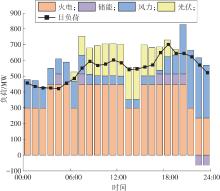
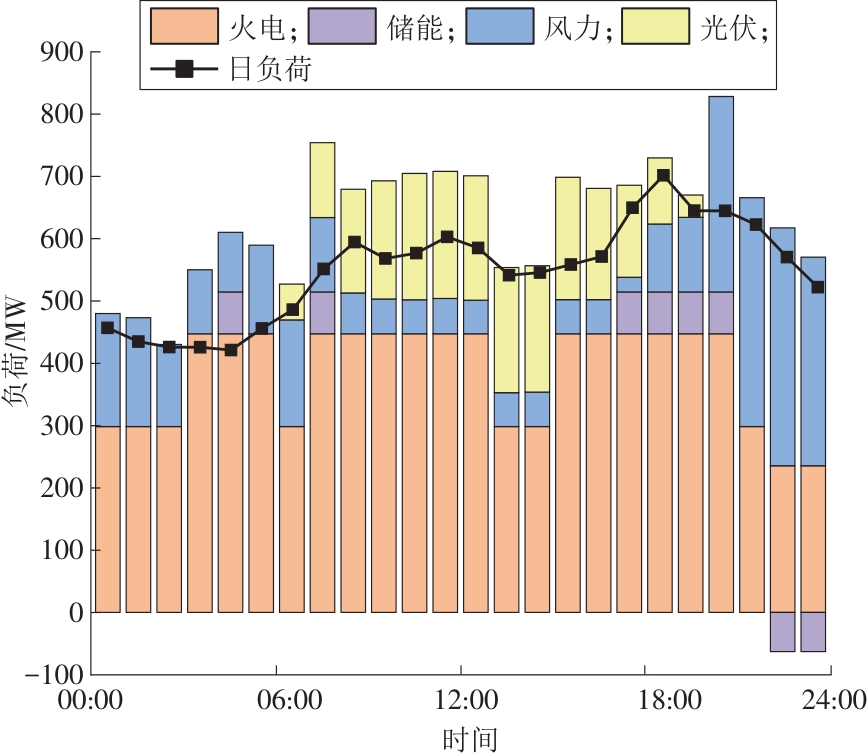
Fig.10
Matching diagram of total output power and daily load
| [1] | 刘明旭, 牟辰泽, 郭明, 等. 考虑含熔盐火储联合机组的虚拟电厂优化调度[J]. 中外能源, 2025, 30(10): 22-32. |
| LIU Mingxu, MOU Chenze, GUO Ming, et al. Optimal dispatching of virtual power plants with molten salt energy storage-CHP units[J]. Sino-Global Energy, 2025, 30(10): 22-32. | |
| [2] | 孙珂. 清洁能源消纳利用情况良好可再生能源电量占特高压直流输送电量的52.5%[N]. 国家电网报, 2024-11-12: (5). |
| [3] |
谭甲群, 吕如轩, 鞠洪晋, 等. 基于改进秃鹰搜索算法的风光火储综合能源系统优化调度策略研究[J]. 综合智慧能源, 2025, 47(8): 68-76.
doi: 10.3969/j.issn.2097-0706.2025.08.008 |
|
TAN Jiaqun, LYU Ruxuan, JU Hongjin, et al. Research on optimal scheduling strategy of wind-photovoltaic-thermal-storage integrated energy system based on IBES[J]. Integrated Intelligent Energy, 2025, 47(8): 68-76.
doi: 10.3969/j.issn.2097-0706.2025.08.008 |
|
| [4] | 卢勇振. 新形势下煤电机组灵活性改造技术研究[J]. 锅炉技术, 2022, 53(6): 72-76, 80. |
| LU Yongzhen. Research on the flexibility modification technology of coal power units under the new situation[J]. Boiler Technology, 2022, 53(6): 72-76, 80. | |
| [5] | 杨灿, 胡丽娜, 魏俊, 等. 燃煤机组耦合熔盐储热系统的性能分析及经济性评价[J]. 储能科学与技术, 2025, 14(12): 4795-4809. |
| YANG Can, HU Lina, WEI Jun, et al. Performance comparison and economic evaluation of coal-fired units coupled with molten salt thermal energy storage systems[J]. Energy Storage Science and Technology, 2025, 14(12): 4795-4809. | |
| [6] | 吕翀, 王斌, 蒋国安, 等. 燃煤电厂耦合熔盐与固体颗粒储热系统热力性能与经济性对比研究[J]. 锅炉技术, 2025, 56(6): 50-59. |
| LYU Chong, WANG Bin, JIANG Guoan, et al. Comparative study of thermal performance and economy of coupled molten salt and solid particle heat storage systems for coal-fired power plants[J]. Boiler Technology, 2025, 56(6): 50-59. | |
| [7] |
王斌, 刘金恺, 姜晓霞, 等. 基于经济性分析的熔盐储热辅助燃煤机组灵活调峰系统优化[J]. 储能科学与技术, 2025, 14(7): 2729-2737.
doi: 10.19799/j.cnki.2095-4239.2025.0304 |
|
WANG Bin, LIU Jinkai, JIANG Xiaoxia, et al. Optimization of flexibile peak shaving system of coal-fired unit aided by molten salt heat storage based on economic analysis[J]. Energy Storage Science and Technology, 2025, 14(7): 2729-2737.
doi: 10.19799/j.cnki.2095-4239.2025.0304 |
|
| [8] |
HAN X, SUN C Q, HE P L, et al. Investigation into the thermodynamic properties of three coupling schemes involving CAES, MSHS, and CFPP systems[J]. Journal of Energy Storage, 2024, 97: 112771.
doi: 10.1016/j.est.2024.112771 |
| [9] |
LIU M, MIAO L, WANG Z, et al. Design and thermo-economic analysis on molten salt thermal energy storage system integrated within coal-fired power plant: Co-storing energy from live and reheat steam[J]. Journal of Energy Storage, 2025, 131: 117637.
doi: 10.1016/j.est.2025.117637 |
| [10] |
ZHANG Q J, DONG J N, CHEN H, et al. Dynamic characteristics and economic analysis of a coal-fired power plant integrated with molten salt thermal energy storage for improving peaking capacity[J]. Energy, 2024, 290: 130132.
doi: 10.1016/j.energy.2023.130132 |
| [11] |
赵大周, 谢玉荣, 张钟平, 等. 300 MW燃煤供热机组熔盐储热系统设计及经济性分析[J]. 综合智慧能源, 2024, 46(9): 45-52.
doi: 10.3969/j.issn.2097-0706.2024.09.006 |
|
ZHAO Dazhou, XIE Yurong, ZHANG Zhongping, et al. Design and economic analysis of the molten salt heat storage system for a 300 MW coal-fired heating unit[J]. Integrated Intelligent Energy, 2024, 46(9): 45-52.
doi: 10.3969/j.issn.2097-0706.2024.09.006 |
|
| [12] |
洪春雪, 肖海平, 谭甲群, 等. 考虑容量电价的风光火储能源基地多目标优化调度[J]. 综合智慧能源, 2025, 47(7): 1-11.
doi: 10.3969/j.issn.2097-0706.2025.07.001 |
|
HONG Chunxue, XIAO Haiping, TAN Jiaqun, et al. Multi-objective optimal schedule of a wind-photovoltaic-thermal-storage energy base considering capacity tariffs[J]. Integrated Intelligent Energy, 2025, 47(7): 1-11.
doi: 10.3969/j.issn.2097-0706.2025.07.001 |
|
| [13] | 杨腾飞, 侯宏娟, 刘鹏, 等. 集成熔融盐储热的光煤互补发电系统变负荷灵活性研究[J]. 太阳能学报, 2025, 46(10): 351-359. |
| YANG Tengfei, HOU Hongjuan, LIU Peng, et al. Research on flexibility in load variations of solar hybrid coal power generation system with molten salt thermal storage[J]. Acta Energiae Solaris Sinica, 2025, 46(10): 351-359. | |
| [14] | 严卉, 刘明, 种道彤, 等. 光煤互补发电系统变工况能势匹配分析[J]. 工程热物理学报, 2023, 44(11): 2981-2990. |
| YAN Hui, LIU Ming, CHONG Daotong, et al. Energy potential matching analysis of solar-aided coal-fired power plant under off-design conditions[J]. Journal of Engineering Thermophysics, 2023, 44(11): 2981-2990. | |
| [15] | 崔庆伟, 付文锋. 光煤互补电站热力系统集成方案㶲分析[J]. 能源工程, 2025, 45(5): 66-71. |
| CUI Qingwei, FU Wenfeng. Exergetic analysis of thermodynamic system integration for solar-coal-fired power plants[J]. Energy Engineering, 2025, 45(5): 66-71. | |
| [16] |
肖艳红, 郭田, 余廷芳. 两种运行模式下光煤互补发电系统热性能对比分析两种运行模式下光煤互补发电系统热性能对比分析[J]. 太阳能学报, 2023, 44(5): 121-127.
doi: 10.19912/j.0254-0096.tynxb.2022-0031 |
|
XIAO Yanhong, GUO Tian, YU Tingfang. Thermal performance analysis of solar-aided coa-fired power generation system under two typical operation modes[J]. Acta Energiae Solaris Sinica, 2023, 44(5): 121-127.
doi: 10.19912/j.0254-0096.tynxb.2022-0031 |
|
| [17] | 魏海姣. 基于储热的燃煤机组深度调峰系统构建及其规模化消纳风力发电模式研究[D]. 北京: 北京工业大学, 2022. |
| WEI Haijiao. Research on deep peak shaving system establishment of coal-fired power unit integrated with thermal energy storage and its application mode for large-scale wind power consumption[D]. Beijing: Beijing University of Technology, 2022. | |
| [18] |
LIU Q, SHANG L L, DUAN Y Y. Performance analyses of a hybrid geothermal-fossil power generation system using low-enthalpy geothermal resources[J]. Applied Energy, 2016, 162: 149-162.
doi: 10.1016/j.apenergy.2015.10.078 |
| [19] |
MIAO L, LIU M, ZHANG K Z, et al. Energy, exergy, and economic analyses on coal-fired power plants integrated with the power-to-heat thermal energy storage system[J]. Energy, 2023, 284: 129236.
doi: 10.1016/j.energy.2023.129236 |
| [20] |
ZHANG K Z, LIU M, ZHAO Y L, et al. Thermo-economic optimization of the thermal energy storage system extracting heat from the reheat steam for coal-fired power plants[J]. Applied Thermal Engineering, 2022, 215: 119008.
doi: 10.1016/j.applthermaleng.2022.119008 |
| [21] | 陈建生. 太阳能-sCO2循环发电系统集成及热-经济-环境分析与优化[D]. 广州: 广东工业大学, 2021. |
| CHEN Jiansheng. SPT-sCO2 cycle power generation system thermal-economy-environment analysis and optimization[D]. Guangzhou: Guangdong University of Technology, 2021. | |
| [22] |
AKBARI A D, MAHMOUDI S M S. Thermoeconomic analysis & optimization of the combined supercritical CO2 (carbon dioxide) recompression Brayton/organic Rankine cycle[J]. Energy, 2014, 78: 501-512.
doi: 10.1016/j.energy.2014.10.037 |
| [23] |
LI R, GUO S, YANG Y, et al. Optimal sizing of wind/concentrated solar plant/electric heater hybrid renewable energy system based on two-stage stochastic programming[J]. Energy, 2020, 209: 118472.
doi: 10.1016/j.energy.2020.118472 |
| [24] | 张萍香. 企业项目投资决策净现值法研究[J]. 重庆理工大学学报(自然科学), 2020, 34(2): 252-258. |
| ZHANG Pingxiang. Research on the net present value method of enterprise project investment decision[J]. Journal of Chongqing University of Technology(Natural Science), 2020, 34(2): 252-258. | |
| [25] |
LIU M, ZHANG X W, MA Y G, et al. Thermo-economic analyses on a new conceptual system of waste heat recovery integrated with an S-CO2 cycle for coal-fired power plants[J]. Energy Conversion and Management, 2018, 161: 243-253.
doi: 10.1016/j.enconman.2018.01.049 |
| [26] | 彭家辉, 倪永中, 王元良, 等. 基于熔盐储热的燃煤机组调峰可行性分析[J]. 热力发电, 2024, 53(1): 99-106. |
| PENG Jiahui, NI Yongzhong, WANG Yuanliang, et al. Feasibility analysis of peak shaving for coal-fired units based on molten salt heat storage[J]. Thermal Power Generation, 2024, 53(1): 99-106. | |
| [27] | 郝小霞. 基于AHP+熵权法的隧道围岩稳定性评价及支护方案优化[J]. 铁道建筑技术, 2025(12):164-167,173. |
| HAO Xiaoxia. Evaluation and supporting scheme optimization of tunnel surrounding rock stability based on AHP+entropy weight method[J]. Railway Construction Technology, 2025(12): 164-167, 173. | |
| [28] | 罗先伟, 赵元元, 刘彦花, 等. 基于熵权-TOPSIS的硫化矿石自燃倾向性评价研究[J]. 有色金属(矿山部分), 2026, 78(1): 85-91. |
| LUO Xianwei, ZHAO Yuanyuan, LIU Yanhua, et al. Evaluation on spontaneous combustion tendency of sulfide ores based on entropy weight-TOPSIS method[J]. Nonferrous Metals (Mining Section), 2026, 78(1): 85-91. |
| Viewed | ||||||
|
Full text |
|
|||||
|
Abstract |
|
|||||