Integrated Intelligent Energy ›› 2026, Vol. 48 ›› Issue (5): 74-82.doi: 10.3969/j.issn.2097-0706.2026.05.008
• Integrated Energy System Analysis and Evaluation • Previous Articles Next Articles
ZHANG Yongjian1( ), LI Bin2(), XING Geyu2(), SUN Junpeng3(), XU Gang3,*(), XUE Xiaojun4()
Received:2025-12-04
Revised:2025-12-12
Published:2026-05-13
Contact:
XU Gang
E-mail:zhangyongj@ncpe.com.cn;16115533@ceic.com;15333178890@126.com;sunjunpengncepu@163.com;xgncepu@163.com;xxj377547176@163.com
Supported by:CLC Number:
ZHANG Yongjian, LI Bin, XING Geyu, SUN Junpeng, XU Gang, XUE Xiaojun. Feasibility study on steam supply expansion of combined heat and power based on molten salt energy storage[J]. Integrated Intelligent Energy, 2026, 48(5): 74-82.
Add to citation manager EndNote|Ris|BibTeX
URL: https://www.hdpower.net/EN/10.3969/j.issn.2097-0706.2026.05.008
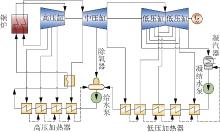
Fig.1
Schematic diagram of case units
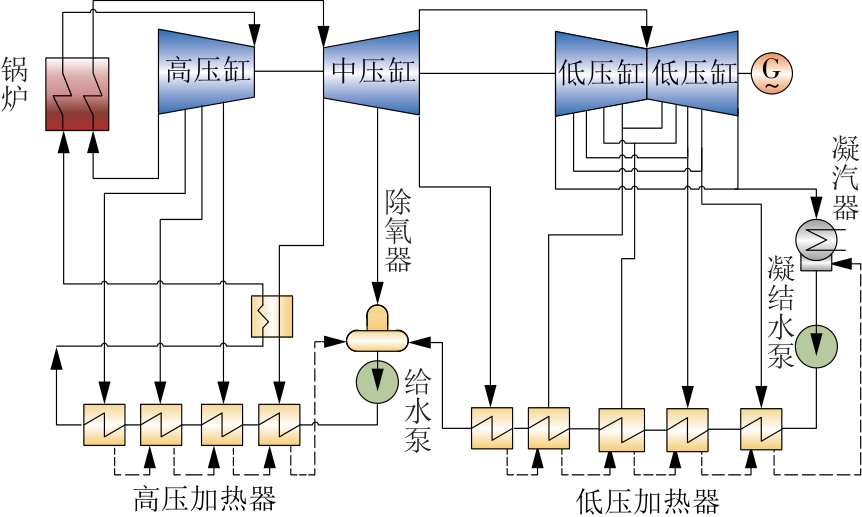
Table 1
Basic parameters of case units
| 参数 | 数值 |
|---|---|
| 主蒸汽流量/(t·h-1) | 1 796.4 |
| 主蒸汽压力/MPa | 30.00 |
| 主蒸汽温度/℃ | 605 |
| 冷段再热蒸汽压力/MPa | 5.37 |
| 冷段再热蒸汽温度/℃ | 333.7 |
| 热段再热蒸汽压力/MPa | 4.99 |
| 热段再热蒸汽温度/℃ | 622 |
| 热段再热蒸汽流量/(t·h-1) | 1 408.7 |
| 额定背压/kPa | 4.5 |
| 发电机额定功率/MW | 660 |
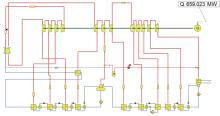
Fig.2
Simulation model of thermal system(screenshot)
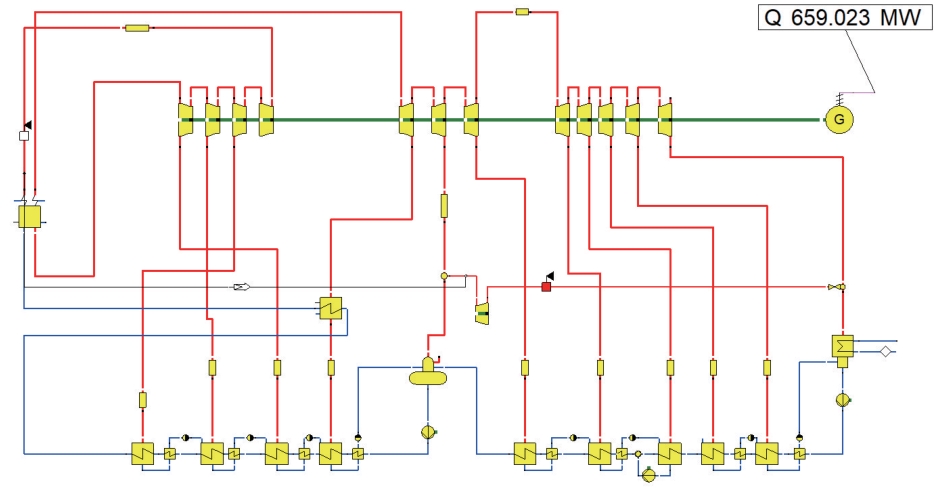
Table 2
Accuracy verification of the model under different operating conditions
| 工况 | 模拟值/MW | 设计值/MW | 误差/% |
|---|---|---|---|
| 100%THA | 659.02 | 660.00 | -0.15 |
| 75%THA | 495.67 | 495.00 | 0.14 |
| 50%THA | 330.54 | 330.00 | 0.16 |
| 30%THA | 198.96 | 198.00 | 0.48 |
Fig.3
Schematic diagram of industrial steam supply system for desuperheating and depressurizing hot reheat steam
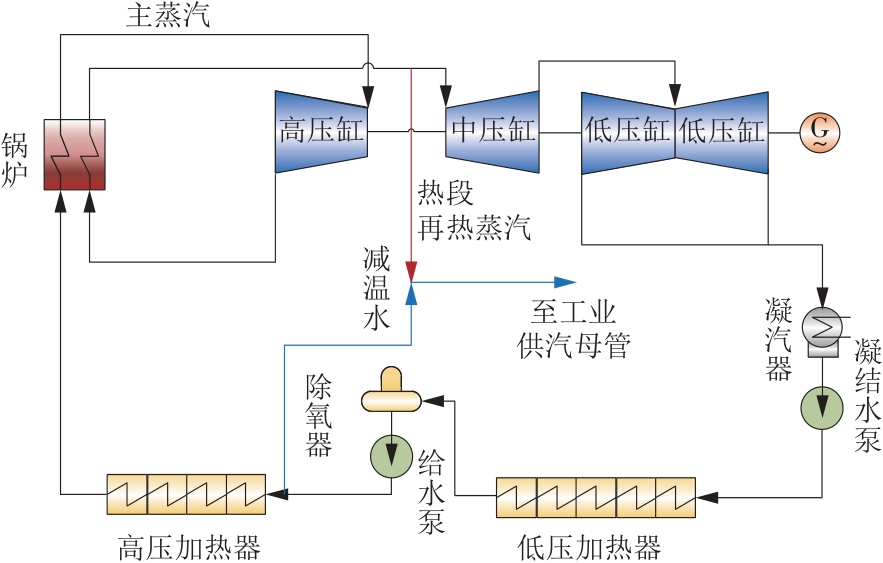
Table 3
Properties of molten salt[15]
| 参数 | 数值 |
|---|---|
| 组分 | 60%NaNO3, 40%KNO3 |
| 比热容/[kJ·(kg·K)-1] | 1.52 |
| 密度/(Kg·m-3) | 1 860 |
| 熔点/℃ | 240 |
| 最高工作温度/℃ | 575 |
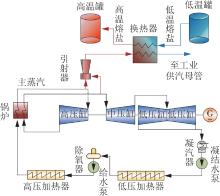
Fig.4
Schematic diagram of molten salt heat storage process with main steam extraction-induced hot reheat steam
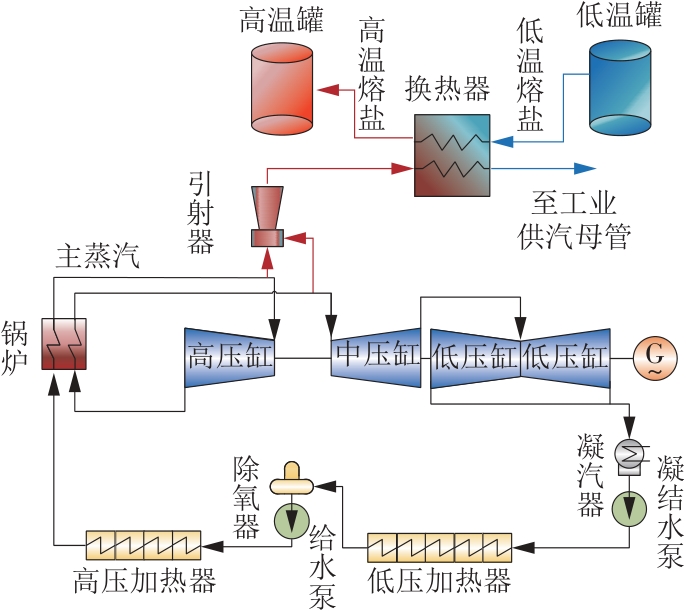
Fig.5
Schematic diagram of molten salt heat release process
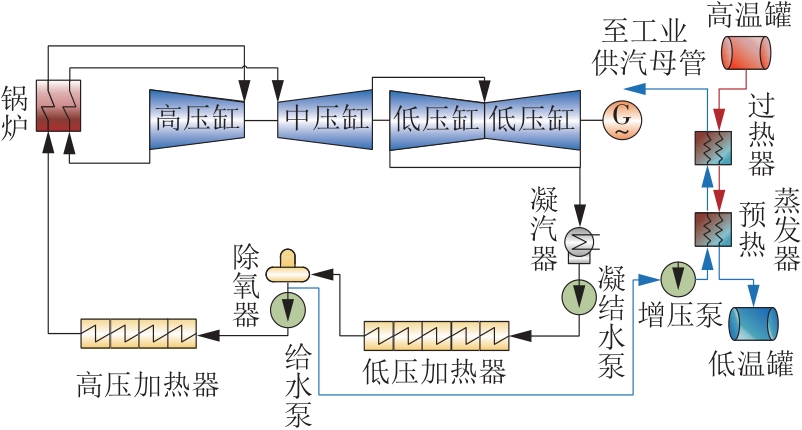
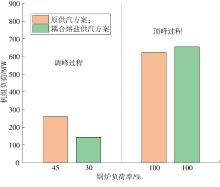
Fig.6
Comparison of parameters during peak shaving and peak reaching under different schemes
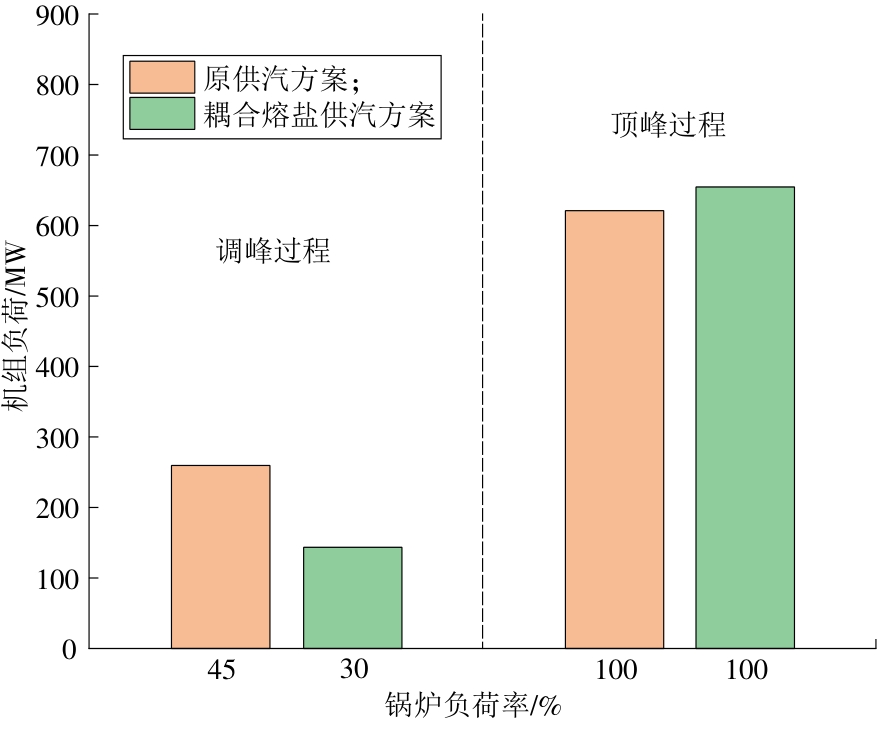
Table 4
Key parameters of molten salt system for energy storage and release
| 参数 | 储热过程 | 放热过程 |
|---|---|---|
| 储放热时间/h | 8.00 | 2.11 |
| 锅炉负荷率/% | 30 | 100 |
| 单位时长换热量/(MW·h) | 25.56 | 96.74 |
| 熔盐量/(t·h-1) | 310 | 1 173 |
| 机组负荷/MW | 143.54 | 654.54 |
Fig.7
Safety operation domain of steam supply before and after unit retrofit
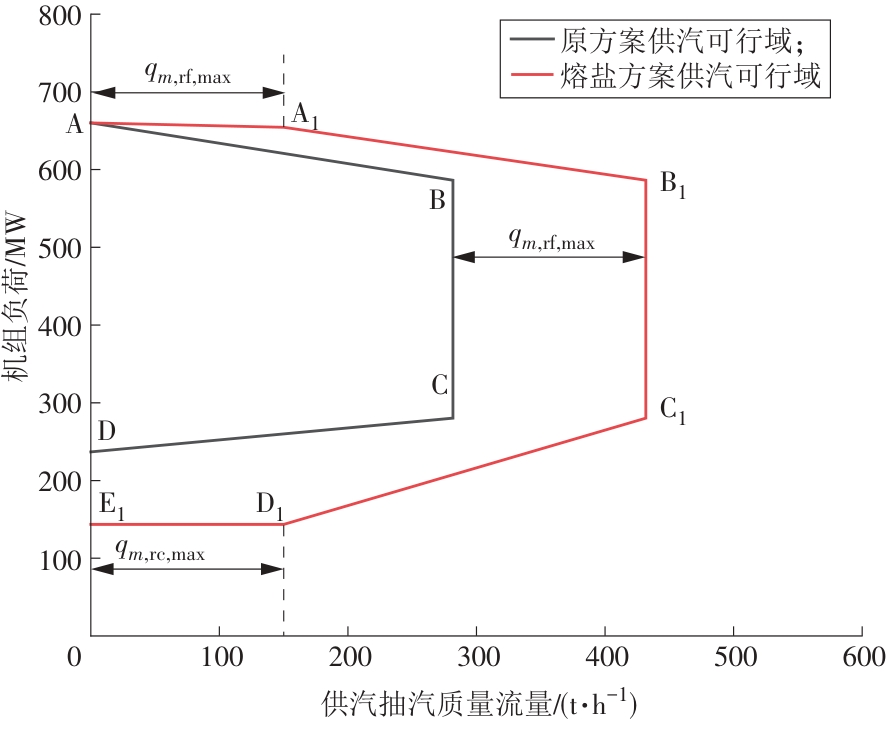
Table 5
Time-of-use electricity prices[26] 元·(kW·h)-1
| 时段 | 电价 | |
|---|---|---|
| 平段 | 00:00 — 08:00 | 0.306 |
| 峰段 | 08:00 —10:00 17:00 —23:00 | 0.499 |
| 谷段 | 09:00 —17:00 | 0.186 |
Table 6
Peak reaching and peak shaving compensation prices for combined heat and power units[27] 元·(kW·h)-1
| 补偿类型 | 负荷率/% | 补偿价格 |
|---|---|---|
| 第一档顶峰补偿 | 90.0~97.5 | 0.30 |
| 第二档顶峰补偿 | 97.5~100.0 | 0.50 |
| 第一档调峰补偿 | 50.0~40.0 | 0 |
| 第二档调峰补偿 | 40.0~0 | 0.35 |
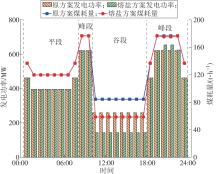
Fig.8
Power generation output and coal consumption of original steam supply scheme and molten salt coupled steam supply scheme on a typical day
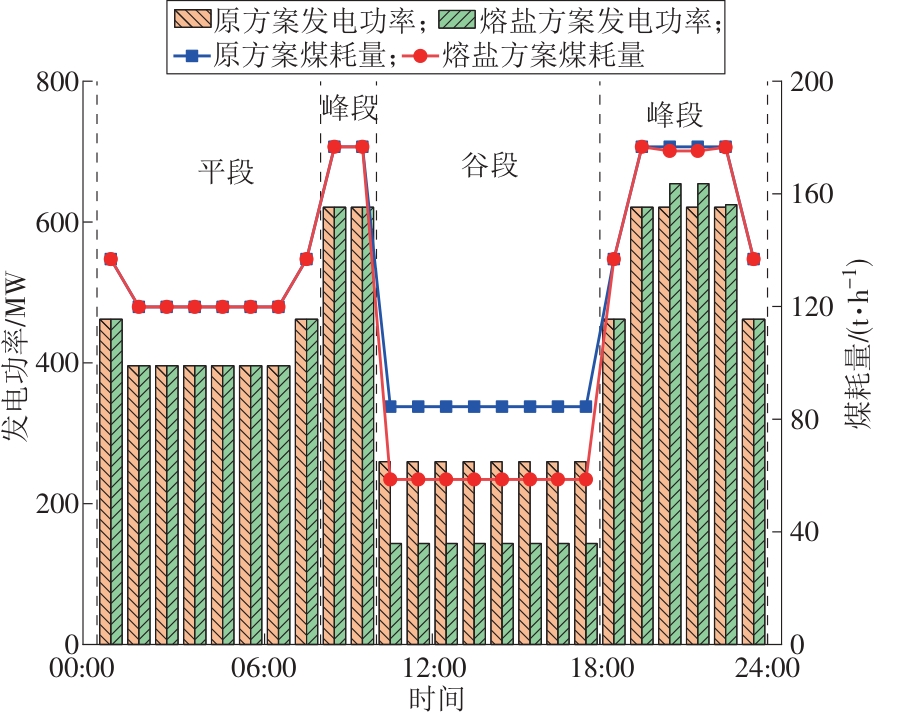
Table 7
Economic parameters of original steam supply scheme and molten salt coupled steam supply scheme 万元·d-1
| 项目 | 原供汽方案 | 耦合系统方案 | 差值 |
|---|---|---|---|
| 顶峰煤耗成本 | 31.69 | 31.42 | -0.27 |
| 顶峰售电收益 | 65.38 | 68.92 | +3.54 |
| 顶峰补偿收益 | 1.71 | 4.30 | +2.59 |
| 调峰煤耗成本 | 57.43 | 39.83 | -17.60 |
| 调峰售电收益 | 38.64 | 21.36 | -17.28 |
| 调峰补偿收益 | 1.22 | 33.73 | +32.51 |
| [1] | 李旭东, 谭青博, 赵浩辰, 等. 碳达峰背景下中国电力行业碳排放因素和脱钩效应[J]. 中国电力, 2024, 57(5): 88-98. |
| LI Xudong, TAN Qingbo, ZHAO Haochen, et al. Carbon emission factors and decoupling effects of China's power industry under the background of carbon peak[J]. Electric Power, 2024, 57(5): 88-98. | |
| [2] | 祁海波, 邹洋, 李钊, 等. 热电联产机组供热能耗影响因素研究[J]. 热能动力工程, 2023, 38(6): 88-95. |
| QI Haibo, ZOU Yang, LI Zhao, et al. Study on factors affecting heating energy consumption of cogeneration unit[J]. Journal of Engineering for Thermal Energy and Power, 2023, 38(6): 88-95. | |
| [3] | 武云跃, 马素霞, 闫利如. 高背压+引射器+抽汽供热方式下热网调节特性分析[J]. 汽轮机技术, 2024, 66(2): 133-137. |
| WU Yunyue, MA Suxia, YAN Liru. Analysis of regulating characteristics of heat supply network under high back pressure+ejector+extraction steam heating mode[J]. Turbine Technology, 2024, 66(2): 133-137. | |
| [4] | 邢阁玉, 孟伟, 白兆宇, 等. 面向高参数大流量工业供汽的高效热电联产系统[J]. 电力科技与环保, 2025, 41(1): 120-129. |
| XING Geyu, MENG Wei, BAI Zhaoyu, et al. A high-efficiency cogeneration system for high parameter and high flow industrial steam supply[J]. Electric Power Technology and Environmental Protection, 2025, 41(1): 120-129. | |
| [5] |
李博, 曹越, 徐景怡, 等. 考虑火电-熔盐储热耦合特性的风光火储能源调度[J]. 综合智慧能源, 2024, 46(12): 55-63.
doi: 10.3969/j.issn.2097-0706.2024.12.007 |
|
LI Bo, CAO Yue, XU Jingyi, et al. Energy dispatch of wind-photovoltaic-thermal-storage considering the coupling characteristics of thermal power and molten salt heat storage[J]. Integrated Intelligent Energy, 2024, 46(12): 55-63.
doi: 10.3969/j.issn.2097-0706.2024.12.007 |
|
| [6] |
张玉杰, 陈讲运, 李建强, 等. 《中国蓄热储能产业发展报告(2024)》: 产业技术、发展现状与典型示范[J]. 储能科学与技术, 2024, 13(12): 4452-4463.
doi: 10.19799/j.cnki.2095-4239.2024.0834 |
| ZHANG Yujie, CHEN Jiangyun, LI Jianqiang, et al. China Thermal energy storage industry development report(2024)—Industry technologies, development status, and model projects[J]. Energy Storage Science and Technology, 2024, 13(12): 4452-4463. | |
| [7] | 左芳菲, 韩伟, 姚明宇. 熔盐储能在新型电力系统中应用现状与发展趋势[J]. 热力发电, 2023, 52(2): 1-9. |
| ZUO Fangfei, HAN Wei, YAO Mingyu. Application status and development trend of molten salt energy storage in novel power systems[J]. Thermal Power Generation, 2023, 52(2): 1-9. | |
| [8] |
袁荣胜, 刘明, 许朋江, 等. 促进能源互联网中绿电消纳的热电联产共享储热系统构型设计及经济性研究[J]. 动力工程学报, 2025, 45(9): 1536-1545.
doi: 10.19805/j.cnki.jcspe.2025.240433 |
|
YUAN Rongsheng, LIU Ming, XU Pengjiang, et al. Design and economic evaluation of cogeneration shared heat storage system for green power consumption in energy Internet[J]. Journal of Chinese Society of Power Engineering, 2025, 45(9): 1536-1545.
doi: 10.19805/j.cnki.jcspe.2025.240433 |
|
| [9] |
王斌, 刘金恺, 姜晓霞, 等. 基于经济性分析的熔盐储热辅助燃煤机组灵活调峰系统优化[J]. 储能科学与技术, 2025, 14(7): 2729-2737.
doi: 10.19799/j.cnki.2095-4239.2025.0304 |
|
WANG Bin, LIU Jinkai, JIANG Xiaoxia, et al. Optimization of flexibile peak shaving system of coal-fired unit aided by molten salt heat storage based on economic analysis[J]. Energy Storage Science and Technology, 2025, 14(7): 2729-2737.
doi: 10.19799/j.cnki.2095-4239.2025.0304 |
|
| [10] | 韩旭, 赵文强, 范彩兄, 等. 火电机组耦合多级熔盐储热系统热力学性能研究[J]. 热能动力工程, 2025, 40(7): 106-112. |
| HAN Xu, ZHAO Wenqiang, FAN Caixiong, et al. Research on thermodynamic performance of multi-stage molten salt thermal storage system coupled with thermal power units[J]. Journal of Engineering for Thermal Energy and Power, 2025, 40(7): 106-112. | |
| [11] | 李蔚, 毛静宇, 李翱, 等. 耦合熔盐储热设备的热电联产系统性能分析及运行调度研究[J]. 热力发电, 2025, 54(2): 1-8. |
| LI Wei, MAO Jingyu, LI Ao, et al. Performance analysis and operation scheduling study for cogeneration system coupled with molten salt thermal storage equipment[J]. Thermal Power Generation, 2025, 54(2): 1-8. | |
| [12] |
谢凯, 王乾, 苏志刚, 等. 耦合熔盐蓄热系统的热电联产机组运行灵活性及性能分析[J]. 动力工程学报, 2025, 45(9): 1546-1556.
doi: 10.19805/j.cnki.jcspe.2025.240501 |
|
XIE Kai, WANG Qian, SU Zhigang, et al. Operation flexibility and performance analysis of combined heat and power unit coupled with molten salt heat storage system[J]. Journal of Chinese Society of Power Engineering, 2025, 45(9): 1546-1556.
doi: 10.19805/j.cnki.jcspe.2025.240501 |
|
| [13] |
赵大周, 谢玉荣, 张钟平, 等. 300 MW燃煤供热机组熔盐储热系统设计及经济性分析[J]. 综合智慧能源, 2024, 46(9): 45-52.
doi: 10.3969/j.issn.2097-0706.2024.09.006 |
|
ZHAO Dazhou, XIE Yurong, ZHANG Zhongping, et al. Design and economic analysis of the molten salt heat storage system for a 300 MW coal-fired heating unit[J]. Integrated Intelligent Energy, 2024, 46(9): 45-52.
doi: 10.3969/j.issn.2097-0706.2024.09.006 |
|
| [14] | 马汀山, 王妍, 吕凯, 等. “双碳”目标下火电机组耦合储能的灵活性改造技术研究进展[J]. 中国电机工程学报, 2022, 42(S1): 136-148. |
| MA Tingshan, WANG Yan, LYU Kai, et al. Research progress on flexibility transformation technology of coupled energy storage for thermal power units under the "dual-carbon" goal[J]. Proceedings of the Chinese Society for Electrical Engineering, 2022, 42(S1): 136-148. | |
| [15] | 江晶亮, 周厉蕾, 张武玄. 太阳能光热电站热介质熔盐与单相流传热性能研究[J]. 锅炉技术, 2021, 52(6): 8-14. |
| JIANG Jingliang, ZHOU Lilei, ZHANG Wuxuan. Study on heat transfer performance of molten salt and single phase flow in concentrating solar power station[J]. Boiler Technology, 2021, 52(6): 8-14. | |
| [16] |
王吉超, 祝令凯, 郑威, 等. 供热机组配置熔盐储热系统构型设计及性能分析[J]. 动力工程学报, 2025, 45(12): 2090-2099, 2197.
doi: 10.19805/j.cnki.jcspe.2025.250396 |
|
WANG Jichao, ZHU Lingkai, ZHENG Wei, et al. Configuration design and performance analysis of a cogeneration unit integrated with a molten salt thermal energy storage system[J]. Journal of Chinese Society of Power Engineering, 2025, 45(12): 2090-2099, 2197.
doi: 10.19805/j.cnki.jcspe.2025.250396 |
|
| [17] |
TANG H Y, LIN M, ZHANG K Z, et al. Performance evaluation and operation optimization of a combined heat and power plant integrated with molten salt heat storage system[J]. Applied Thermal Engineering, 2024, 245:122848.
doi: 10.1016/j.applthermaleng.2024.122848 |
| [18] | 高耀岿, 曾德良, 平博宇, 等. 吸收式热泵供热机组安全区的计算[J]. 热力发电, 2020, 49(2): 58-64. |
| GAO Yaokui, ZENG Deliang, PING Boyu, et al. Calculation of safe operation area for CHP units with absorption heat pump[J]. Thermal Power Generation, 2020, 49(2): 58-64. | |
| [19] | 丁一, 王春亮, 席跃伟, 等. 630 MW超临界供汽热电联产机组收益计算[J]. 中国电力, 2026, 59(1): 76-83. |
| DING Yi, WANG Chunliang, XI Yuewei, et al. Revenue calculation for 630 MW supercritical steam-supply combined heat and power unit[J]. Electric Power, 2026, 59(1): 76-83. | |
| [20] | 杨灿, 胡丽娜, 魏俊, 等. 燃煤机组耦合熔盐储热系统的性能分析及经济性评价[J]. 储能科学与技术, 2025, 14(12): 4795-4809. |
| YANG Can, HU Lina, WEI Jun, et al. Performance comparison and economic evaluation of coal-fired units coupled with molten salt thermal energy storage systems[J]. Energy Storage Science and Technology, 2025, 14(12): 4795-4809. | |
| [21] |
AHMED N, ELFEKY K E, LU L, et al. Thermal and economic evaluation of thermocline combined sensible-latent heat thermal energy storage system for medium temperature applications[J]. Energy Conversion and Management, 2019, 189: 14-23.
doi: 10.1016/j.enconman.2019.03.040 |
| [22] | 巩志强, 韩悦, 徐明新, 等. 煤电耦合熔盐储热调峰的技术经济性[J]. 洁净煤技术, 2025, 31(8): 200-209. |
| GONG Zhiqiang, HAN Yue, XU Mingxin, et al. Technical and economic on peaking regulation of coal-fired plant integrated with molten salt heat storage[J]. Clean Coal Technology, 2025, 31(8): 200-209. | |
| [23] |
ZHANG Q J, DONG J N, CHEN H, et al. Dynamic characteristics and economic analysis of a coal-fired power plant integrated with molten salt thermal energy storage for improving peaking capacity[J]. Energy, 2024, 290: 130132.
doi: 10.1016/j.energy.2023.130132 |
| [24] | 李建林, 邸文峰, 李雅欣, 等. 长时储能技术及典型案例分析[J]. 热力发电, 2023, 52(11): 85-94. |
| LI Jianlin, DI Wenfeng, LI Yaxin, et al. Analysis of long-term energy storage technologies and typical case studies[J]. Thermal Power Generation, 2023, 52(11): 85-94. | |
| [25] | 马汀山, 王伟, 王东晔, 等. 基于熔盐储热辅助煤电机组深度调峰的系统设计及容量计算方法研究[J]. 热力发电, 2023, 52(7): 113-118. |
| MA Tingshan, WANG Wei, WANG Dongye, et al. Research on system design and capacity calculation method for deep peak shaving of coal-fire unit based on molten salt heat storage assistance[J]. Thermal Power Generation, 2023, 52(7): 113-118. | |
| [26] | 周天羽, 张一农, 徐钢, 等. 考虑调峰辅助服务收益的耦合储热罐热电联产机组运行调度研究[J]. 热力发电, 2025, 54(5): 92-101. |
| ZHOU Tianyu, ZHANG Yinong, XU Gang, et al. Research on operation scheduling of cogeneration units coupled with heat storage tank considering peak shaving ancillary service income[J]. Thermal Power Generation, 2025, 54(5): 92-101. | |
| [27] |
王家豪, 马恒瑞, 王波, 等. 面向综合能源系统的辅助服务市场与多类型市场耦合关系分析[J]. 综合智慧能源, 2023, 45(10): 82-92.
doi: 10.3969/j.issn.2097-0706.2023.10.010 |
|
WANG Jiahao, MA Hengrui, WANG Bo, et al. Analysis on the coupling between the auxiliary service market and multiple types of markets for integrated energy systems[J]. Integrated Intelligent Energy, 2023, 45(10): 82-92.
doi: 10.3969/j.issn.2097-0706.2023.10.010 |
| [1] | YUE Baiyang, GENG Shimin, CHENG Siyuan. Design and economic analysis of molten salt thermal storage system for 600 MW condensing unit [J]. Integrated Intelligent Energy, 2026, 48(5): 64-73. |
| [2] | HUANG Shuai, XIANG Xinyu, LI Ang, JIN Xu, Aruna , ZHANG Jiapeng. Cycle optimization and environmental economic evaluation of transcritical CO₂ heat pump heating systems [J]. Integrated Intelligent Energy, 2026, 48(4): 81-89. |
| [3] | CHEN Yuan, GUO Xiaohan, WANG Tingjian, XU Peiyun, CHEN Peng, WANG Di, DENG Liangsheng. Economic calculation and price cost analysis of the trigeneration system based on phosphoric acid fuel cells [J]. Integrated Intelligent Energy, 2025, 47(10): 26-33. |
| [4] | ZHAO Dazhou, XIE Yurong, ZHANG Zhongping, DENG Ruifeng, LIU Lili. Design and economic analysis of the molten salt heat storage system for a 300 MW coal-fired heating unit [J]. Integrated Intelligent Energy, 2024, 46(9): 45-52. |
| [5] | BAI Zhang, HAO Wenjie, LI Qi, HAO hongliang, WEN Caifeng, GUO Su, HUANG Xiankun. Capacity configuration optimization of wind‒solar hydrogen production based on life cycle assessment [J]. Integrated Intelligent Energy, 2024, 46(10): 1-11. |
| [6] | MIAO Cairan, ZHU Yaopei, WANG Qi. Optimal configuration of integrated energy systems considering gas and thermal inertia [J]. Integrated Intelligent Energy, 2023, 45(10): 44-52. |
| [7] | CHEN Yihui, LIN Lingqi, TIAN Xin, ZHANG Dongliang, WU Jun, LIU Zichen. Three-level wind power AVC coordinated control strategy [J]. Integrated Intelligent Energy, 2022, 44(4): 20-27. |
| [8] | ZHAO Yongliang, LIU Ming, WANG Chaoyang, SUN Ruiqiang, CHONG Daotong, YAN Junjie. Thermo-economic analysis on the pumped thermal energy storage system based on the solid packed beds [J]. Huadian Technology, 2021, 43(7): 1-8. |
| [9] | ZHOU Nan, LIANG Xiujin, LI Zhuang. Economic analysis on white plume treatment for coal-fired units [J]. Huadian Technology, 2020, 42(9): 63-68. |
| [10] |
JIANG Ting1,2,XU Jingjing1,2,MA Qin1,2,YU Li1,2.
Economic analysis of low temperature flue gas waste heat utilization in distributed energy system
[J]. Huadian Technology, 2019, 41(5): 46-49.
|
| [11] |
WU Shaojing,ZHOU Changyou,CHEN Bin,LU Gang.
Analysis on improved adjustment strategy for adjustable fixed bracket system
[J]. Huadian Technology, 2019, 41(4): 56-58.
|
| [12] |
SUN Siyu1,YU Chengqi2,SUN Tao3,LI Xinjian3,WEI Yi4,TAN Jingbo2,ZHANG Juntao2.
Advance in study on CCHP distributed energy system |
| [13] |
WANG Zhengrong, GENG Xuan, WANG Yang, XIA Huaipeng, FU Lihui, SHEN Mingzhong, SHEN Jianyong, WANG Kailiang.
Comparative analysis of design schemes for wet plume removal in coalfired power plant
[J]. Huadian Technology, 2018, 40(9): 5-9.
|
| [14] |
ZHU Wentao,LIANG Xiujin,ZHU Yue.
Technical and economic analysis on the energysaving renovation by the waste heat deep recovery of a 300MW coalfired unit
[J]. Huadian Technology, 2018, 40(9): 1-4.
|
| [15] |
WANG Xueqin1,JIANG Ting2,XU Jingjing2,DENG Ya’nan2,HU Yongfeng2.
Research and application of cooling storage solution in the natural gas distributed energy station
[J]. Huadian Technology, 2018, 40(11): 72-76.
|
| Viewed | ||||||
|
Full text |
|
|||||
|
Abstract |
|
|||||