综合智慧能源 ›› 2026, Vol. 48 ›› Issue (6): 68-81.doi: 10.3969/j.issn.2097-0706.2026.06.006
孙健( ), 刘敏慧(), 胡芸蓉, 薛健豪, 胡志武, 杜小泽()
收稿日期:2026-04-14
修回日期:2026-05-21
出版日期:2026-06-25
作者简介:孙健(1985),男,副教授,博士,从事新型热泵及综合能源优化技术等方面的研究,s@ncepu.edu.cn;基金资助:
SUN Jian(), LIU Minhui(), HU Yunrong, XUE Jianhao, HU Zhiwu, DU Xiaoze()
Received:2026-04-14
Revised:2026-05-21
Published:2026-06-25
Supported by:摘要:
针对现有耦合热泵缺少适配150 ℃供热工况的工质优选、热力及经济性综合分析的短板,提出了一种150 ℃压缩-吸收耦合高温热泵机组,以实现低品位余热高效提质,降低工业高温供热能耗与运行成本。基于稳态热力学方法建立系统数学模型,对高压侧单工质和低压侧二元混合工质进行筛选,分析蒸发-冷凝器温度、制热温度、余热出口温度及水蒸气压缩机压比对机组热力性能的影响,并进行经济性对比。结果表明:高压侧优选工质为反式-1-氯-3,3,3-三氟丙烯;低压侧优选混合工质为正戊烷(R601)/顺式-1,3,3,3-四氟丙烯,R601最佳摩尔分数为0.69,系统性能系数(COP)为5.16;蒸发-冷凝器温度由85 ℃升高至95 ℃时,COP由2.16降至2.02,制热量由739.29 kW增至761.26 kW;制热温度由140 ℃升高至160 ℃时,COP由2.22降至1.97,制热量由727.00 kW增至774.95 kW;余热出口温度由40 ℃升高至50 ℃时,COP由1.91升至2.14,而制热量由1 314.83 kW降至617.46 kW;水蒸气压缩机压比由1.20升高至1.70时,COP由2.14降至2.06,溴化锂浓溶液质量分数由54.16%升至58.02%,循环倍率由6.56降至4.79。在相同供热量条件下,耦合热泵系统小时运行成本分别较燃气锅炉和电锅炉降低55.6%和72.8%。研究表明,该耦合热泵机组兼具良好的热力性能与经济性,在工业中低温余热深度回收及高温供热替代方面具有较好的应用前景。
孙健, 刘敏慧, 胡芸蓉, 薛健豪, 胡志武, 杜小泽. 面向工业余热回收的150 ℃高温耦合热泵性能研究[J]. 综合智慧能源, 2026, 48(6): 68-81.
SUN Jian, LIU Minhui, HU Yunrong, XUE Jianhao, HU Zhiwu, DU Xiaoze. Study on performance of a 150 ℃ high-temperature coupled heat pump for industrial waste heat recovery[J]. Integrated Intelligent Energy, 2026, 48(6): 68-81.
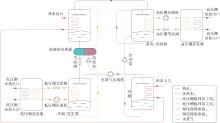
图1
耦合热泵机组流程
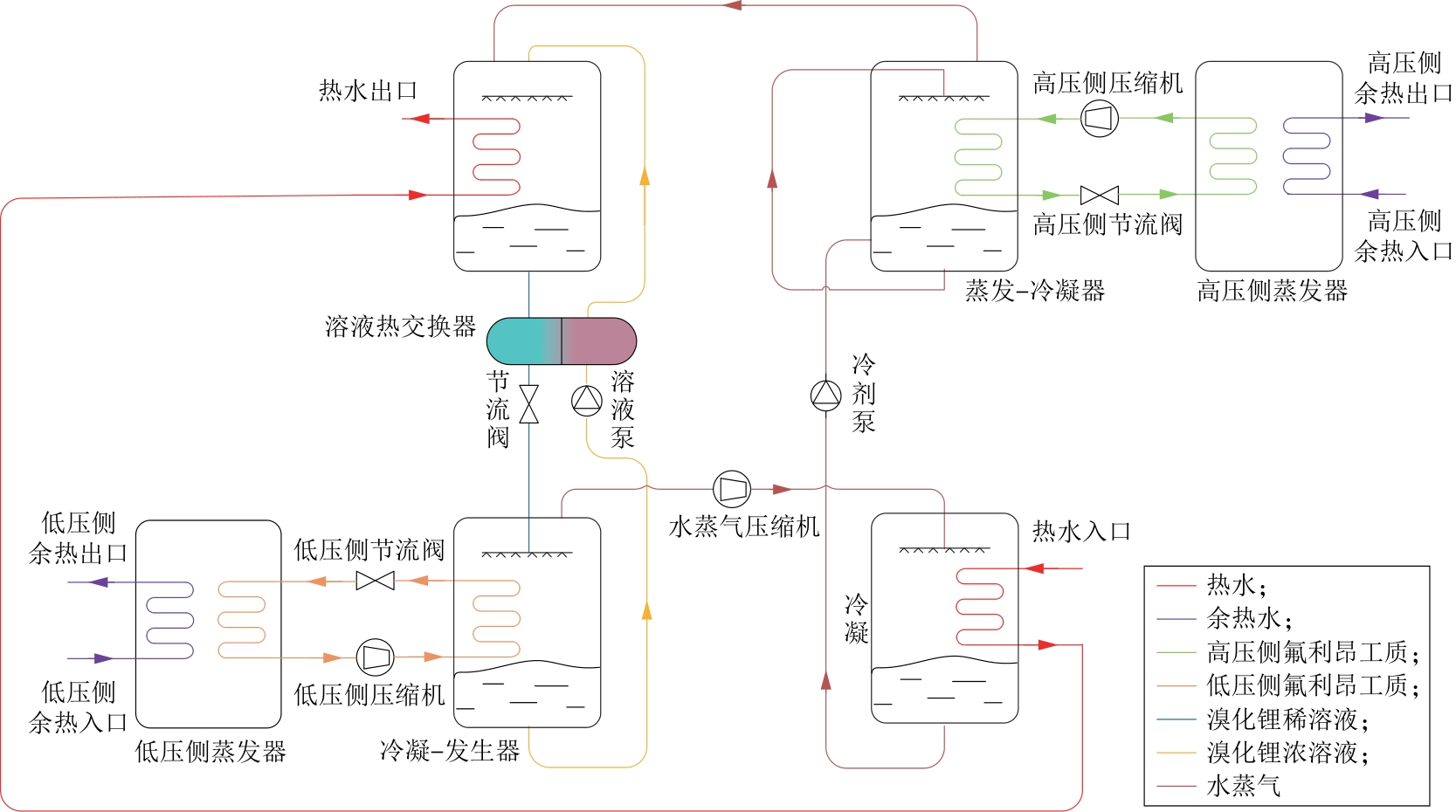

表1
高压侧热泵循环不同工质运行参数
| 工质 | COP | 压比 | 单位容积制热量/(kJ∙m-3) | 排气温度/℃ | 排气压力/kPa |
|---|---|---|---|---|---|
| R1233zd(E) | 3.62 | 2.84 | 2 554 | 98.81 | 833.45 |
| R1336mzz(Z) | 3.56 | 3.10 | 1 639 | 90.55 | 555.17 |
| R1224yd(Z) | 3.54 | 2.81 | 2 758 | 95.69 | 931.23 |
| R1234ze(Z) | 3.59 | 2.77 | 3 276 | 101.94 | 1 083.64 |
| R601 | 3.65 | 2.95 | 1 452 | 91.93 | 470.60 |
| R600 | 3.37 | 2.40 | 4 505 | 95.55 | 1 641.96 |
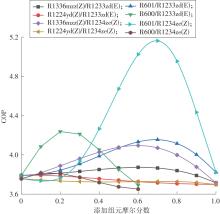
图2
各二元混合工质COP随添加组元摩尔分数的变化
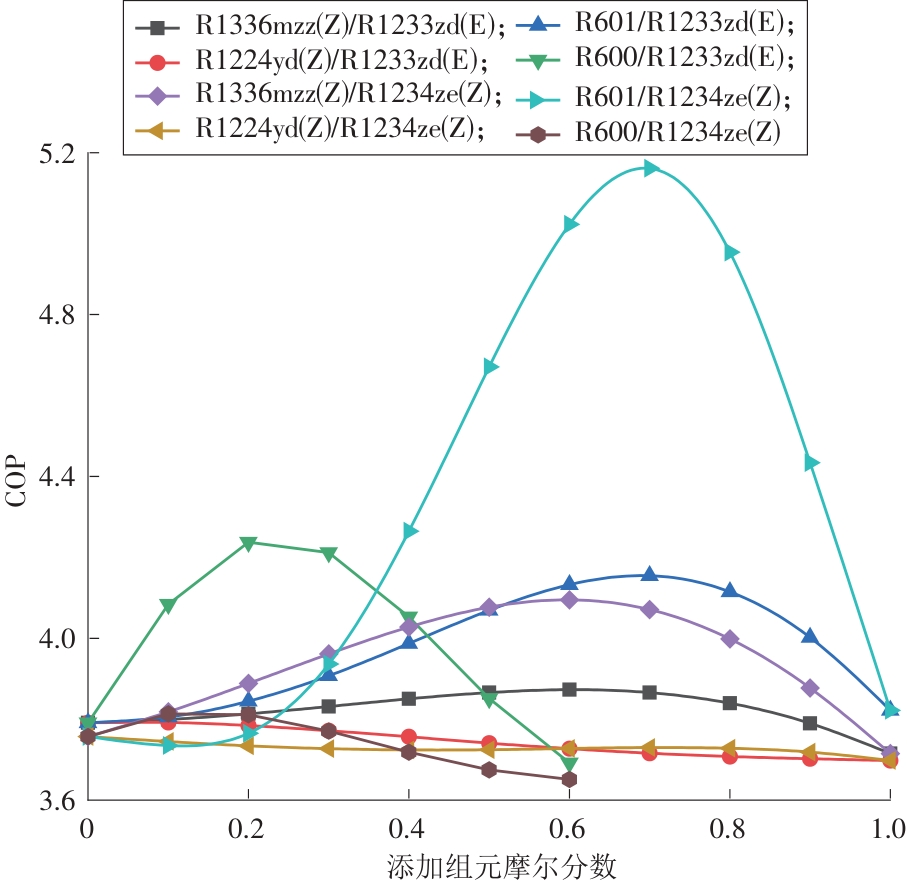
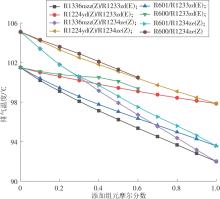
图3
各二元混合工质排气温度随添加组元摩尔分数的变化
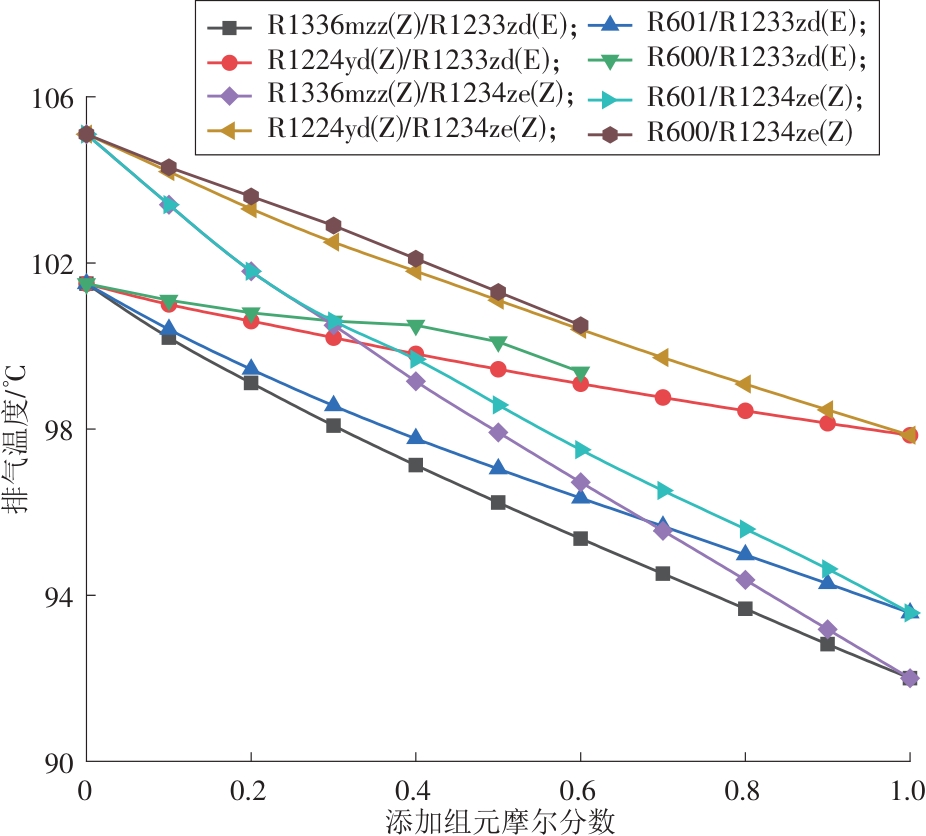
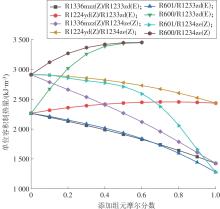
图4
各二元混合工质单位容积制热量随添加组元摩尔分数的变化
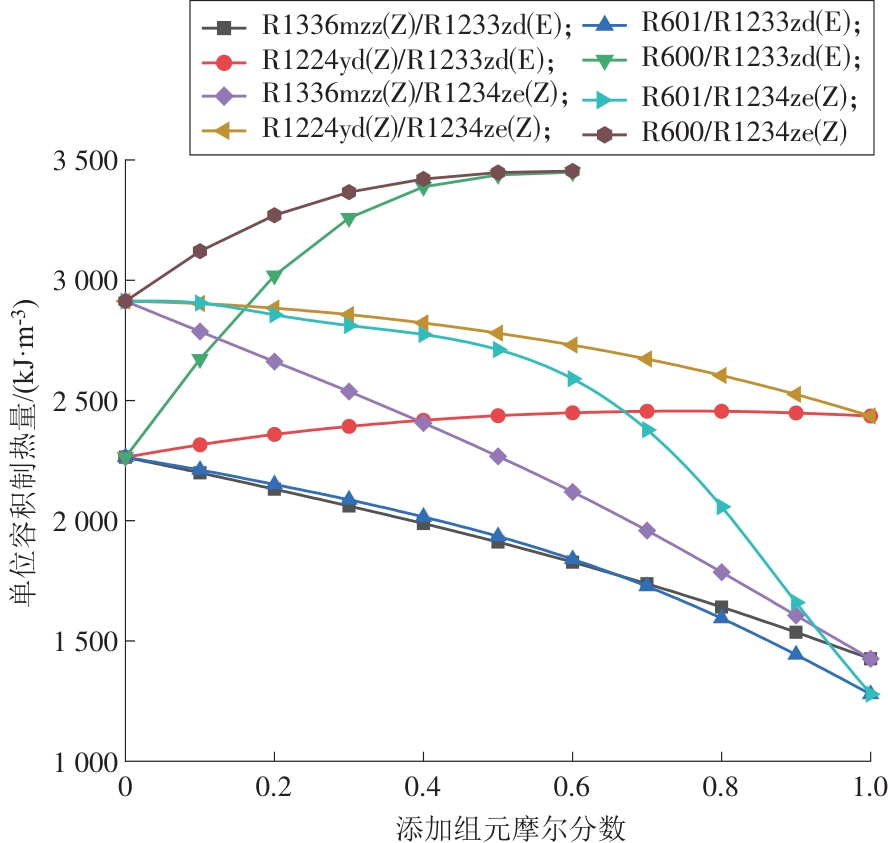
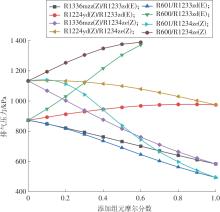
图5
各二元混合工质排气压力随添加组元摩尔分数的变化
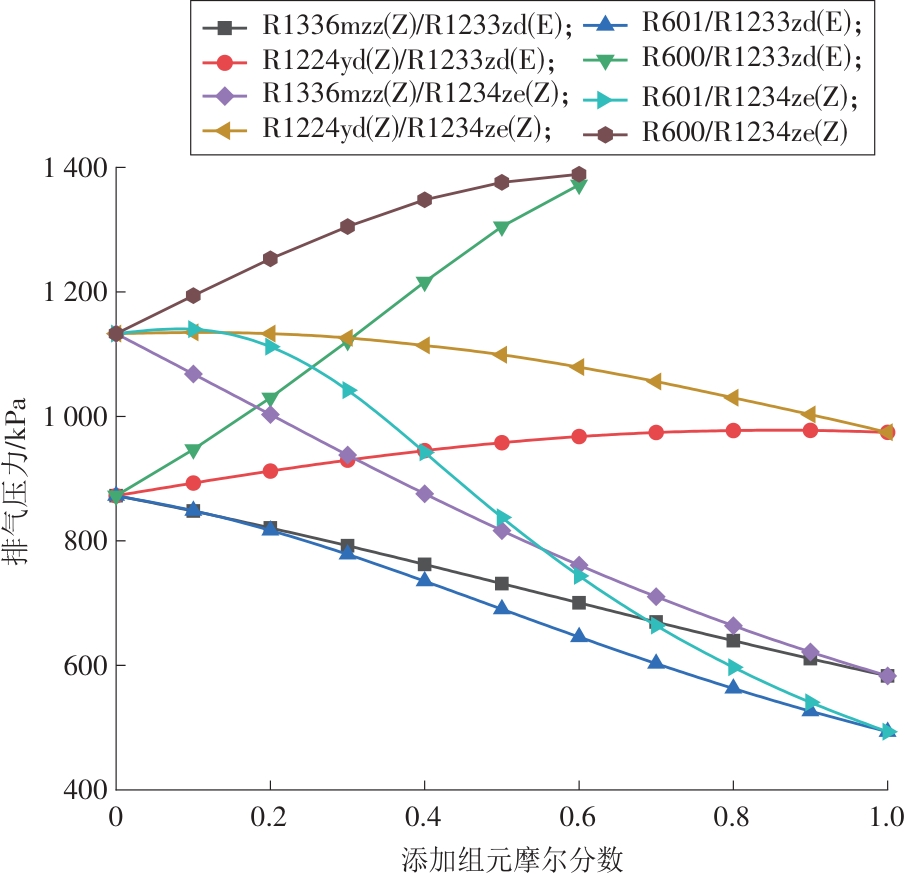
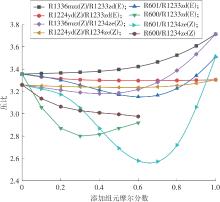
图6
各二元混合工质压比随添加组元摩尔分数的变化
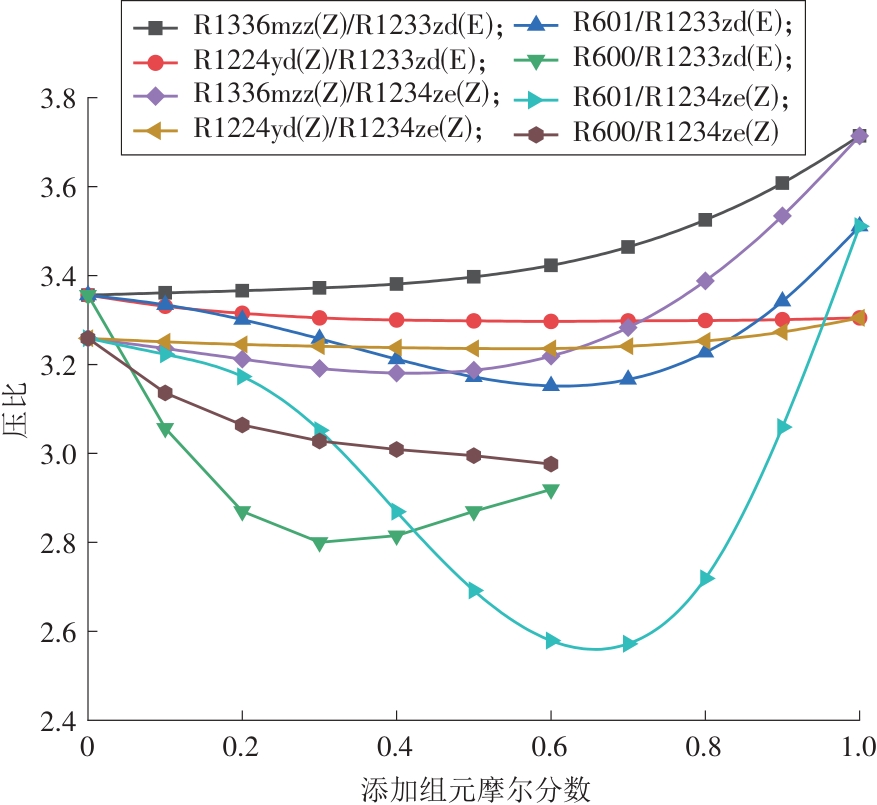
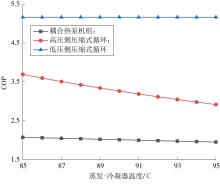
图7
机组COP随蒸发-冷凝器温度的变化
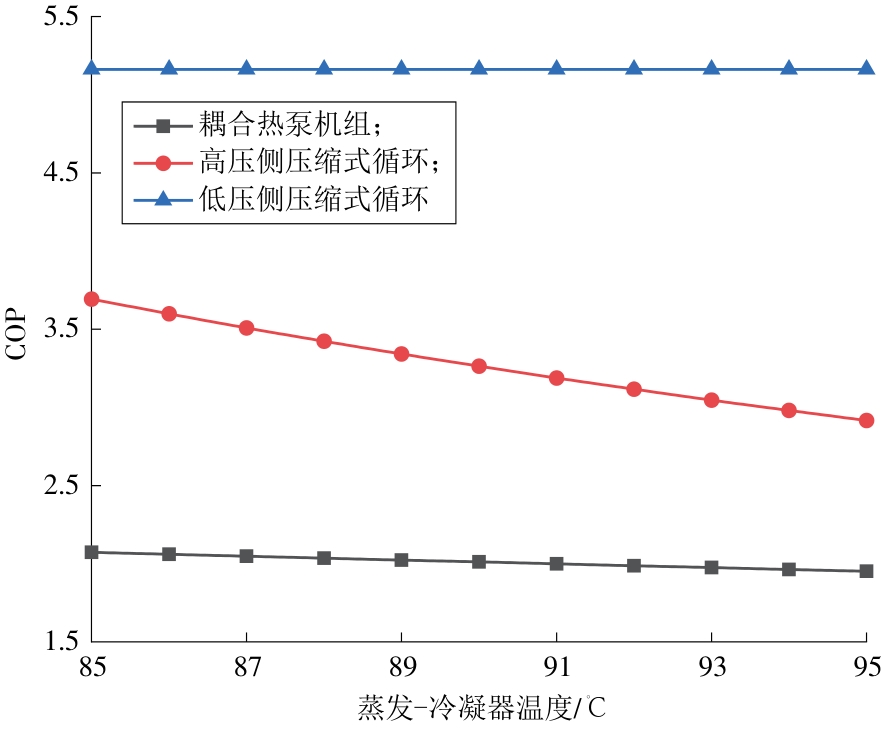
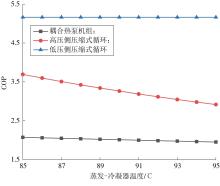
图8
机组制热量随蒸发-冷凝器温度的变化
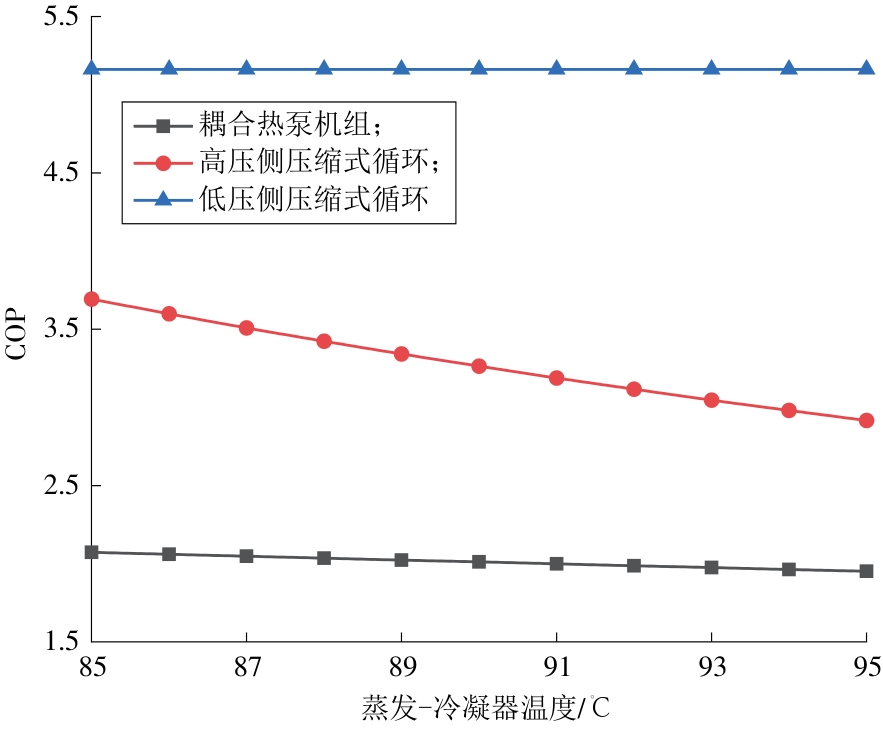
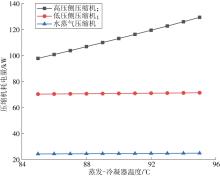
图9
各压缩机耗电量随蒸发-冷凝器温度的变化
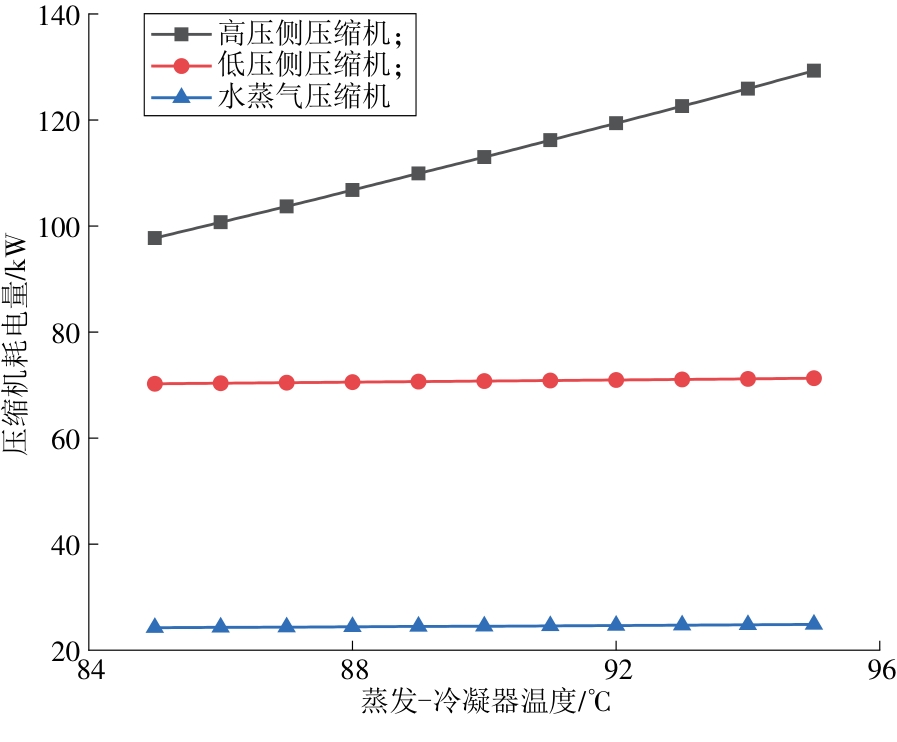
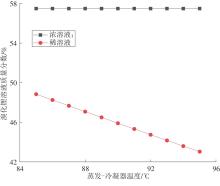
图10
溴化锂溶液质量分数随蒸发-冷凝器温度的变化
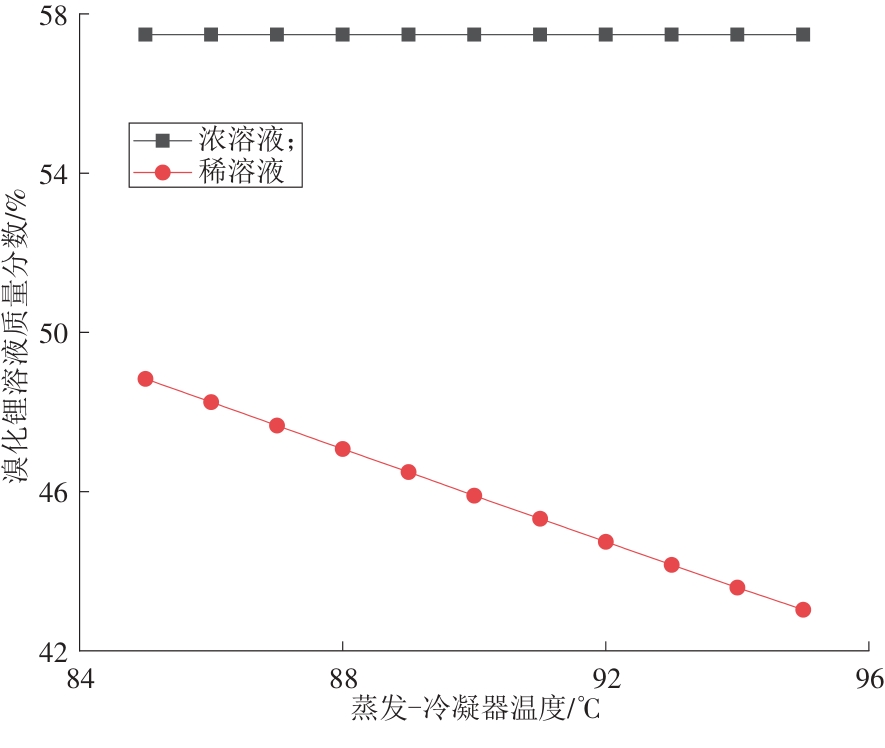
图11
机组COP随制热温度的变化
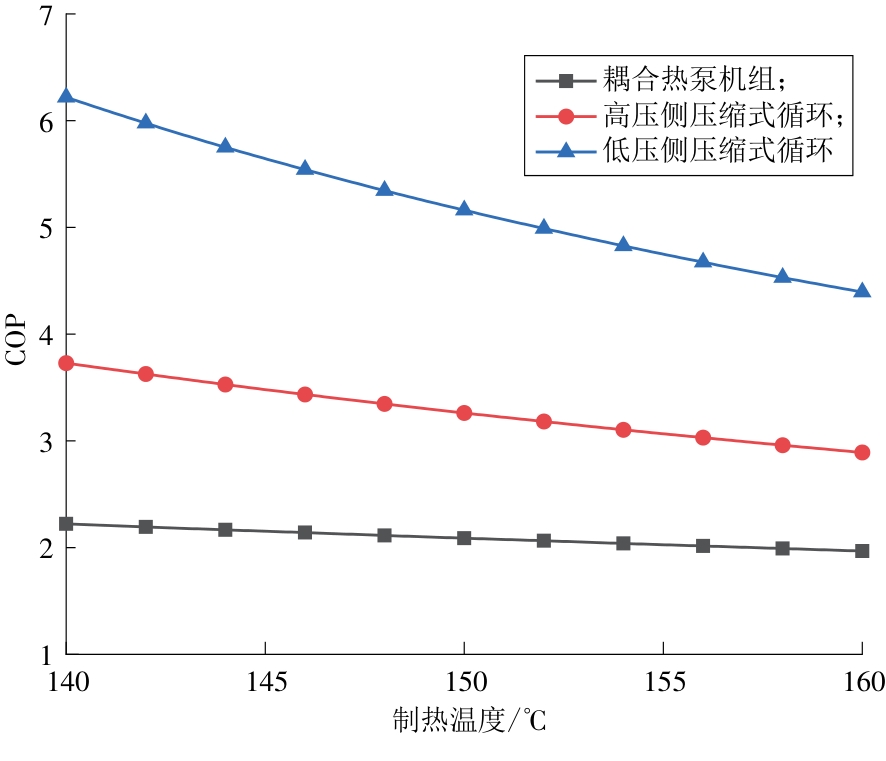
图12
各压缩机耗电量随制热温度的变化
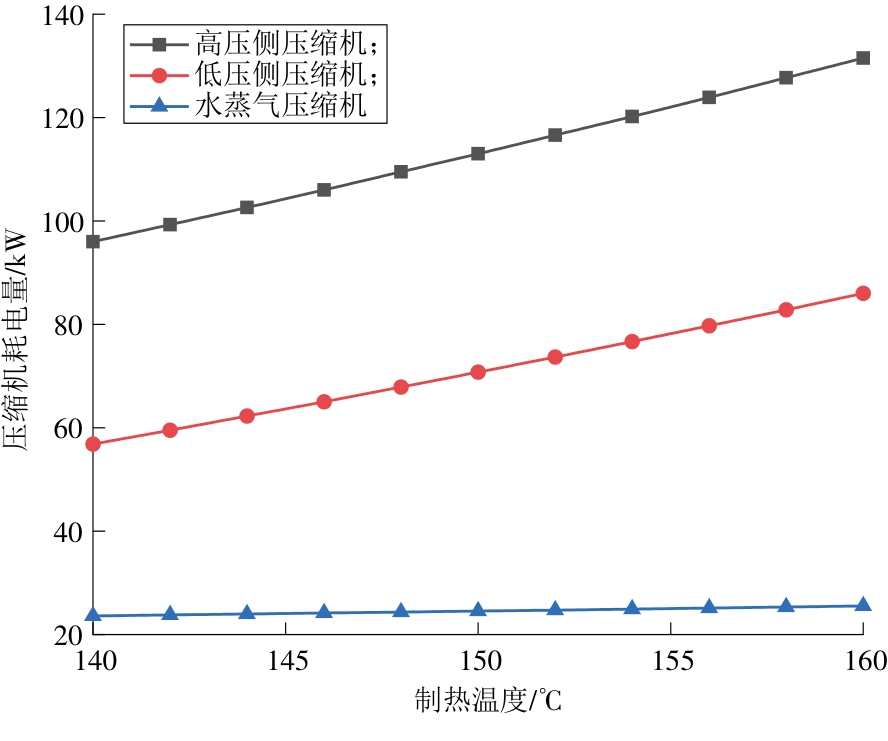
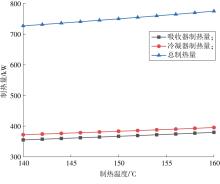
图13
机组制热量随制热温度的变化
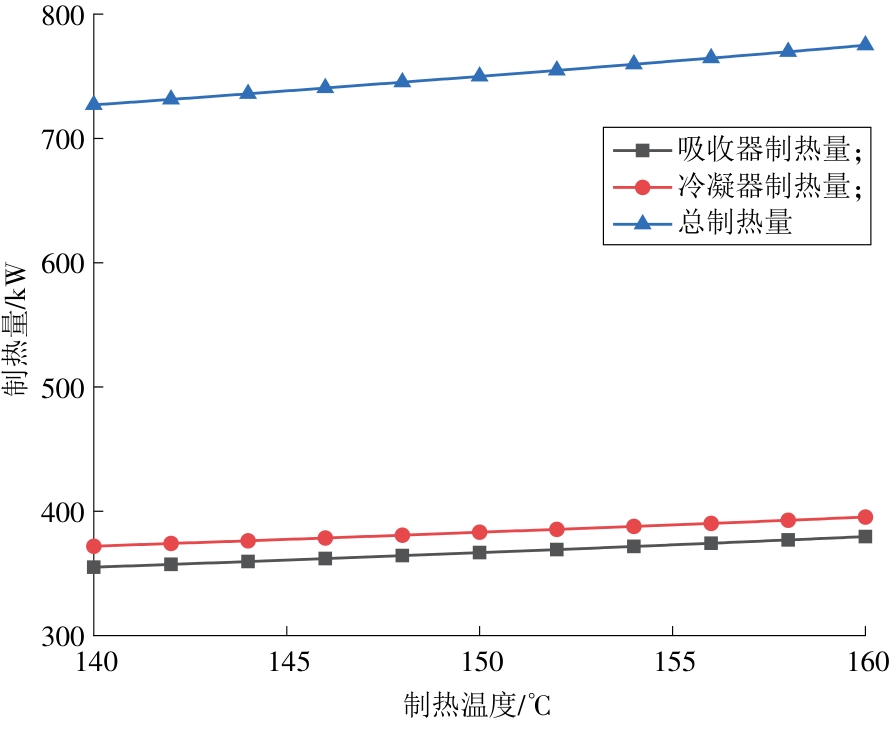
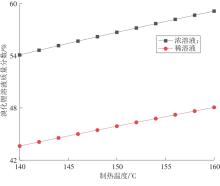
图14
溴化锂溶液质量分数随制热温度的变化
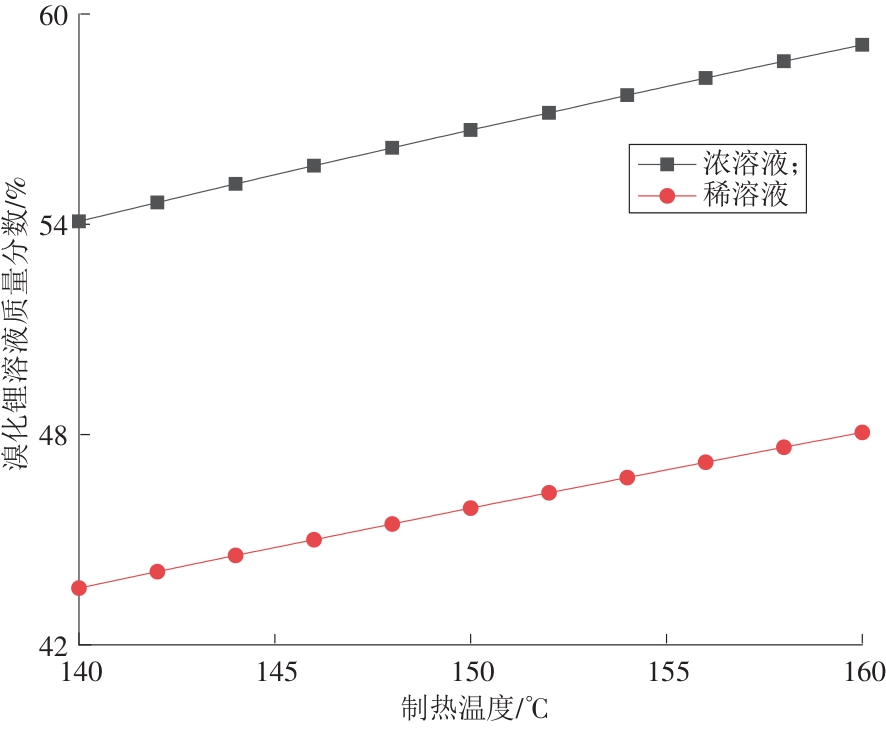
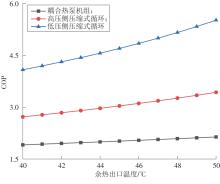
图15
机组COP随余热出口温度的变化
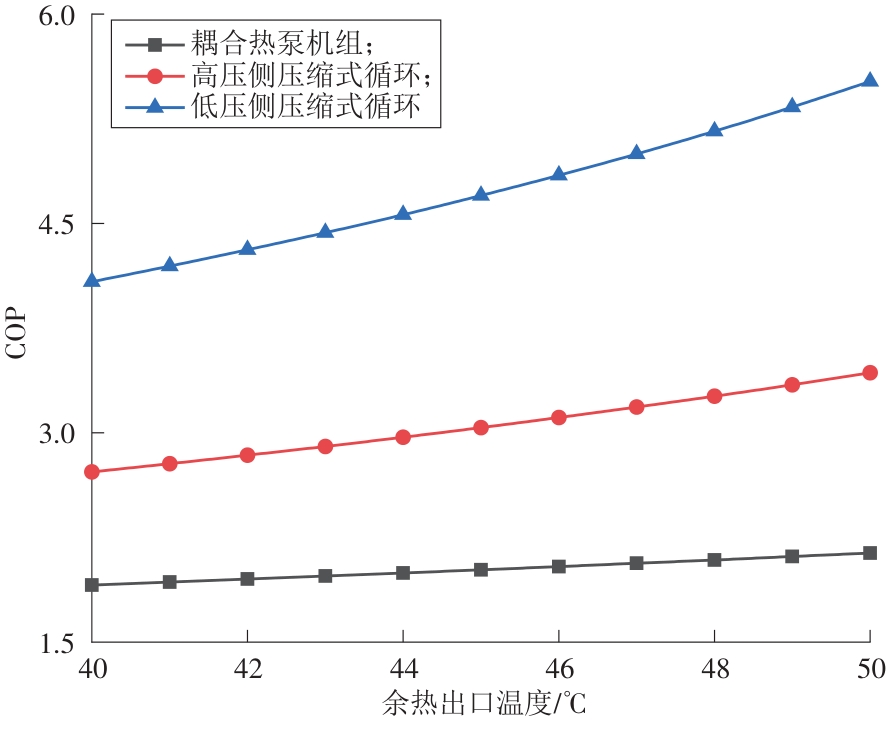
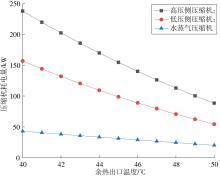
图16
各压缩机耗电量随余热出口温度的变化
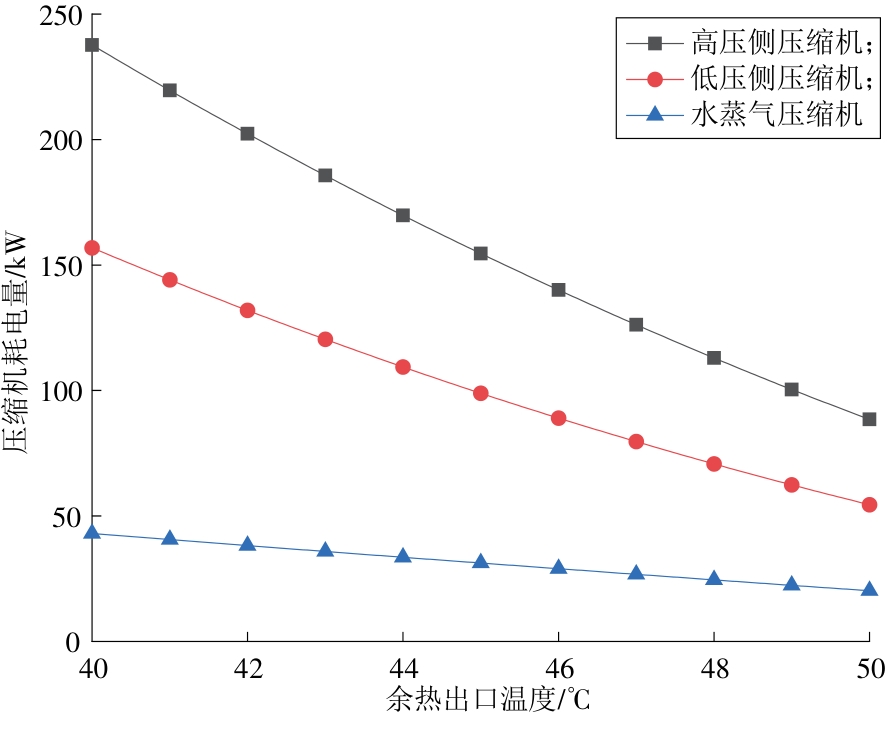
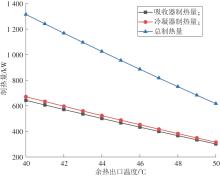
图17
机组制热量随余热出口温度的变化
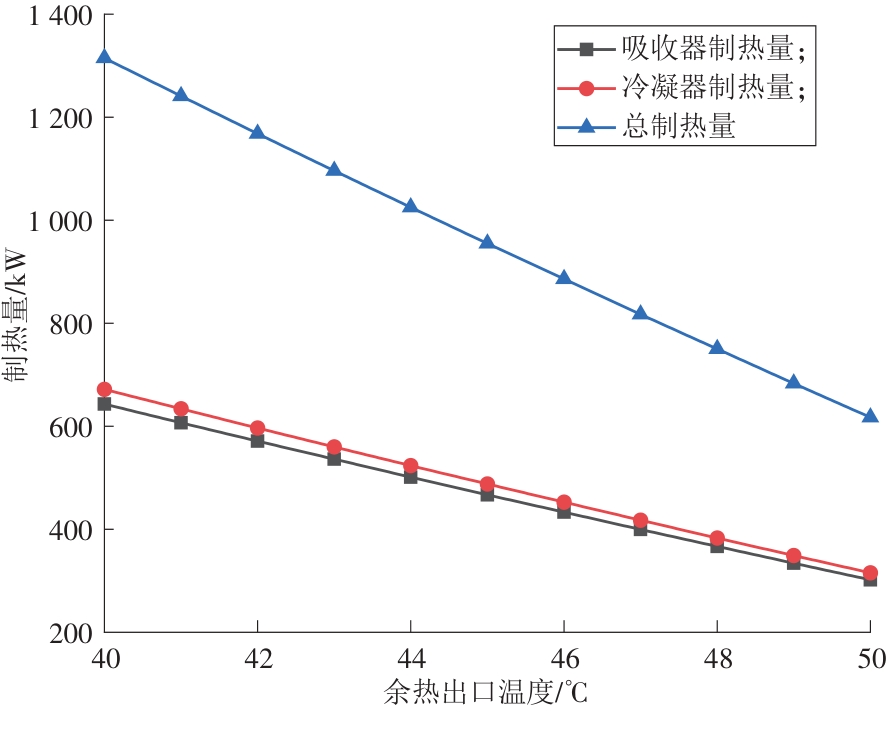
图18
耦合热泵机组COP随水蒸气压缩机压比的变化
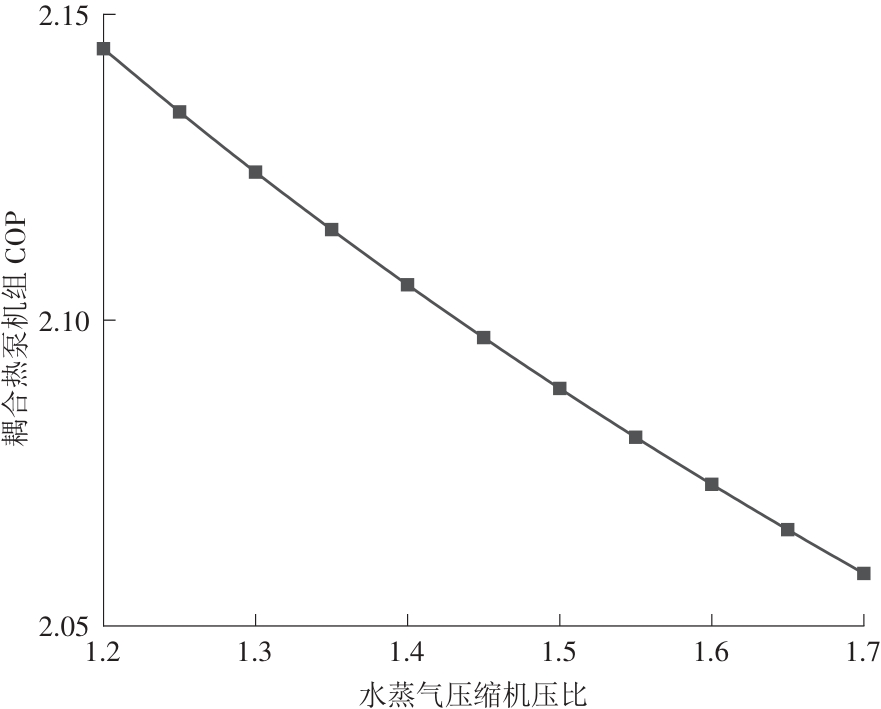
图19
溴化锂溶液质量分数随水蒸气压缩机压比的变化
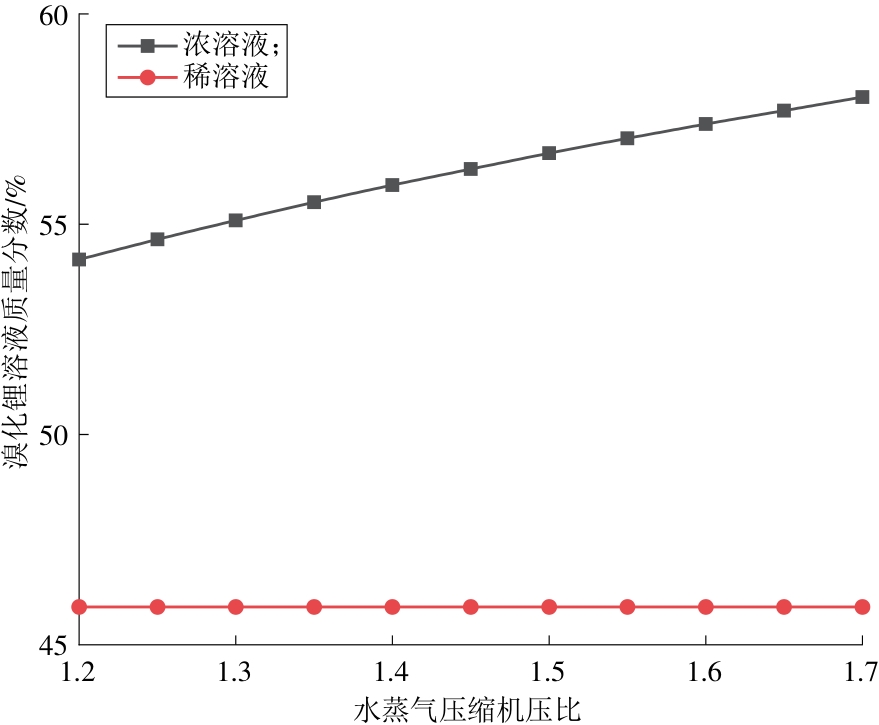
图20
循环倍率随水蒸气压缩机压比的变化
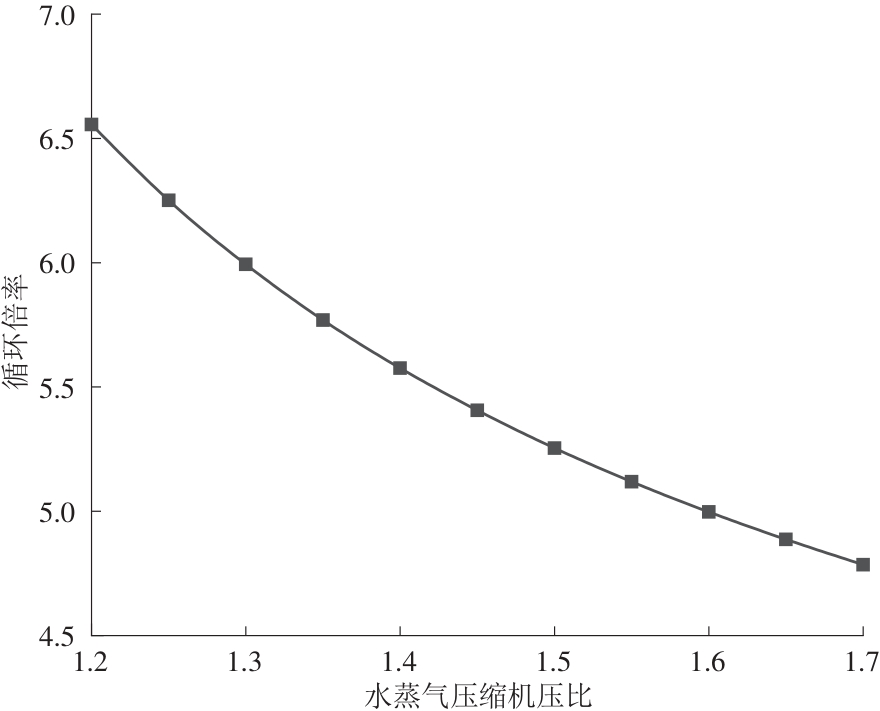
表2
不同供热方案运行成本对比
| 供热方案 | 每小时运行成本/元 | 单位热量成本/ (元∙GJ-1) | 耦合热泵相对节省比例/% |
|---|---|---|---|
| 耦合热泵 | 129.14 | 47.83 | |
| 燃气锅炉 | 290.59 | 107.63 | 55.6 |
| 电锅炉 | 474.45 | 175.74 | 72.8 |
| [1] | 国家统计局. 中华人民共和国2024年国民经济和社会发展统计公报[EB/OL].(2025-02-28)[2026-04-01]. https://www.stats.gov.cn/zwfwck/sjfb/202502/t20250228_1958817.html. |
| [2] | 王如竹, 王丽伟, 蔡军, 等. 工业余热热泵及余热网络化利用的研究现状与发展趋势[J]. 制冷学报, 2017, 38(2): 1-10. |
|
WANG Ruzhu, WANG Liwei, CAI Jun, et al. Research status and trends on industrial heat pump and network utilization of waste heat[J]. Journal of Refrigeration, 2017, 38(2): 1-10.
doi: 10.1016/j.ijrefrig.2013.09.044 |
|
| [3] | 胡斌, 姜佳彤, 吴迪, 等. 工业高温热泵发展现状与展望[J]. 制冷学报, 2023, 44(6): 1-12. |
|
HU Bin, JIANG Jiatong, WU Di, et al. Development status and prospects of industrial high-temperature heat pumps[J]. Journal of Refrigeration, 2023, 44(6): 1-12.
doi: 10.1016/j.ijrefrig.2014.05.004 |
|
| [4] |
安美燕, 赵心蕊, 徐震原, 等. 工业余热回收的耦合压缩-吸收式高温热泵循环[J]. 上海交通大学学报, 2021, 55(4): 434-443.
doi: 10.16183/j.cnki.jsjtu.2020.023 |
| AN Meiyan, ZHAO Xinrui, XU Zhenyuan, et al. A hybrid compression-absorption high temperature heat pump cycles for industrial waste heat recovery[J]. Journal of Shanghai Jiao Tong University, 2021, 55(4): 434-443. | |
| [5] |
孙健, 王寅武, 吴可欣, 等. 综合能源系统中热泵技术研究与应用[J]. 综合智慧能源, 2023, 45(4): 1-11.
doi: 10.3969/j.issn.2097-0706.2023.04.001 |
|
SUN Jian, WANG Yinwu, WU Kexin, et al. Research and application of heat pump technology in integrated energy systems[J]. Integrated Intelligent Energy, 2023, 45(4): 1-11.
doi: 10.3969/j.issn.2097-0706.2023.04.001 |
|
| [6] |
胡芸蓉, 周礼庆, 姜海潮, 等. 新型宽温域热电双驱压缩-吸收型热泵循环特性分析[J]. 综合智慧能源, 2024, 46(12): 64-71.
doi: 10.3969/j.issn.2097-0706.2024.12.008 |
|
HU Yunrong, ZHOU Liqing, JIANG Haichao, et al. Characteristic analysis of a new wide temperature range thermoelectric dual-drive compression-absorption heat pump cycle[J]. Integrated Intelligent Energy, 2024, 46(12): 64-71.
doi: 10.3969/j.issn.2097-0706.2024.12.008 |
|
| [7] |
马旭东, 杜彦君, 李冰淇, 等. 高温热泵耦合储能系统的热力学分析与性能提升[J]. 综合智慧能源, 2025, 47(12): 66-72.
doi: 10.3969/j.issn.2097-0706.2025.12.007 |
|
MA Xudong, DU Yanjun, LI Bingqi, et al. Thermodynamic analysis and performance enhancement of high-temperature heat pump coupled energy storage system[J]. Integrated Intelligent Energy, 2025, 47(12): 66-72.
doi: 10.3969/j.issn.2097-0706.2025.12.007 |
|
| [8] | 赵力. 高温热泵在我国的应用及研究进展[J]. 制冷学报, 2005, 26(2): 8-13. |
| ZHAO Li. Application and development of high temperature heat pumps in China[J]. Journal of Refrigeration, 2005, 26(2): 8-13. | |
| [9] |
李蔚, 杨存辉, 吴国林, 等. 热电联产机组耦合吸收式热泵运行特性的研究[J]. 动力工程学报, 2023, 43(7): 951-958.
doi: 10.19805/j.cnki.jcspe.2023.07.018 |
|
LI Wei, YANG Cunhui, WU Guolin, et al. Research on operating characteristics of coupled absorption heat pump for cogeneration units[J]. Journal of Chinese Society of Power Engineering, 2023, 43(7): 951-958.
doi: 10.19805/j.cnki.jcspe.2023.07.018 |
|
| [10] | 张学镭, 陈海平. 回收循环水余热的热泵供热系统热力性能分析[J]. 中国电机工程学报, 2013, 33(8): 1-8, 15. |
| ZHANG Xuelei, CHEN Haiping. Thermodynamic analysis of heat pump heating supply systems with circulating water heat recovery[J]. Proceedings of the CSEE, 2013, 33(8): 1-8, 15. | |
| [11] |
董益秀, 王如竹. 高温热泵的循环、工质研究及应用展望[J]. 化工学报, 2023, 74(1): 133-144.
doi: 10.11949/0438-1157.20220995 |
| DONG Yixiu, WANG Ruzhu. High temperature heat pump: Cycle configurations, working fluids and application potentials[J]. CIESC Journal, 2023, 74(1): 133-144. | |
| [12] |
JIANG J T, HU B, WANG R Z, et al. A review and perspective on industry high-temperature heat pumps[J]. Renewable and Sustainable Energy Reviews, 2022, 161: 112106.
doi: 10.1016/j.rser.2022.112106 |
| [13] | 王晓东, 赵力, 高攀. 一种新型中高温热泵非共沸工质的理论与实验分析[J]. 工程热物理学报, 2008, 29(7): 1095-1098. |
| WANG Xiaodong, ZHAO Li, GAO Pan. Theoretical and experimental analysis of a new zeotropic mixture for moderate and high temperature heat pumps[J]. Journal of Engineering Thermophysics, 2008, 29(7): 1095-1098. | |
| [14] | 孙健, 马世财, 霍成, 等. 新型高温耦合热泵循环性能研究[J]. 工程热物理学报, 2024, 45(12): 3611-3617. |
| SUN Jian, MA Shicai, HUO Cheng, et al. Study on the performance of a novel high temperature coupled heat pump cycle[J]. Journal of Engineering Thermophysics, 2024, 45(12): 3611-3617. | |
| [15] | 黄国华, 江亿, 李亚南, 等. 热水长输供蒸汽吸收-压缩耦合高温热泵性能研究[J/OL]. 制冷学报: 1-10(2025-12-02)[2026-04-01]. https://link.cnki.net/urlid/11.2182.TB.20251201.0910.002. |
| HUANG Guohua, JIANG Yi, LI Yanan, et al. Performance of coupled high-temperature heat pump with steam supply through long-distance hot-water pipeline[J/OL]. Journal of Refrigeration: 1-10(2025-12-02)[2026-04-01]. https://link.cnki.net/urlid/11.2182.TB.20251201.0910.002. | |
| [16] |
孙健, 马世财, 霍成, 等. 基于水蒸气工质新型压缩-吸收式热泵循环性能分析[J]. 太阳能学报, 2022, 43(10): 15-20.
doi: 10.19912/j.0254-0096.tynxb.2021-0317 |
|
SUN Jian, MA Shicai, HUO Cheng, et al. Performance analysis of new compression absorption heat pump cycle based on steam working medium[J]. Acta Energiae Solaris Sinica, 2022, 43(10): 15-20.
doi: 10.19912/j.0254-0096.tynxb.2021-0317 |
|
| [17] |
JOUHARA H, ŻABNIEŃSKA-GÓRA A, DELPECH B, et al. High-temperature heat pumps: Fundamentals, modelling approaches and applications[J]. Energy, 2024, 303: 131882.
doi: 10.1016/j.energy.2024.131882 |
| [18] | ADAMSON K-M, WALMSLEY T G, CARSON J K, et al. High-temperature and transcritical heat pump cycles and advancements: A review[J]. Renewable & Sustainable Energy Reviews, 2022, 167: 112798. |
| [19] | WANG R Z, YAN H Z, WU D, et al. High temperature heat pumps for industrial heating processes using water as refrigerant[J]. Energy, 2024, 313: 133847. |
| [20] |
李建辉, 韦俊, 赵贯甲. 工业余热回收的高温蒸汽热泵工质筛选及系统模拟[J]. 过程工程学报, 2025, 25(11): 1156-1167.
doi: 10.12034/j.issn.1009-606X.225058 |
|
LI Jianhui, WEI Jun, ZHAO Guanjia. Work mass screening and system simulation of high temperature steam heat pump for industrial waste heat recovery[J]. The Chinese Journal of Process Engineering, 2025, 25(11): 1156-1167.
doi: 10.12034/j.issn.1009-606X.225058 |
|
| [21] |
HAMID K, REN S, TOLSTOREBROV I, et al. Experimental optimization of an absorption-compression heat pump with wet compression for large temperature glide industrial applications[J]. Renewable Energy, 2025, 243: 122531.
doi: 10.1016/j.renene.2025.122531 |
| [22] | 周新乐, 薛昊栋, 周永钢. 600MW湿冷机组利用热泵回收余热供热措施优化[J]. 内蒙古电力技术, 2022, 40(6): 89-93. |
| ZHOU Xinle, XUE Haodong, ZHOU Yonggang. Application and optimization of heat pump for 600 MW wet cooling unit[J]. Inner Mongolia Electric Power, 2022, 40(6): 89-93. | |
| [23] | 林海, 岳建华. 吸收式热泵技术及其在火电厂的应用[J]. 内蒙古电力技术, 2012, 30(4): 84-87. |
| LIN Hai, YUE Jianhua. Technology of absorption heat type pump and its application in thermal power plant[J]. Inner Mongolia Electric Power, 2012, 30(4): 84-87. | |
| [24] | 秦宇. 160℃吸收压缩耦合热泵工质及循环特性研究[D]. 北京: 华北电力大学, 2024. |
| QIN Yu. Research on working fluid and cycle characteristics of 160 ℃ absorption compression coupled heat pump[D]. Beijing: North China Electric Power University, 2024. | |
| [25] | 马世财, 周少祥, 王寅武, 等. 基于吸收-压缩新型热泵循环变工况性能分析[J]. 华北电力大学学报(自然科学版), 2022, 49(4): 105-112. |
| MA Shicai, ZHOU Shaoxiang, WANG Yinwu, et al. Performance analysis of new type of heat pump under varying cycle conditions based on absorption-compression[J]. Journal of North China Electric Power University (Natural Science Edition), 2022, 49(4): 105-112. | |
| [26] | 鲁敦放, 胡芃. 太阳能驱动第二类吸收式热泵海水淡化系统能量分析[J]. 中国科学技术大学学报, 2020, 50(5): 570-575. |
| LU Dunfang, HU Peng. Energy and exergy analyses of seawater desalination system based on absorption heat transformer driven by solar energy[J]. Journal of University of Science and Technology of China, 2020, 50(5): 570-575. | |
| [27] | 李雄亚, 滑雪, 郭晓林. R516A与R134a在水冷冷水机组的性能对比研究[J]. 制冷学报, 2024, 45(6): 83-90. |
|
LI Xiongya, HUA Xue, GUO Xiaolin. Comparative research on performances of R516A and R134a in water-cooled chillers[J]. Journal of Refrigeration, 2024, 45(6): 83-90.
doi: 10.1016/j.ijrefrig.2014.06.002 |
|
| [28] |
孙健, 秦宇, 王寅武, 等. 基于热网驱动的综合能源新型空气源高温热水机组性能研究[J]. 综合智慧能源, 2022, 44(7): 33-39.
doi: 10.3969/j.issn.2097-0706.2022.07.004 |
|
SUN Jian, QIN Yu, WANG Yinwu, et al. Study on the performance of new air-source high-temperature hot water units driven by heat supply network in integrated energy systems[J]. Integrated Intelligent Energy, 2022, 44(7): 33-39.
doi: 10.3969/j.issn.2097-0706.2022.07.004 |
|
| [29] | 洪文鹏, 何建军. 回收电厂余热的新型吸收式热泵系统[J]. 东北电力大学学报, 2019, 39(3): 67-73. |
| HONG Wenpeng, HE Jianjun. Thenew absorption heat pump system to reclam waste heat in power plant[J]. Journal of Northeast Dianli University (Natural Science Edition), 2019, 39(3): 67-73. | |
| [30] | 谷永辉, 张继武, 郭卓群, 等. 除氧器排气余热回收系统节能效益分析[J]. 东北电力技术, 2021, 42(3):13-15. |
| GU Yonghui, ZHANG Jiwu, GUO Zhuoqun, et al. Analysis of saving energy benefit deaerator exhaust waste heat recovery system[J]. Northeast Electric Power Technology, 2021, 42(3):13-15. |
| [1] | 张越, 翟融融, 李婧玮, 泮文欣, 陈永安. 基于多工质布雷顿循环的塔式光热电站性能分析[J]. 综合智慧能源, 2026, 48(6): 46-56. |
| [2] | 岳柏杨, 耿士敏, 程思远. 600 MW凝汽式机组熔盐储热系统设计及经济性分析[J]. 综合智慧能源, 2026, 48(5): 64-73. |
| [3] | 张永剑, 李彬, 邢阁玉, 孙俊鹏, 徐钢, 薛小军. 基于熔盐储能的热电联产供汽扩容可行性研究[J]. 综合智慧能源, 2026, 48(5): 74-82. |
| [4] | 黄帅, 向新宇, 李昂, 金旭, 阿如娜, 张家鹏. 跨临界CO2热泵供暖系统循环优化与环境经济性评估[J]. 综合智慧能源, 2026, 48(4): 81-89. |
| [5] | 马旭东, 杜彦君, 李冰淇, 崔胤, 张灿灿, 吴玉庭. 高温热泵耦合储能系统的热力学分析与性能提升[J]. 综合智慧能源, 2025, 47(12): 66-72. |
| [6] | 陈袁, 郭潇涵, 王廷鉴, 徐佩芸, 陈鹏, 王迪, 邓良胜. 基于磷酸燃料电池的三联供系统经济性测算及价格成本分析[J]. 综合智慧能源, 2025, 47(10): 26-33. |
| [7] | 赵大周, 谢玉荣, 张钟平, 邓睿锋, 刘丽丽. 300 MW燃煤供热机组熔盐储热系统设计及经济性分析[J]. 综合智慧能源, 2024, 46(9): 45-52. |
| [8] | 白章, 郝文杰, 李琦, 郝洪亮, 温彩凤, 郭苏, 黄贤坤. 基于全生命周期评价的风光制氢综合系统容量配置优化研究[J]. 综合智慧能源, 2024, 46(10): 1-11. |
| [9] | 赵东鹏, 赵力, 邓帅, 赵睿恺, 许伟聪. 混合工质对喷射式冷电联供循环性能的影响[J]. 综合智慧能源, 2023, 45(4): 26-34. |
| [10] | 孙健, 秦宇, 王寅武, 吴可欣, 戈志华. 基于新型工质热泵的烟气余热回收优化温度研究[J]. 综合智慧能源, 2023, 45(4): 19-25. |
| [11] | 赵永亮, 刘明, 王朝阳, 孙瑞强, 种道彤, 严俊杰. 基于固体填料床的泵热储能系统热-经济性分析[J]. 华电技术, 2021, 43(7): 1-8. |
| [12] | 周楠, 梁秀进, 李壮. 燃煤机组白色烟羽治理方案经济性分析[J]. 华电技术, 2020, 42(9): 63-68. |
| [13] | 江婷1,2,徐静静1,2,马琴1,2,余莉1,2. 分布式能源系统低温烟气余热利用经济性分析[J]. 华电技术, 2019, 41(5): 46-49. |
| [14] | 吴少璟,周长友,陈彬,陆刚. 固定可调支架系统调节策略改进分析[J]. 华电技术, 2019, 41(4): 56-58. |
| [15] | 孙思宇1,于成琪2,孙涛3,李新建3,卫奕4,谭敬波2,张军涛2. 冷热电三联供分布式能源系统研究进展[J]. 华电技术, 2019, 41(11): 26-31. |
| 阅读次数 | ||||||
|
全文 |
|
|||||
|
摘要 |
|
|||||