Integrated Intelligent Energy ›› 2026, Vol. 48 ›› Issue (3): 37-46.doi: 10.3969/j.issn.2097-0706.2026.03.004
• Low-carbon Optimization for Energy Systems • Previous Articles Next Articles
MU Yutong( ), WANG Wei*()
Received:2025-08-22
Revised:2026-01-04
Published:2026-03-25
Contact:
WANG Wei
E-mail:15104660442@163.com;vickywong@nefu.edu.cn
Supported by:CLC Number:
MU Yutong, WANG Wei. Low-carbon optimal scheduling of wind-solar-thermal-storage combined power generation systems based on APO-PSO[J]. Integrated Intelligent Energy, 2026, 48(3): 37-46.
Add to citation manager EndNote|Ris|BibTeX
URL: https://www.hdpower.net/EN/10.3969/j.issn.2097-0706.2026.03.004
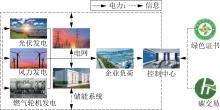
Fig.1
Basic operating modes of system
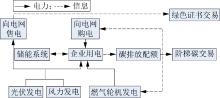
Fig.2
Schematic diagram of RECT-SCT mechanism
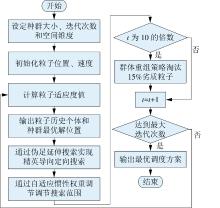
Fig.3
Model solution flowchart
Table 1
Parameters of APO-PSO algorithm
| 参数 | 参数值 | 功能说明 |
|---|---|---|
| 种群规模N | 100 | 平衡计算效率与搜索能力 |
| 最大迭代次数Imax | 500 | 确保充分收敛 |
| 初始惯性权重ω | 0.9 | 控制历史速度影响 |
| 个体学习因子c1 | 2.0 | 调节个体经验导向 |
| 群体学习因子c2 | 2.0 | 调节群体经验导向 |
| 伪足延伸比例 | 0.4 | 每代执行延伸操作的粒子比例 |
| 延伸强度系数 | 0.3 | 控制伪足搜索范围 |
| 重组比例Nworst | 0.15 | 淘汰劣质粒子比例 |
| 重组周期 | 10 | 维持种群多样性间隔 |
Table 2
Grid time-of-use electricity prices
| 时段类型 | 时段 | 购电电价 | 售电电价 |
|---|---|---|---|
| 峰 | 10:00 —15:00;17:00 —22:00 | 1.2 | 0.6 |
| 平 | 07:00 —10:00;15:00 —17:00 22:00 —24:00 | 0.8 | 0.4 |
| 谷 | 00:00 —07:00 | 0.5 | 0.3 |
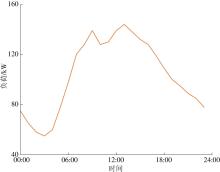
Fig.4
System electrical load
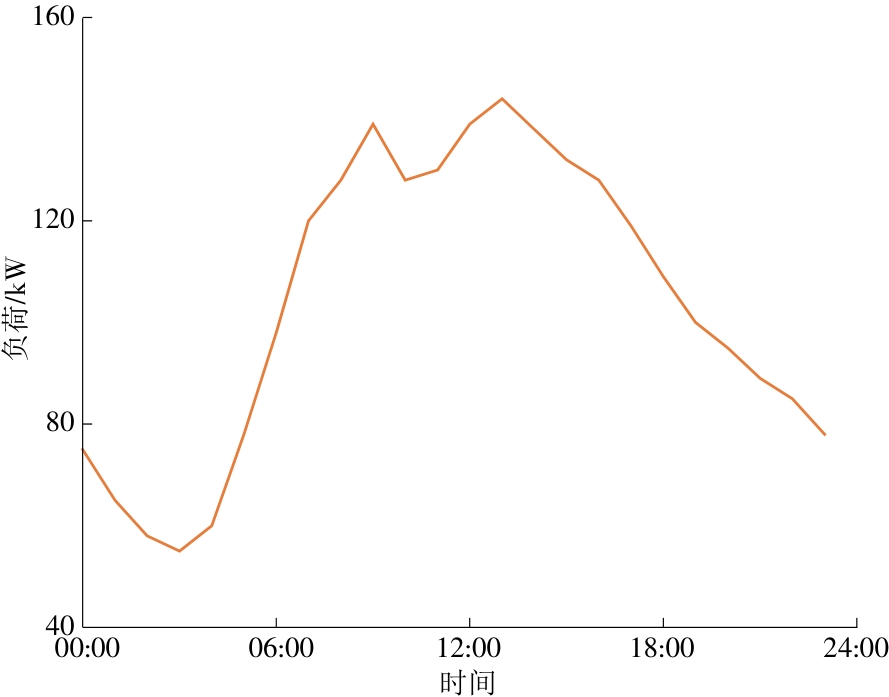
Fig.5
Generation results of typical photovoltaic power output scenarios
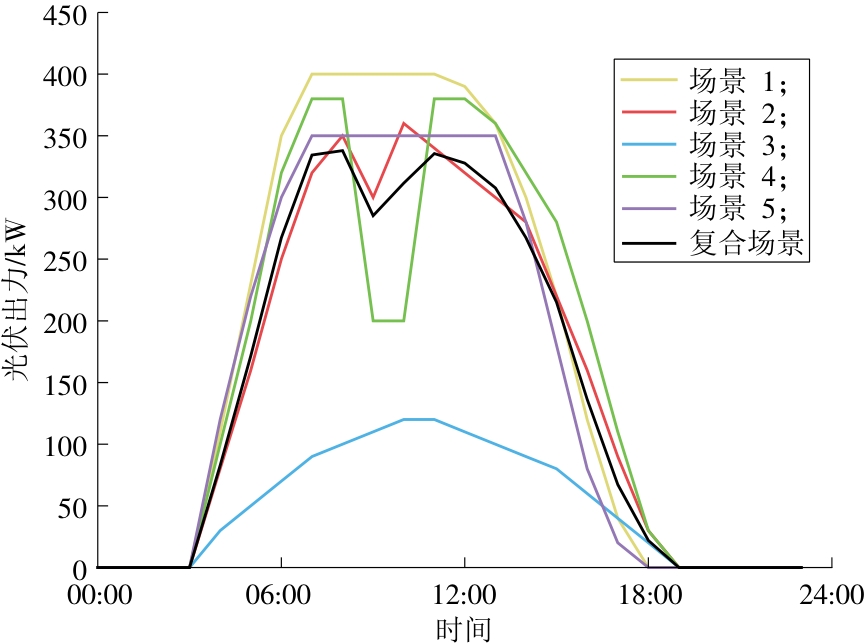
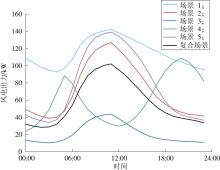
Fig.6
Generation results of typical wind power output scenarios
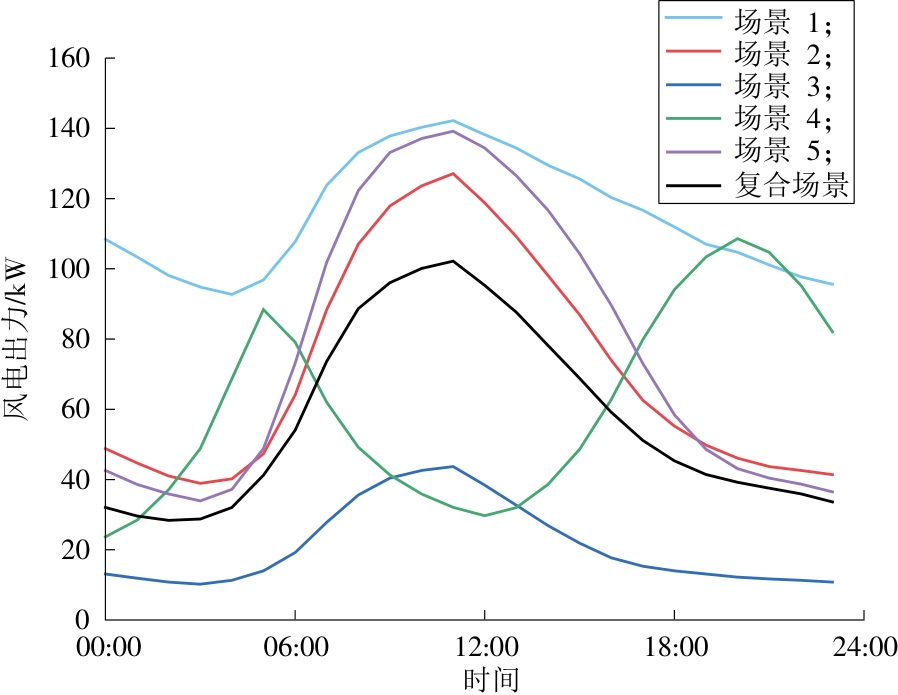
Table 3
Probabilities of typical scenarios
| 场景 | 光伏发电场景概率 | 风力发电场景概率 |
|---|---|---|
| 1 | 22.3 | 15.2 |
| 2 | 34.7 | 31.6 |
| 3 | 17.6 | 23.5 |
| 4 | 15.3 | 12.4 |
| 5 | 10.1 | 17.3 |
Table 4
Typical scenarios design
| 情景 | CET | SCT | RECT |
|---|---|---|---|
| 1 | × | × | × |
| 2 | √ | × | × |
| 3 | × | √ | × |
| 4 | √ | × | √ |
| 5 | × | √ | √ |
Table 5
Solution results of different algorithms under scenario 5
| 求解方法 | 净收益/元 | 可再生能源发 电弃电率/% | 碳排放量/kg |
|---|---|---|---|
| APO-PSO | 693.57 | 1.74 | 280.48 |
| APO | 453.14 | 3.44 | 539.29 |
| PSO | 517.16 | 2.65 | 417.50 |
| GA | 488.64 | 3.01 | 440.11 |
Fig.7
Convergence curves of four algorithms
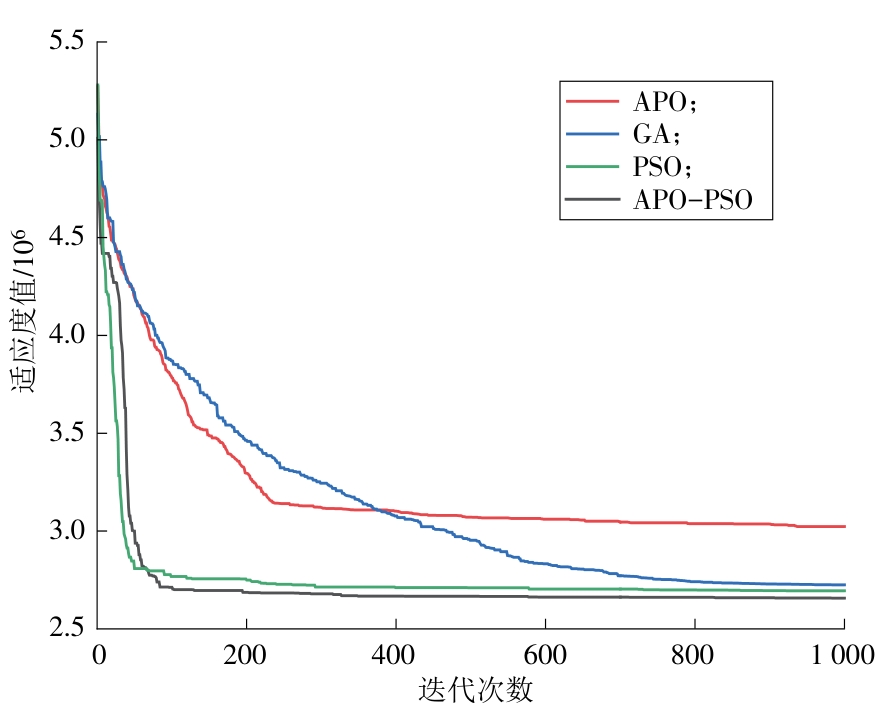
Table 6
Operation results of five scenarios
| 情景 | 净收益/元 | 燃气轮机运行成本/元 | 可再生能源发电运维成本/元 | 可再生能源发电弃电罚金/元 | 储能系统运维成本/元 | 购电成 本/元 | 售电收益/元 | CET收益/元 | SCT收益/元 | RECT收益/元 | 可交易REC占比/% |
|---|---|---|---|---|---|---|---|---|---|---|---|
| 1 | 254.88 | 99.55 | 768.97 | 3.95 | 21.54 | 147.17 | 1 296.06 | ||||
| 2 | 465.02 | 72.95 | 768.97 | 3.24 | 31.08 | 151.29 | 1 314.40 | 178.15 | |||
| 3 | 545.13 | 66.55 | 768.97 | 3.12 | 36.09 | 166.72 | 1 334.17 | 252.41 | |||
| 4 | 581.61 | 57.12 | 768.97 | 2.68 | 35.34 | 170.29 | 1 339.52 | 191.97 | 84.52 | 59.40 | |
| 5 | 693.57 | 34.11 | 768.97 | 1.93 | 33.30 | 183.63 | 1 363.50 | 262.41 | 89.60 | 62.97 |
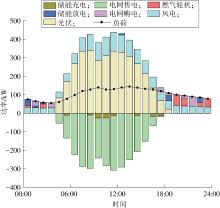
Fig.8
Optimal scheduling results of scenario 1
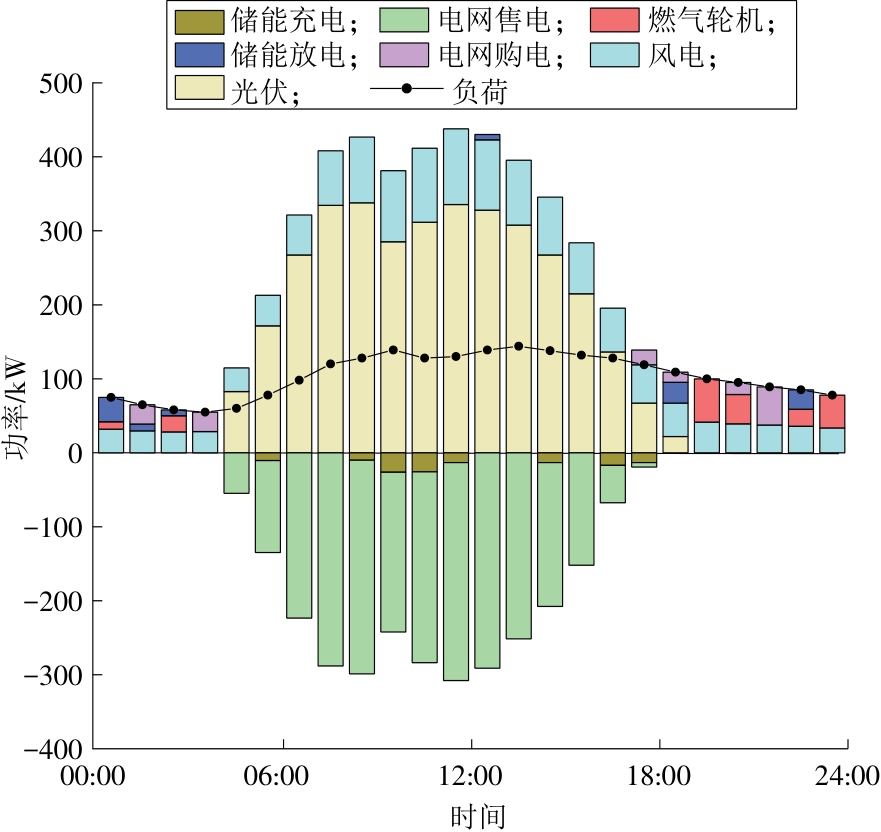
Fig.9
Optimal scheduling results of scenario 5
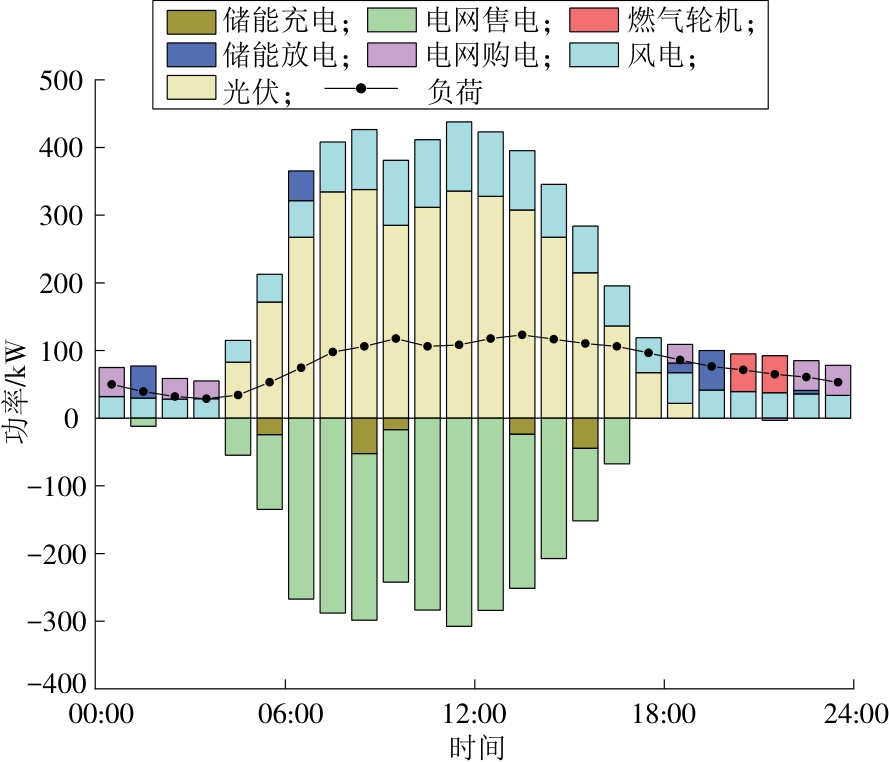
Table 7
Carbon emissions of five scenarios
| 情景 | 碳排放量 |
|---|---|
| 1 | 422.50 |
| 2 | 387.40 |
| 3 | 331.64 |
| 4 | 332.12 |
| 5 | 280.48 |
Table 8
Economic benefits
| 情景 | 碳交易收益 | SCT收益 | RECT收益 | 净收益 |
|---|---|---|---|---|
| 1 | 254.88 | |||
| 2 | 178.15 | 464.02 | ||
| 3 | 252.41 | 544.53 | ||
| 4 | 191.97 | 84.52 | 581.61 | |
| 5 | 262.41 | 89.60 | 693.57 |
| [1] |
谭甲群, 吕如轩, 鞠洪晋, 等. 基于改进秃鹰搜索算法的风光火储综合能源系统优化调度策略研究[J]. 综合智慧能源, 2025, 47(8): 68-76.
doi: 10.3969/j.issn.2097-0706.2025.08.008 |
|
TAN Jiaqun, LYU Ruxuan, JU Hongjin, et al. Research on optimal scheduling strategy of wind-photovoltaic-thermal-storage integrated energy system based on IBES[J]. Integrated Intelligent Energy, 2025, 47(8): 68-76.
doi: 10.3969/j.issn.2097-0706.2025.08.008 |
|
| [2] |
叶青海. “双碳”目标下协同推进能源结构调整与新质生产力形成的策略研究[J]. 工业技术经济, 2025, 44(7): 69-77.
doi: 10.3969/j.issn.1004-910X.2025.07.007 |
| YE Qinghai. Research on the strategy of collaborative promotion of energy structure adjustment and formation of new quality productivity under the "dual carbon" goal[J]. Journal of Industrial Technology and Economy, 2025, 44(7): 69-77. | |
| [3] |
王放放, 杨鹏威, 赵光金, 等. 新型电力系统下火电机组灵活性运行技术发展及挑战[J]. 发电技术, 2024, 45(2): 189-198.
doi: 10.12096/j.2096-4528.pgt.23079 |
|
WANG Fangfang, YANG Pengwei, ZHAO Guangjin, et al. Development and challenge of flexible operation technology of thermal power units under new power system[J]. Power Generation Technology, 2024, 45(2): 189-198.
doi: 10.12096/j.2096-4528.pgt.23079 |
|
| [4] |
窦翔, 李卓群, 张哲, 等. 基于CNN-BiLSTM-RF-KDE的综合能源系统负荷预测[J]. 综合智慧能源, 2025, 47(9): 60-70.
doi: 10.3969/j.issn.2097-0706.2025.09.007 |
|
DOU Xiang, LI Zhuoqun, ZHANG Zhe, et al. Load forecasting for integrated energy systems based on CNN-BiLSTM-RF-KDE[J]. Integrated Intelligent Energy, 2025, 47(9): 60-70.
doi: 10.3969/j.issn.2097-0706.2025.09.007 |
|
| [5] | 高放, 姚浩天, 高庆, 等. 考虑参数共享的深度强化学习双阶段分布式电源优化[J]. 中国电机工程学报, 2025, 45(19): 7493-7509. |
| GAO Fang, YAO Haotian, GAO Qing, et al. Two-stage distributed generators optimization based on deep reinforcement learning with parameter sharing[J]. Proceedings of the CSEE, 2025, 45(19): 7493-7509. | |
| [6] |
马彦宏, 吕清泉, 张珍珍, 等. 考虑储能系统SOC的双卡尔曼滤波风电功率波动平抑策略[J]. 综合智慧能源, 2023, 45(2): 61-68.
doi: 10.3969/j.issn.2097-0706.2023.02.008 |
|
MA Yanhong, LYU Qingquan, ZHANG Zhenzhen, et al. Wind power fluctuation mitigation strategy based on double Kalman filter considering the SOC of the energy storage system[J]. Integrated Intelligent Energy, 2023, 45(2): 61-68.
doi: 10.3969/j.issn.2097-0706.2023.02.008 |
|
| [7] | ZHOU B, LYU L, GAO H J, et al. Robust day-ahead trading strategy for multiple virtual power plants[J]. Power System Technology, 2018, 42 (8): 2694-2703. |
| [8] | 周博, 吕林, 高红均, 等. 多虚拟电厂日前鲁棒交易策略研究[J]. 电网技术, 2018, 42(8):2694-2703. |
| ZHOU Bo, LYU Lin, GAO Hongjun, et al. Robust day-ahead trading strategy for multiple virtual power plants[J]. Power System Technology, 2018, 42(8):2694-2703. | |
| [9] |
WANG S X, YUAN S C. Interval optimization for integrated electrical and natural-gas systems with power to gas considering uncertainties[J]. International Journal of Electrical Power & Energy Systems, 2020, 119: 105906.
doi: 10.1016/j.ijepes.2020.105906 |
| [10] |
ZENG L J, XU J Z, WU M, et al. Day-ahead interval optimization for CCHP system considering uncertainty of wind power and PV[J]. International Journal of Electrical Power & Energy Systems, 2022, 138: 107895.
doi: 10.1016/j.ijepes.2021.107895 |
| [11] |
CHENG Z P, JIA D Q, LI Z W, et al. Multi-time scale dynamic robust optimal scheduling of CCHP microgrid based on rolling optimization[J]. International Journal of Electrical Power & Energy Systems, 2022, 139: 107957.
doi: 10.1016/j.ijepes.2022.107957 |
| [12] | 王淏, 王润铸, 谢开贵, 等. 新能源电力系统能量-网损-备用协同决策下的交流潮流嵌入式节点边际定价方法[J/OL]. 中国电机工程学报,1-16(2025-08-12)[2025-08-20].https://doi.org/10.13334/j.0258-8013.pcsee. |
| 250736. WANG Hao, WANG Runzhu, XIE Kaigui, et al. AC power flow embedded locational marginal pricing method under synergistic decision-making of energy, network loss and reserve in new energy power systems[J/OL]. Proceedings of the CSEE, 1-16(2025-08-12)[2025-08-20].https://doi.org/10.13334/j.0258-8013.pcsee.250736. | |
| [13] | 高锋阳, 裴淑萍, 李龙, 等. 基于改进生成对抗网络的可控可解释性风光场景生成方法[J/OL]. 电力自动化设备,1-12(2025-08-15)[2025-08-20].https://doi.org/10.16081/j.epae.202508010. |
| GAO Fengyang, PEI Shuping, LI Long, et al. Controllable and interpretable wind-solar scenario generation method based on improved generative adversarial network[J/OL]. Electric Power Automation Equipment,1-12(2025-08-15)[2025-08-20].https://doi.org/10.16081/j.epae.202508010. | |
| [14] | 傅国斌, 杨凯璇, 孙海斌, 等. 低惯量电力系统频率安全约束优化运行研究综述与展望[J]. 中国电力, 2025, 58(9): 148-163. |
| FU Guobin, YANG Kaixuan, SUN Haibin, et al. Frequency security constrained optimal operation of low-inertia power systems: review and prospects[J]. Electric Power, 2025, 58(9): 148-163. | |
| [15] | 袁桂丽, 杨彪, 丁宁, 等. 考虑综合需求响应和阶梯型碳交易的综合能源系统协调优化调度[J]. 现代电力, 2025, 42(4): 659-668. |
| YUAN Guili, YANG Biao, DING Ning, et al. Coordinated and optimized dispatching of integrated energy system considering integrated demand response and ladder-type carbon trading[J]. Modern Electric Power, 2025, 42(4): 659-668. | |
| [16] | 杨顺顺. 碳排放权和用能权交易双重试点市场政策效应评估[J]. 生态与农村环境学报,1-15(2025-07-08)[2025-08-20].https://www.ere.ac.cn/article/doi/10.19741/j.issn.1673-4831.2025.0321.https://www.ere.ac.cn/article/doi/10.19741/j.issn.1673-4831.2025.0321. |
| YANG Shunshun. Policy effect evaluation of dual pilot markets for carbon emission rights and energy use rights trading[J]. Journal of Ecology and Rural Environment,1-15(2025-07-08)[2025-08-20].https://www.ere.ac.cn/article/doi/10.19741/j.issn.1673-4831.2025.0321.https://www.ere.ac.cn/article/doi/10.19741/j.issn.1673-4831.2025.0321. | |
| [17] |
LUO Z, MA S L, LIU D W, et al. Non-cooperative game optimization of coal mine integrated energy system considering energy-carbon-green certificates coupling trading[J]. Journal of Cleaner Production, 2025, 520: 146072.
doi: 10.1016/j.jclepro.2025.146072 |
| [18] |
WANG B K, LI C H, BAN Y S, et al. A multi-market equilibrium model considering the carbon-green certificate mutual recognition trading mechanism under the electricity market[J]. Energy, 2025, 330: 136902.
doi: 10.1016/j.energy.2025.136902 |
| [19] |
PAN Y S, GUO X Y, YANG S B, et al. A two-stage optimal dispatch model for wind-storage-carbon capture power plants considering carbon emission and green certificate trading[J]. Energy, 2025, 332: 137192.
doi: 10.1016/j.energy.2025.137192 |
| [20] |
CHEN H P, WU H, LI H L, et al. Bi-level optimal scheduling of integrated energy systems considering incentive-based demand response and green certificate-carbon trading mechanisms[J]. Energy Reports, 2025, 13: 330-344.
doi: 10.1016/j.egyr.2024.12.016 |
| [21] |
WANG X Y, CHEN H, TONG X, et al. Optimal scheduling of a multi-energy complementary system simultaneously considering the trading of carbon emission and green certificate[J]. Energy, 2024, 310: 133212.
doi: 10.1016/j.energy.2024.133212 |
| [22] |
GAO J, SHAO Z G, CHEN F X, et al. Multi-energy trading strategies for integrated energy systems based on low-carbon and green certificate[J]. Electric Power Systems Research, 2025, 238: 111120.
doi: 10.1016/j.epsr.2024.111120 |
| [23] |
JIANG H, LIU X Y, ZHOU H, et al. Multi-time-scale optimal scheduling strategy of electricity-heat-cold-gas integrated energy system considering ladder carbon trading[J]. Energy Reports, 2025, 13: 4000-4014.
doi: 10.1016/j.egyr.2025.03.040 |
| [24] | 国家能源局. 可再生能源绿色电力证书核发和交易规则(国能发新能规〔2024〕67号)[A/OL]. 2024, https://zfxxgk.nea.gov.cn/2024-08/26/c_1310785819.htm. |
| [25] |
JU L W, TAN Q L, ZHAO R, et al. Multi-objective electro-thermal coupling scheduling model for a hybrid energy system comprising wind power plant, conventional gas turbine, and regenerative electric boiler, considering uncertainty and demand response[J]. Journal of Cleaner Production, 2019, 237: 117774.
doi: 10.1016/j.jclepro.2019.117774 |
| [26] |
SHEHAB M. Artificial protozoa optimizer: A bio-inspired metaheuristic for complex engineering optimization[J]. Results in Engineering, 2025, 27: 106883.
doi: 10.1016/j.rineng.2025.106883 |
| [27] |
ZHANG L, LIU D Y, CAI G W, et al. An optimal dispatch model for virtual power plant that incorporates carbon trading and green certificate trading[J]. International Journal of Electrical Power & Energy Systems, 2023, 144: 108558.
doi: 10.1016/j.ijepes.2022.108558 |
| [28] | 张高, 王旭, 蒋传文, 等. 采用双层优化调度的虚拟电厂经济性分析[J]. 电网技术, 2016, 40(8): 2295-2301. |
| ZHANG Gao, WANG Xu, JIANG Chuanwen, et al. Economic analysis of virtual power plants based on bi-level optimization dispatch[J]. Power System Technology, 2016, 40(8): 2295-2301. | |
| [29] | 蔡昌春, 何瑶瑶, 石庆伦, 等. 考虑绿证-碳交易与需求响应的含氢IES低碳优化调度[J]. 电力工程技术, 2025(3):43-52. |
| CAI Changchun, HE Yaoyao, SHI Qinglun, et al. Low-carbon optimal dispatching of hydrogen-containing IES considering joint green certificate-carbon emission trading and demand response[J]. Electric Power Engineering Technology, 2025(3): 43-52. |
| [1] | TAN Jiaqun, LYU Ruxuan, JU Hongjin, HONG Chunxue, XIAO Haiping, LEI Jing, HAN Zhenxing. Research on optimal scheduling strategy of wind-photovoltaic-thermal-storage integrated energy system based on IBES [J]. Integrated Intelligent Energy, 2025, 47(8): 68-76. |
| [2] | XING Zuoxia, ZHAO Ziyi, SUN Hao, ZHANG Pengfei, FU Qitong. Research on low-carbon economic operation optimization of integrated energy systems based on multi-level utilization of hydrogen production from electricity [J]. Integrated Intelligent Energy, 2025, 47(7): 71-81. |
| [3] | JI Bin, LI Yonggang, CHANG Li, QIAN Juan, TU Shanshan. Analysis of the linkage of carbon-electricity market mechanism under China's "carbon control" trend [J]. Integrated Intelligent Energy, 2025, 47(5): 1-11. |
| [4] | ZENG Haozheng, YIN Linfei. Research on multi-objective optimal economic dispatch of power systems based on NSMFO-BERT algorithm [J]. Integrated Intelligent Energy, 2025, 47(4): 98-106. |
| [5] | YANG Jian, HAO Guojie, WU Xinyue, GUO Mingqiang, CHEN Chong, LEI Zhimin. Optimization of travel routes and economic operation strategies for integrated transportation and energy systems considering EV carbon emissions [J]. Integrated Intelligent Energy, 2025, 47(2): 41-49. |
| [6] | WANG Qianrui, RUAN Jingxin, WANG Yueshe. Economic optimal scheduling of electricity-hydrogen coordinated energy storage system considering spatiotemporal correlation of wind and photovoltaic power outputs [J]. Integrated Intelligent Energy, 2025, 47(12): 34-45. |
| [7] | LIU Ziteng, ZHAO Jianli, TAO Weijian, SHEN Cong, AI Qian. Distributed energy management strategy for smart buildings based on V2B technology [J]. Integrated Intelligent Energy, 2025, 47(11): 24-35. |
| [8] | HU Jiacheng, ZHANG Ning, CAO Yutong, HU Cungang. Load optimization scheduling decision for virtual power plants with distributed energy accessed [J]. Integrated Intelligent Energy, 2025, 47(1): 62-69. |
| [9] | FAN Yanbo, XIONG Yaxuan, LI Xiang, TIAN Xi, YANG Yang. Advancement in multi-objective optimization for building energy use based on genetic algorithms [J]. Integrated Intelligent Energy, 2024, 46(9): 69-85. |
| [10] | LI Feifei, XU Huiwei, CUI Jindong. Research on the influencing factors of carbon emissions from petrochemical industry in Jilin Province based on the STIRPAT model [J]. Integrated Intelligent Energy, 2024, 46(8): 12-19. |
| [11] | LI Mingyang, DOU Mengyuan. Optimal scheduling of virtual power plants integrating electric vehicles based on reinforcement learning [J]. Integrated Intelligent Energy, 2024, 46(6): 27-34. |
| [12] | LI Yun, ZHOU Shijie, HU Zheqian, LIANG Junyuan, XIAO Leiming. Optimal scheduling of integrated energy systems based on NSGA-Ⅱ-WPA [J]. Integrated Intelligent Energy, 2024, 46(4): 1-9. |
| [13] | WEI Xikai, TAN Xiaoshi, LIN Ming, CHENG Junjie, XIANG Keqi, DING Shuxin. Calculation and prediction of carbon emission factors for the national power grid from 2005 to 2035 [J]. Integrated Intelligent Energy, 2024, 46(3): 72-78. |
| [14] | KONG Huichao, WANG Wenzhong, LEI Yi, PENG Jing, LI Haibo. Electric power and energy rebalancing method for new power systems at receiving ends of industrial parks [J]. Integrated Intelligent Energy, 2024, 46(2): 68-74. |
| [15] | ZHEN Xiaofei, LI Shang'e, ZHANG Yongheng, JIAO Ruonan, WU Wenbing. Research on multi-objective optimization of envelope structures for nearly zero-energy buildings in Northwest China [J]. Integrated Intelligent Energy, 2024, 46(12): 81-90. |
| Viewed | ||||||
|
Full text |
|
|||||
|
Abstract |
|
|||||