综合智慧能源 ›› 2026, Vol. 48 ›› Issue (2): 27-36.doi: 10.3969/j.issn.2097-0706.2026.02.003
崔向虎1( ), 徐越飞1(), 戚佳金1(), 张静1(), 陈世喆1(), 李金诺2,*()
收稿日期:2025-09-22
修回日期:2025-10-24
出版日期:2026-02-25
通讯作者:
*李金诺(1997),男,硕士生,从事配电网运行状态监测与故障识别方法等方面研究,lijinnuo12@163.com。作者简介:崔向虎(1978),男,高级工程师,从事计算机应用、电力新能源通信设备、控制理论方面的研究,99522570@qq.com;
CUI Xianghu1(), XU Yuefei1(), QI Jiajin1(), ZHANG Jing1(), CHEN Shizhe1(), LI Jinnuo2,*()
Received:2025-09-22
Revised:2025-10-24
Published:2026-02-25
摘要:
针对配电网故障辨识过程中故障特征易被噪声掩盖,单一特征难以全面反映故障信息等问题,提出了一种多源特征融合去噪网络的配电网故障辨识方法。利用离散小波变换(DWT)对归一化处理后的零序电压与三相电流信号进行多尺度分解,将原始信号重构为高频与低频分量,减少特征混叠的影响。然后,在高频分支中构建时频残差自适应去噪模块,嵌入傅里叶卷积,提取具有丰富频域信息的高频特征,并结合通道注意力机制,实现信号的精准去噪;在低频分支中,设计轻量级卷积网络提取低频分量的时序特征,增强时频信息互补。引入一种时序-通道注意力机制进行自适应特征融合,增强特征提取能力的同时抑制冗余特征,从而实现复杂工况下故障类型的精确诊断。试验结果表明,所提方法在仿真数据集下取得99.12%的准确率,相较于现有方法显著提高了故障辨识的准确率。
中图分类号:
崔向虎, 徐越飞, 戚佳金, 张静, 陈世喆, 李金诺. 基于多源特征融合去噪网络的配电网故障辨识方法研究[J]. 综合智慧能源, 2026, 48(2): 27-36.
CUI Xianghu, XU Yuefei, QI Jiajin, ZHANG Jing, CHEN Shizhe, LI Jinnuo. Research on distribution network fault identification method based on multi-source feature fusion denoising network[J]. Integrated Intelligent Energy, 2026, 48(2): 27-36.

图1
一维傅里叶卷积结构 (1)将高频信号输入至卷积核尺寸为3×3的卷积层中,利用激活函数ReLU以及批量归一化处理(BN)进行非线性变换,得到初步特征Xconv。

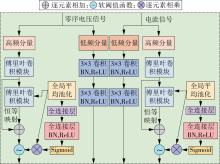
图2
时频残差自适应去噪模块
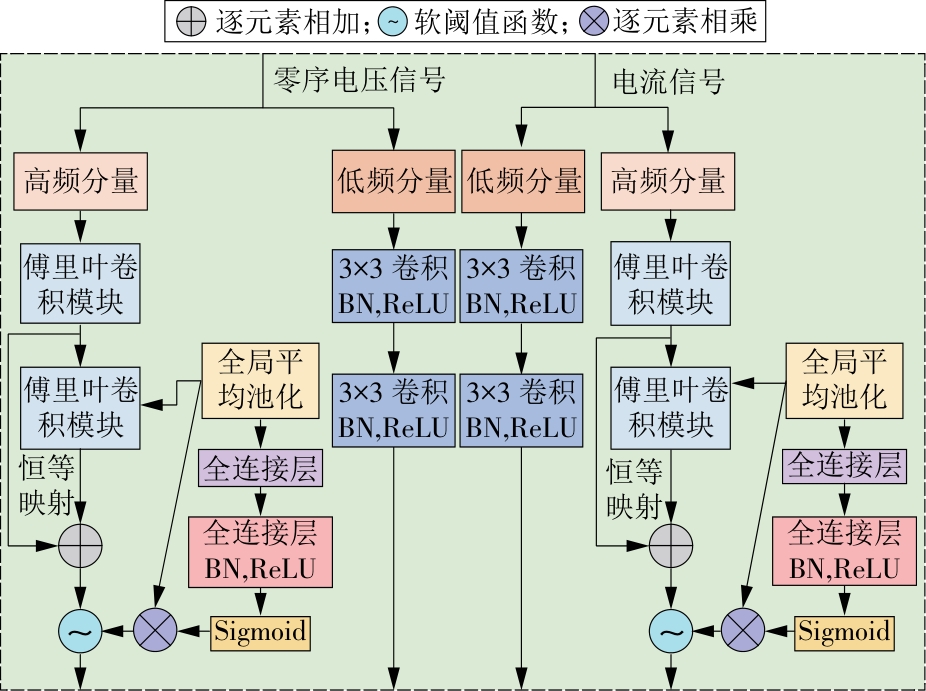
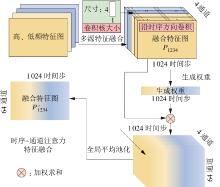
图3
时序-通道注意力机制
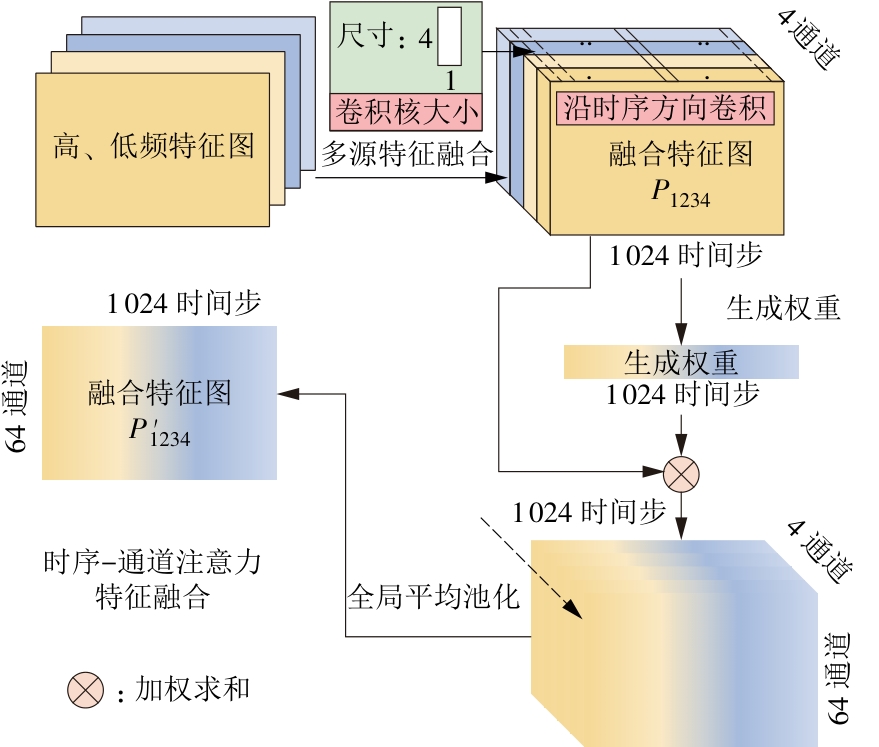
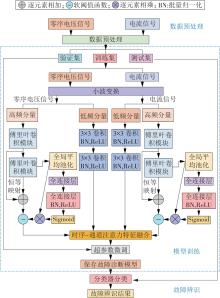
图4
配电网故障辨识总体框架
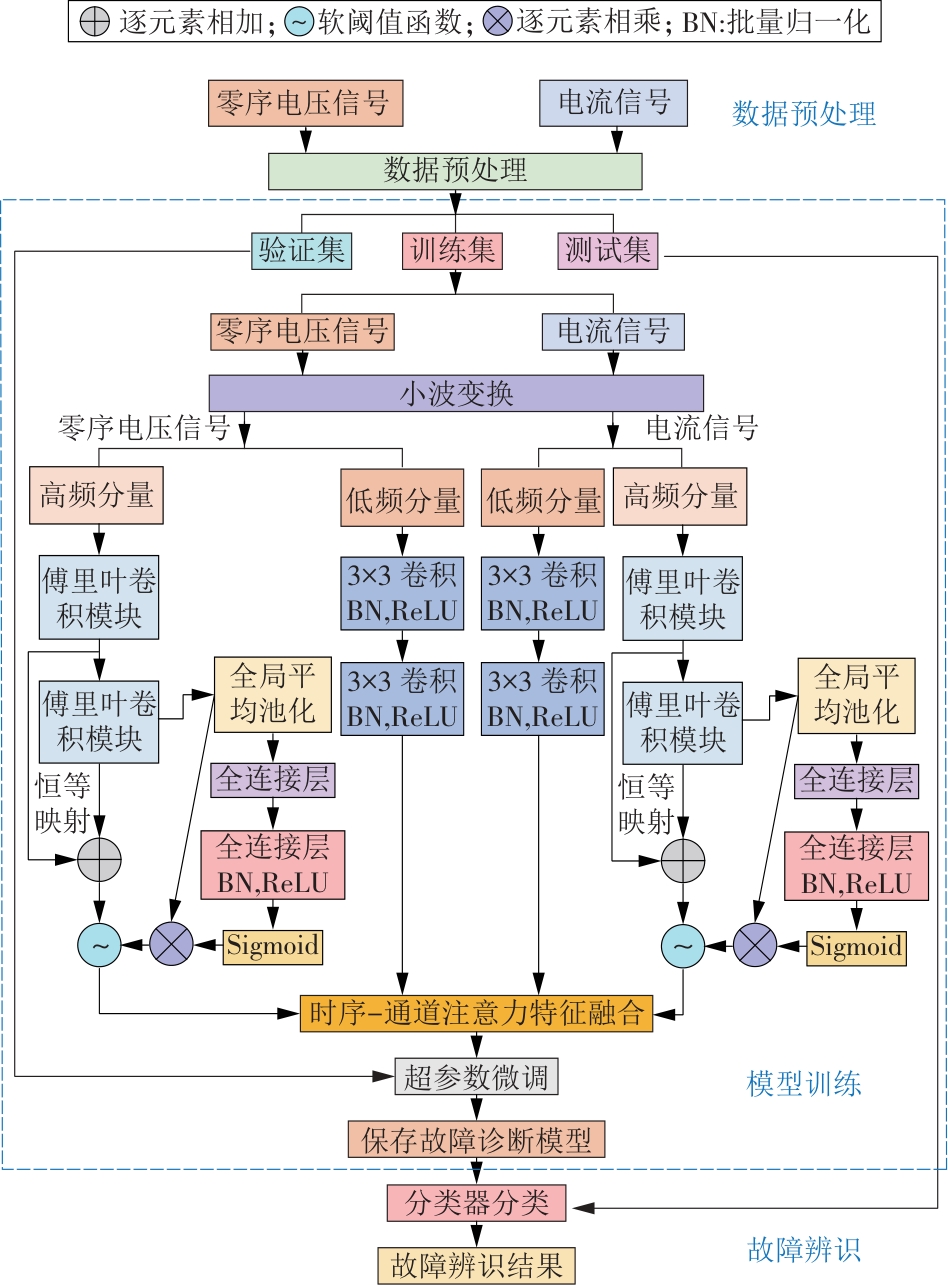
表1
分类器结构
| 网络结构 | 激活函数 | 输出形状 |
|---|---|---|
| 线性层 1 | 128 | |
| 线型层 2 | 32 | |
| 线性层 3 | Softmax | 10 |
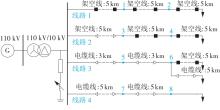
图5
10 kV配电网系统拓扑结构
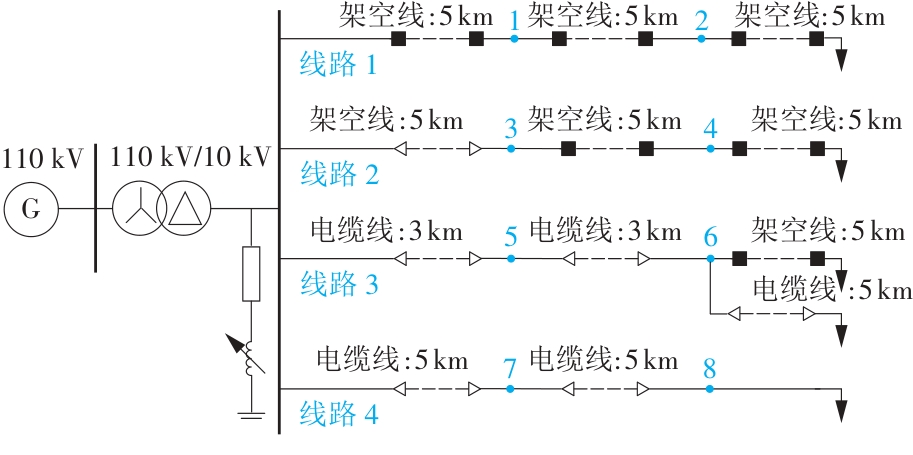
表2
故障样本参数设置
| 标签 | 故障类型 | 时间步长 | 故障阻抗/Ω | 初始相位角/(°) |
|---|---|---|---|---|
| AG | A相接地 | 1 024 | 0.01,50,100,200,300,500,1 000 | 0,30,60,90,120,150,180 |
| BG | B相接地 | |||
| CG | C相接地 | |||
| AB | AB相短路 | |||
| AC | AC相短路 | |||
| BC | BC相短路 | |||
| ABG | AB相接地 | |||
| ACG | AC相接地 | |||
| BCG | BC相接地 | |||
| ABC | ABC相短路 |
表3
网络模型参数设置
| 参数 | 批次大小 | 学习率 | 迭代次数 |
|---|---|---|---|
| 数值 | 36 | 0.001 | 50 |
图6
模型训练结果分析
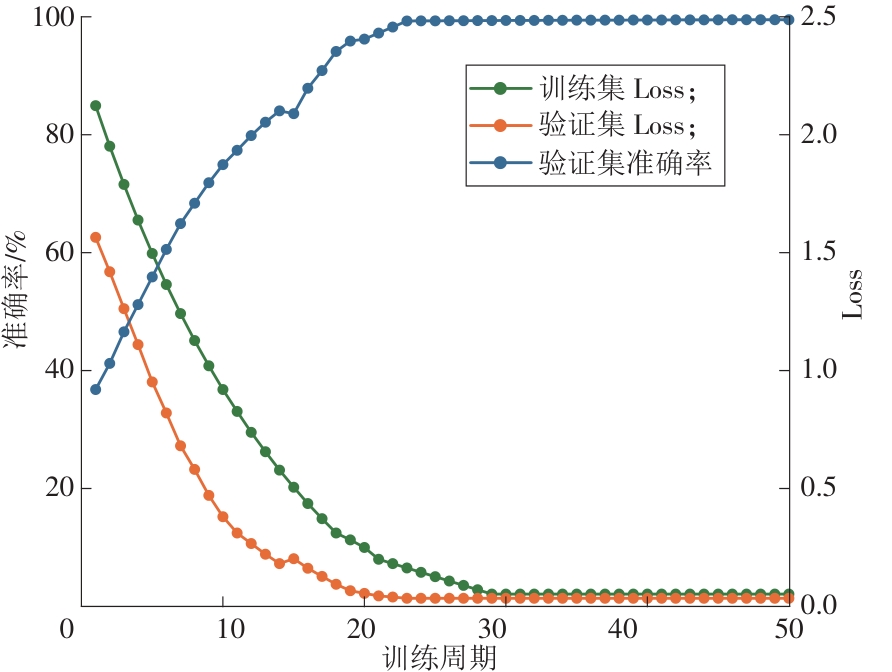
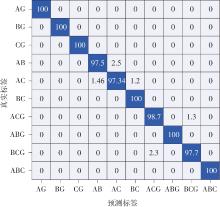
图7
各类故障准确率混淆矩阵
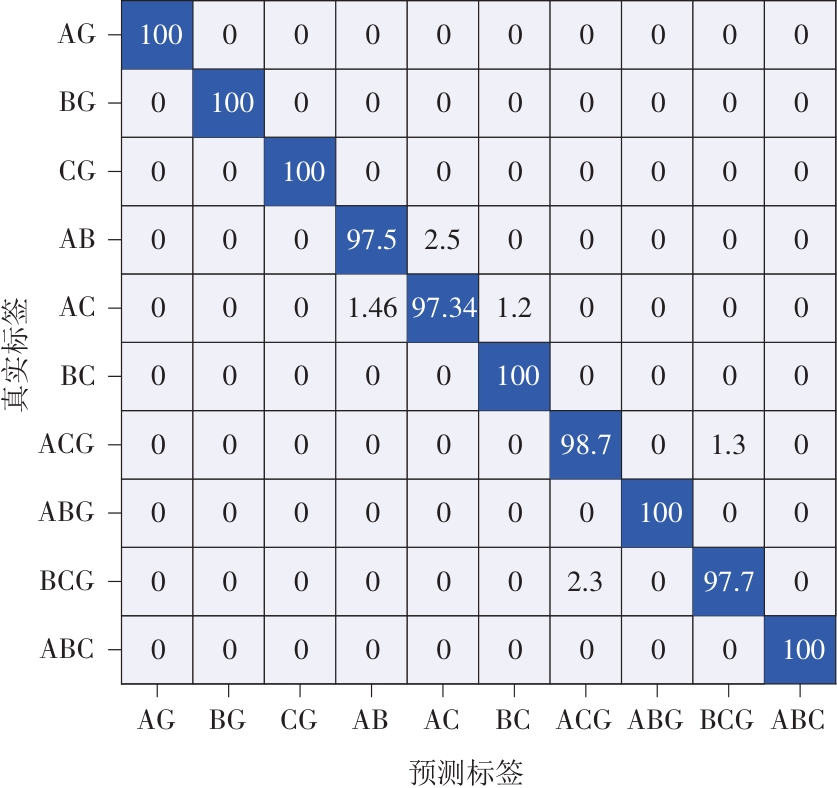
图8
50次迭代后的分类特征可视化
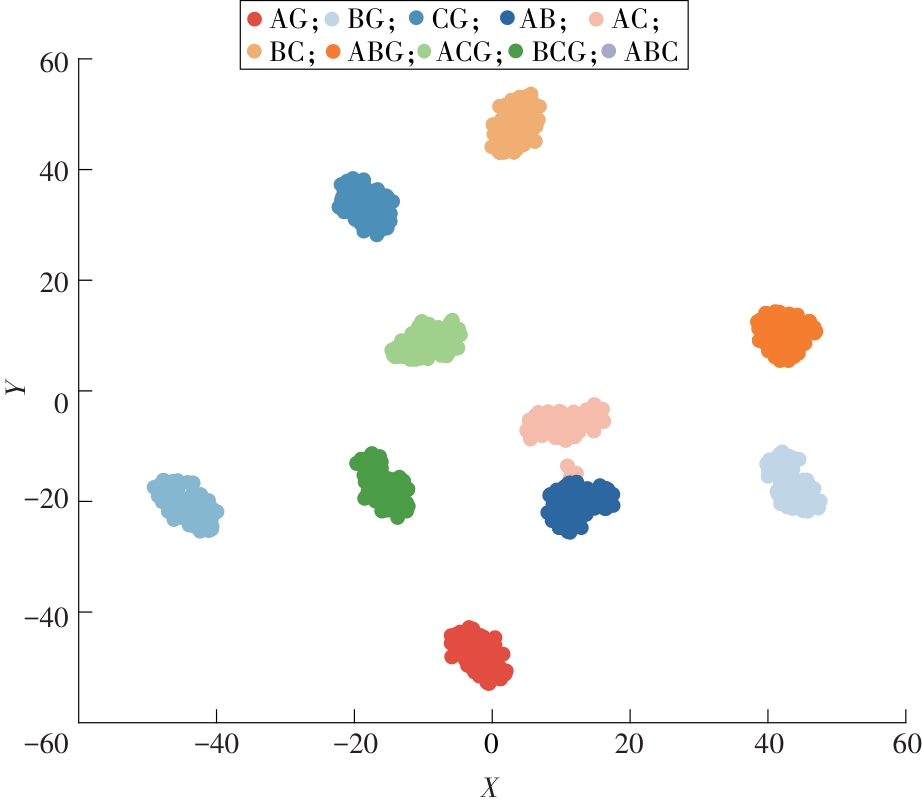
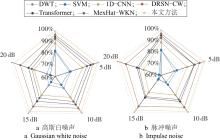
图9
不同方法在噪声环境下的识别性能
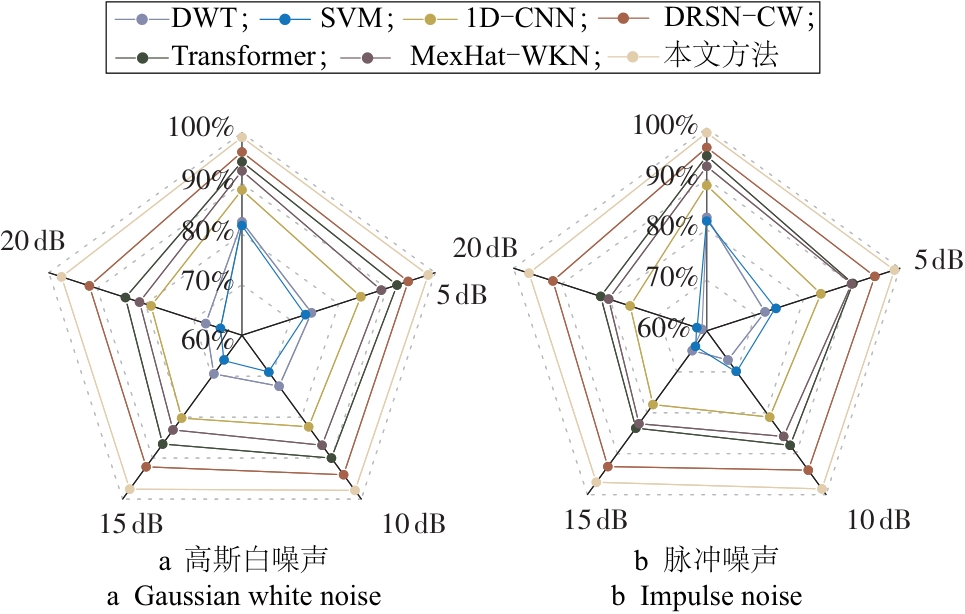
表4
多源特征融合去噪网络消融试验结果
| 方案 | DWT | 注意力机制 | 准确率/% |
|---|---|---|---|
| 1 | √ | TCA | 99.12 |
| 2 | TCA | 96.35 | |
| 3 | √ | 95.55 | |
| 4 | √ | SE | 97.20 |
| 5 | √ | ECA | 98.15 |
| 6 | √ | CAM | 97.36 |
表5
不同方法准确率及召回率对比
| 方法 | 准确率 | 召回率 |
|---|---|---|
| DWT | 82.40 | 81.73 |
| SVM | 81.69 | 81.54 |
| 1D-CNN | 88.71 | 88.04 |
| DRSN-CW | 96.21 | 96.10 |
| Trasformer | 94.56 | 94.35 |
| MexHat-WKN | 92.48 | 92.03 |
| 本文方法 | 99.12 | 98.83 |
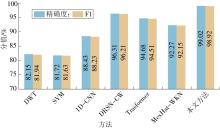
图10
不同方法精度和F1分数
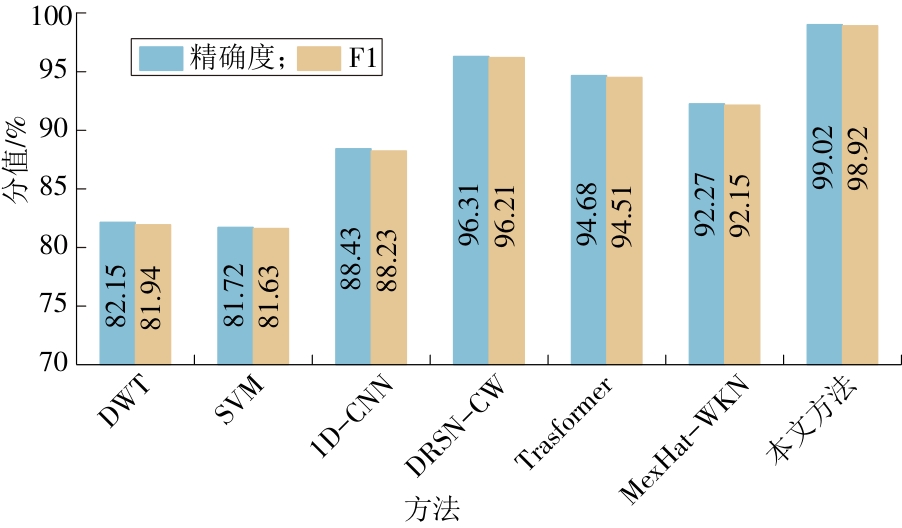
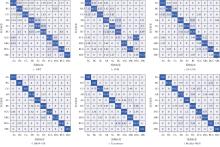
图11
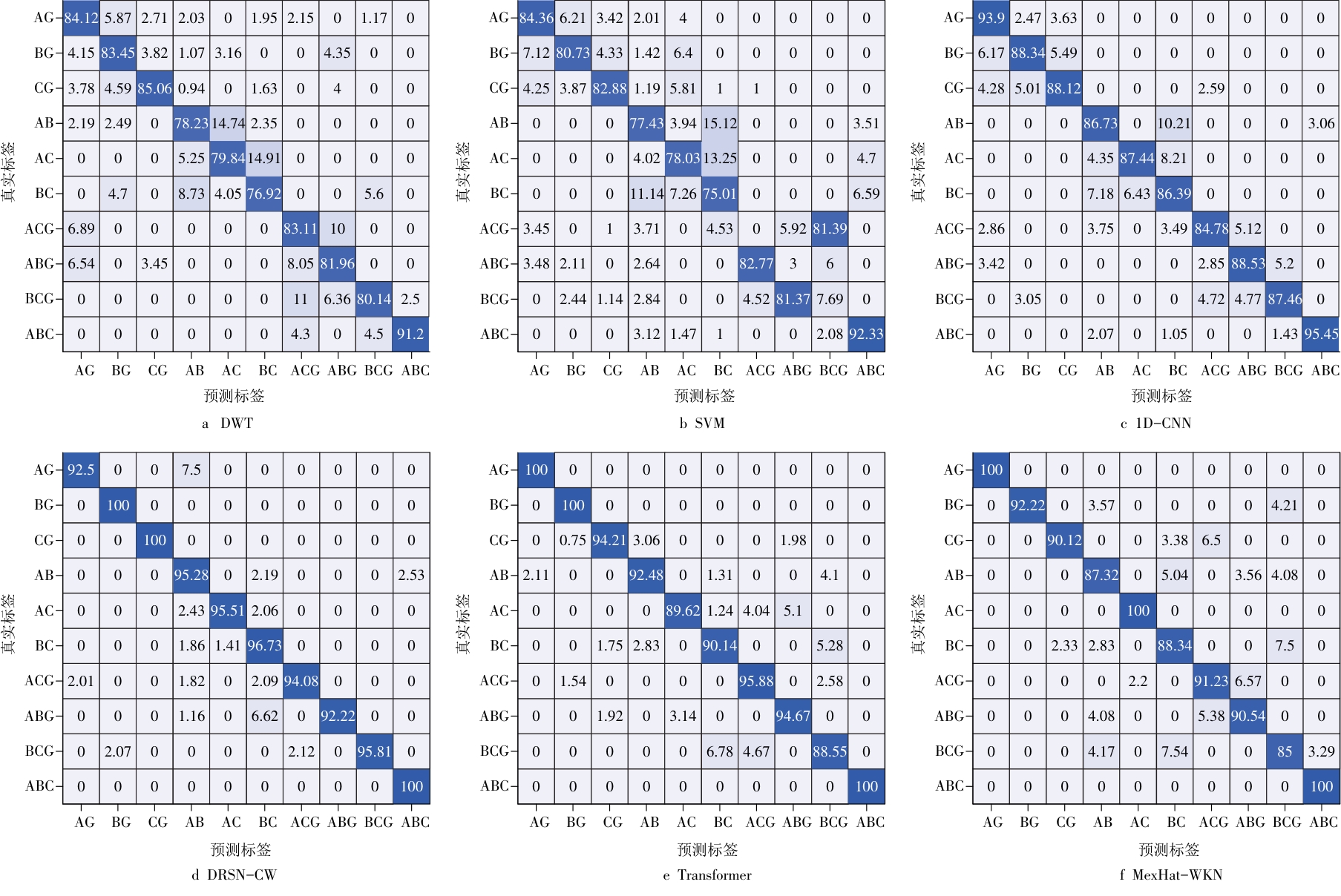
不同方法各故障混淆矩阵
| [1] | 李泽文, 葛俊辰, 陈思旭, 等. 基于VMD-MWPE和PNN的配电网故障分类辨识方法[J]. 江西电力, 2025, 49(3): 28-37. |
| LI Zewen, GE Junchen, CHEN Sixu, et al. Fault classification and identification method of distribution network based on VMD-MWPE and PNN[J]. Jiangxi Electric Power, 2025, 49(3): 28-37. | |
| [2] | 王建, 吴昊, 张博, 等. 不平衡样本下基于迁移学习- AlexNet的输电线路故障辨识方法[J]. 电力系统自动化, 2022, 46(22): 182-191. |
| WANG Jian, WU Hao, ZHANG Bo, et al. Fault identification method for transmission line based on transfer learning-AlexNet with imbalanced samples[J]. Automation of Electric Power Systems, 2022, 46(22): 182-191. | |
| [3] |
WANG J, ZHANG B, YIN D, et al. Distribution network fault comprehensive identification method based on voltage-ampere curves and deep ensemble learning[J]. International Journal of Electrical Power & Energy Systems, 2025, 164: 110403.
doi: 10.1016/j.ijepes.2024.110403 |
| [4] |
RIZEAKOS V, BACHOUMIS A, ANDRIOPOULOS N, et al. Deep learning-based application for fault location identification and type classification in active distribution grids[J]. Applied Energy, 2023, 338: 120932.
doi: 10.1016/j.apenergy.2023.120932 |
| [5] | 李靖鑫, 李旭锋, 杨金东, 等. 非线性负载配电网异常时频电流行波辨识方法[J]. 电子设计工程, 2024, 32(24): 143-146, 151. |
| LI Jingxin, LI Xufeng, YANG Jindong, et al. Nonlinear load distribution network abnormal time-frequency current wave identification method[J]. Electronic Design Engineering, 2024, 32(24): 143-146, 151. | |
| [6] | 庄小艇, 孙蒙恩, 赖天德, 等. 基于负荷波动特征量提取和稳健估计的低压配电网回路阻抗辨识方法[J]. 供用电, 2025, 42(2): 29-37. |
| ZHUANG Xiaoting, SUN Meng'en, LAI Tiande, et al. A low voltage distribution network loop impedance identification method based on load fluctuation feature extraction and robust estimation[J]. Distribution & Utilization, 2025, 42(2): 29-37. | |
| [7] |
GUO M F, YANG N C, YOU L X. Wavelet-transform based early detection method for short-circuit faults in power distribution networks[J]. International Journal of Electrical Power & Energy Systems, 2018, 99: 706-721.
doi: 10.1016/j.ijepes.2018.01.013 |
| [8] |
JI L P, TIAN X L, WEI Z H, et al. Intelligent fault diagnosis in power distribution networks using LSTM-DenseNet network[J]. Electric Power Systems Research, 2025, 239: 111202.
doi: 10.1016/j.epsr.2024.111202 |
| [9] |
SAAD M, KIM C H, MUNIR N. Single-phase auto-reclosing scheme using particle filter and convolutional neural network[J]. IEEE Transactions on Power Delivery, 2022, 37(6): 4775-4785.
doi: 10.1109/TPWRD.2022.3159256 |
| [10] | 叶远波, 王吉文, 邵庆祝, 等. 配电网故障识别Transformer-联邦迁移学习算法设计[J]. 电力系统及其自动化学报, 2025, 37(10): 120-128. |
| YE Yuanbo, WANG Jiwen, SHAO Qingzhu, et al. Design of Transformer-based federated transfer learning algorithm for distribution network fault recognition[J]. Proceedings of the CSU-EPSA, 2025, 37(10): 120-128. | |
| [11] | 梁栋, 赵月梓, 贺国润, 等. 基于图半监督与多任务学习的配电网故障区段与类型统一辨识[J]. 电力系统保护与控制, 2024, 52(12): 25-32. |
| LIANG Dong, ZHAO Yuezi, HE Guorun, et al. Unified identification of fault section and type for distribution networks based on graph semi-supervised and multi-task learning[J]. Power System Protection and Control, 2024, 52(12): 25-32. | |
| [12] |
任一鸣, 杜董生, 邓祥帅, 等. 基于GRU和GWO-KELM的电力线路故障诊断[J]. 综合智慧能源, 2024, 46(3): 54-62.
doi: 10.3969/j.issn.2097-0706.2024.03.007 |
|
REN Yiming, DU Dongsheng, DENG Xiangshuai, et al. Power line fault diagnosis based on GRU and GWO-KELM[J]. Integrated Intelligent Energy, 2024, 46(3): 54-62.
doi: 10.3969/j.issn.2097-0706.2024.03.007 |
|
| [13] |
陈昊蓝, 靳冰莹, 刘亚东, 等. 基于门控循环注意力网络的配电网故障识别方法[J]. 上海交通大学学报, 2024, 58(3): 295-303.
doi: 10.16183/j.cnki.jsjtu.2022.091 |
| CHEN Haolan, JIN Bingying, LIU Yadong, et al. Fault detection in power distribution systems based on gated recurrent attention network[J]. Journal of Shanghai Jiao Tong University, 2024, 58(3): 295-303. | |
| [14] |
IBRAHIM A H M, SADANANDAN S K, GHAOUD T, et al. Incipient fault detection in power distribution networks: Review, analysis, challenges and future directions[J]. IEEE Access, 2024, 12: 112822-112838.
doi: 10.1109/ACCESS.2024.3443252 |
| [15] |
SHALBY E M, ABDELAZIZ A Y, AHMED E S, et al. A comprehensive guide to selecting suitable wavelet decomposition level and functions in discrete wavelet transform for fault detection in distribution networks[J]. Scientific Reports, 2025, 15(1): 1160.
doi: 10.1038/s41598-024-82025-2 |
| [16] |
FAHIM S R, SARKER S K, MUYEEN S M, et al. A deep learning based intelligent approach in detection and classification of transmission line faults[J]. International Journal of Electrical Power & Energy Systems, 2021, 133: 107102.
doi: 10.1016/j.ijepes.2021.107102 |
| [17] |
HAO S, FAN S A, MA X, et al. MKDNet: A fault detection method based on multi-scale entropy mode denoising and collaborative knowledge distillation for distribution networks[J]. Electric Power Systems Research, 2025, 249: 112003.
doi: 10.1016/j.epsr.2025.112003 |
| [18] | 卢晓强, 李刚, 周万竣, 等. 基于最小二乘双支持向量机的配电网短路故障辨识方法研究[J]. 武汉大学学报(工学版), 2022, 55(4): 401-408. |
| LU Xiaoqiang, LI Gang, ZHOU Wanjun, et al. Research on identification method of short-circuit fault in distribution network based on least squares twin support vector machine[J]. Engineering Journal of Wuhan University, 2022, 55(4): 401-408. | |
| [19] | 李政洋, 曹一家, 陈春, 等. 配电网相电压不对称动态变化下的高阻接地故障辨识[J]. 中国电机工程学报, 2024, 44(22): 8744-8759. |
| LI Zhengyang, CAO Yijia, CHEN Chun, et al. Identification of high-impedance ground faults under dynamic variations of voltage unbalance in distribution networks[J]. Proceedings of the CSEE, 2024, 44(22): 8744-8759. | |
| [20] | HU J, SHEN L, SUN G. Squeeze-and-excitation networks[C]// Proceedings of the IEEE Conference on Computer Vision and Pattern Recognition. 2018: 7132-7141. |
| [21] |
冯骥, 杨国华, 史磊, 等. 基于并行融合深度残差收缩网络的有源配电网故障诊断[J]. 综合智慧能源, 2024, 46(6): 8-15.
doi: 10.3969/j.issn.2097-0706.2024.06.002 |
|
FENG Ji, YANG Guohua, SHI Lei, et al. Research on fault diagnosis of active distribution network based on parallel fusion deep residual shrinkage network[J]. Integrated Intelligent Energy, 2024, 46(6): 8-15.
doi: 10.3969/j.issn.2097-0706.2024.06.002 |
|
| [22] | 刘宝稳, 崔露瑶, 曾祥君, 等. 配电网两相接地零序电压空间轨迹区域特征与故障相识别[J/OL]. 电网技术, 2025: 1-15(2025-08-04) [2025-09-22]. https://kns.cnki.net/KCMS/detail/detail.aspx?filename=DWJS20250801007&dbname=CJFD&dbcode=CJFQ. |
| LIU Baowen, CUI Luyao, ZENG Xiangjun, et al. Spatial trajectory characteristics of zero-sequence voltage for two-phase grounding fault and fault phase identification in distribution networks[J/OL]. Power System Technology, 2025: 1-15(2025-08-04) [2025-09-22]. https://kns.cnki.net/KCMS/detail/detail.aspx?filename=DWJS20250801007&dbname=CJFD&dbcode=CJFQ. | |
| [23] | 缪欣, 黄海悦. 基于Δi-PCA原理的分布式小电流接地选线保护方法研究[J]. 机电信息, 2023(4): 76-81. |
| MIAO Xin, HUANG Haiyue. Research on distributed protection method of small current grounding line selection based on Δi-PCA principle[J]. Mechanical and Electrical Information, 2023(4): 76-81. | |
| [24] | 甘捷, 姚孝庭, 于景国, 等. 变频器10 kV断路器柜速断保护动作故障分析及处理[J]. 东北电力技术, 2021, 42(1): 41-43. |
| GAN Jie, YAO Xiaoting, YU Jingguo, et al. Analysis and treatment of Quick-B reak protection fault for 10 kV switchgear in frequency converter[J]. Northeast Electric Power Technology, 2021, 42(1): 41-43. | |
| [25] | CHI L, JIANG B, MU Y. Fast Fourier convolution[J]. Advances in Neural Information Processing Systems, 2020, 33: 4479-4488. |
| [26] |
ATTAR M S, MIVEH M R. High‐impedance fault detection in distribution networks based on support vector machine and wavelet transform approach (Case study: Markazi Province of Iran)[J]. Energy Science & Engineering, 2025, 13(3): 1171-1183.
doi: 10.1002/ese3.v13.3 |
| [27] | 张灵芝, 王杨帆, 刘基典, 等. 电网故障行波传感器研究及测试[J]. 电力科学与技术学报, 2020, 35(2): 142-149. |
| ZHANG Lingzhi, WANG Yangfan, LIU Jidian, et al. Research and experiments on the transmission characteristics of traveling wave sensor for power fault[J]. Journal of Electric Power Science and Technology, 2020, 35(2): 142-149. | |
| [28] |
SIDDIQUE M N I, SHAFIULLAH M, MEKHILEF S, et al. Fault classification and location of a PMU-equipped active distribution network using deep convolution neural network(CNN)[J]. Electric Power Systems Research, 2024, 229: 110178.
doi: 10.1016/j.epsr.2024.110178 |
| [29] |
ZHAO M H, ZHONG S, FU X, et al. Deep residual shrinkage networks for fault diagnosis[J]. IEEE Transactions on Industrial Informatics, 2019, 16(7): 4681-4690.
doi: 10.1109/TII.9424 |
| [30] | VASWANI A, SHAZEER N, PARMAR N, et al. Attention is all you need[J]. Advances in Neural Information Processing Systems, 2017, 30: 03762. |
| [31] |
LI T F, ZHAO Z B, SUN C, et al. WaveletKernelNet: An interpretable deep neural network for industrial intelligent diagnosis[J]. IEEE Transactions on Systems, Man, and Cybernetics: Systems, 2022, 52(4): 2302-2312.
doi: 10.1109/TSMC.2020.3048950 |
| [32] | WANG Q L, WU B G, ZHU P F, et al. ECA-Net: Efficient channel attention for deep convolutional neural networks[C]// Proceedings of the IEEE/CVF conference on computer vision and pattern recognition, 2020: 11534-11542. |
| [33] | ZHOU B L, KHOSLA A, LAPEDRIZA A, et al. Learning deep features for discriminative localization[C]// Proceedings of the IEEE Conference on Computer Vision and Pattern Recognition, 2016: 2921-2929. |
| [34] | PRATT H, WILLIAMS B, COENEN F, et al. FCNN: Fourier convolutional neural networks[C]// Joint European Conference on Machine Learning and Knowledge Discovery in Databases. Cham: Springer International Publishing, 2017: 786-798. |
| [1] | 梁倍宁, 殷林飞. ADC-YOLO:面向绝缘子巡检的轻量化动态注意力检测器[J]. 综合智慧能源, 2026, 48(2): 1-14. |
| [2] | 徐嘉豪, 徐俊俊. 基于时空多视图学习的智能变电站远动终端不良数据恢复[J]. 综合智慧能源, 2026, 48(2): 15-26. |
| [3] | 徐长福, 赵新冬, 梁伟, 贺兴, 卜艺康. 基于数字孪生的GIL管廊SF6气体多泄漏场景下的扩散特性研究[J]. 综合智慧能源, 2026, 48(2): 37-46. |
| [4] | 纪方旭, 苏营, 丁坤, 吴海飞, 陈翔, 何尧玺, 张经炜. 光伏阵列数学建模与健康状态评估方法综述[J]. 综合智慧能源, 2026, 48(2): 68-85. |
| [5] | 吴小欢, 沈景贵, 张欣, 胡裕民, 徐烨玲, 石明玉. 基于BMF-GADF与改进Swin Transformer的配电网故障选线方法[J]. 综合智慧能源, 2026, 48(2): 86-95. |
| [6] | 郑杨, 石龙, 陆烨, 郝广东. 故障修复和拓扑重构协同的配电网灾后恢复调度[J]. 综合智慧能源, 2026, 48(2): 96-105. |
| [7] | 徐聪, 徐静静, 江婷, 薛东, 闫立辰. 数据驱动的综合能源系统运行优化研究[J]. 综合智慧能源, 2026, 48(1): 34-42. |
| [8] | 潘雷, 丁云飞, 庞毅, 王宇璇, 陈建伟, 高瑞, 张立阳. 基于SC-SAC算法的REHMIS-IES优化调度策略[J]. 综合智慧能源, 2026, 48(1): 43-58. |
| [9] | 薛东, 徐静静, 江婷, 王晓海, 徐聪. 基于双重特征处理的园区综合能源系统供热负荷预测研究[J]. 综合智慧能源, 2026, 48(1): 59-66. |
| [10] | 龙宇, 刘晓峰, 刘怀, 刘国宝, 李峰, 于子翔. 高比例分布式光伏接入下配电网电压有功-无功鲁棒控制[J]. 综合智慧能源, 2026, 48(1): 67-77. |
| [11] | 刘超然, 刘玲玲, 王凤. 基于大数据技术的分布式发电电能质量分析[J]. 综合智慧能源, 2026, 48(1): 78-84. |
| [12] | 梁富光, 马忠强. 基于评价因子重构与DECN-BiGRU的海岛微电网负荷预测[J]. 综合智慧能源, 2026, 48(1): 85-97. |
| [13] | 耿博辰, 石鑫, 熊亚选, 蒋泽龄. 热化学储热钙循环改性强化研究进展[J]. 综合智慧能源, 2025, 47(12): 1-13. |
| [14] | 王芊瑞, 阮景昕, 王跃社. 考虑风、光出力时空相关性的电-氢协同储能系统经济性优化调度研究[J]. 综合智慧能源, 2025, 47(12): 34-45. |
| [15] | 闫京, 李萌, 关宝良, 孟思宇, 樊颜搏, 王凤龙, 杨尚峰, 杨众杨, 熊亚选. 基于储能的寒冷地区住宅多能源供能多目标优化研究[J]. 综合智慧能源, 2025, 47(12): 46-56. |
| 阅读次数 | ||||||
|
全文 |
|
|||||
|
摘要 |
|
|||||