Integrated Intelligent Energy ›› 2025, Vol. 47 ›› Issue (12): 73-80.doi: 10.3969/j.issn.2097-0706.2025.12.008
• Application of Integrated Energy Systems • Previous Articles Next Articles
YAN Jing1( ), JIANG Zeling2(), GUAN Baoliang1, MENG Siyu1, WANG Fenglong1, YANG Shangfeng1, YANG Zhongyang1, XIONG Yaxuan2,*()
Received:2025-06-05
Revised:2025-09-16
Published:2025-12-25
Contact:
XIONG Yaxuan
E-mail:tyhgongnuan@163.com;876537897@qq.com;xiongyaxuan@bucea.edu.cn
Supported by:CLC Number:
YAN Jing, JIANG Zeling, GUAN Baoliang, MENG Siyu, WANG Fenglong, YANG Shangfeng, YANG Zhongyang, XIONG Yaxuan. Load prediction of primary heating networks based on tree models and neural networks[J]. Integrated Intelligent Energy, 2025, 47(12): 73-80.
Add to citation manager EndNote|Ris|BibTeX
URL: https://www.hdpower.net/EN/10.3969/j.issn.2097-0706.2025.12.008
Table 1
Parameter ranges of the dataset
| 参数 | 室外干球温度/℃ | 室外风速/(m·s-1) | 室外相对湿度/% | 太阳辐照度/(W·m-2) | 热泵供水温度/℃ | 热泵回水温度/℃ | 热负荷/kW |
|---|---|---|---|---|---|---|---|
| 最小值 | -5.78 | 30.52 | 0.04 | 0 | 34.28 | 31.22 | 1 187.325 9 |
| 最大值 | 13.07 | 64.25 | 10.84 | 771.00 | 41.98 | 35.93 | 2 286.033 7 |
| 平均值 | 4.80 | 42.76 | 1.33 | 87.29 | 38.23 | 33.08 | 1 760.960 7 |
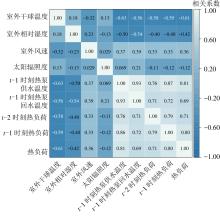
Fig.1
Pearson correlation coefficients between parameters
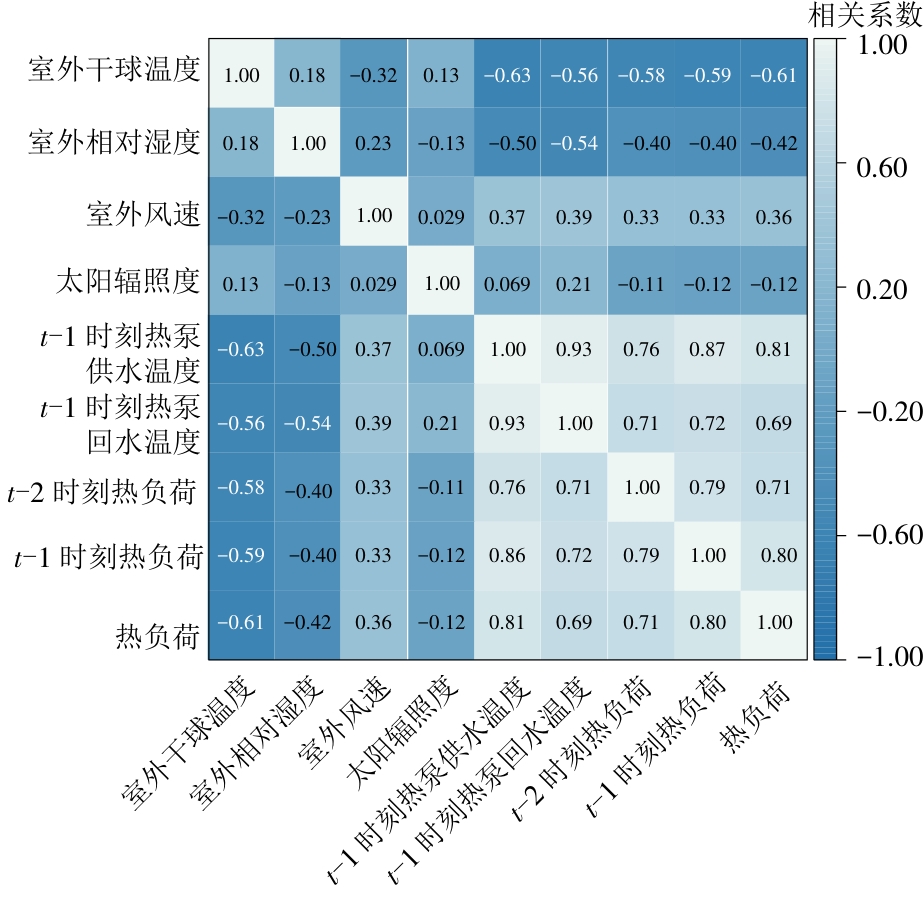
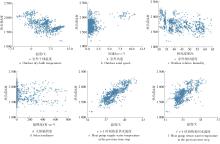
Fig.2
Scatter plot of the relationship between heating load and various characteristic parameters
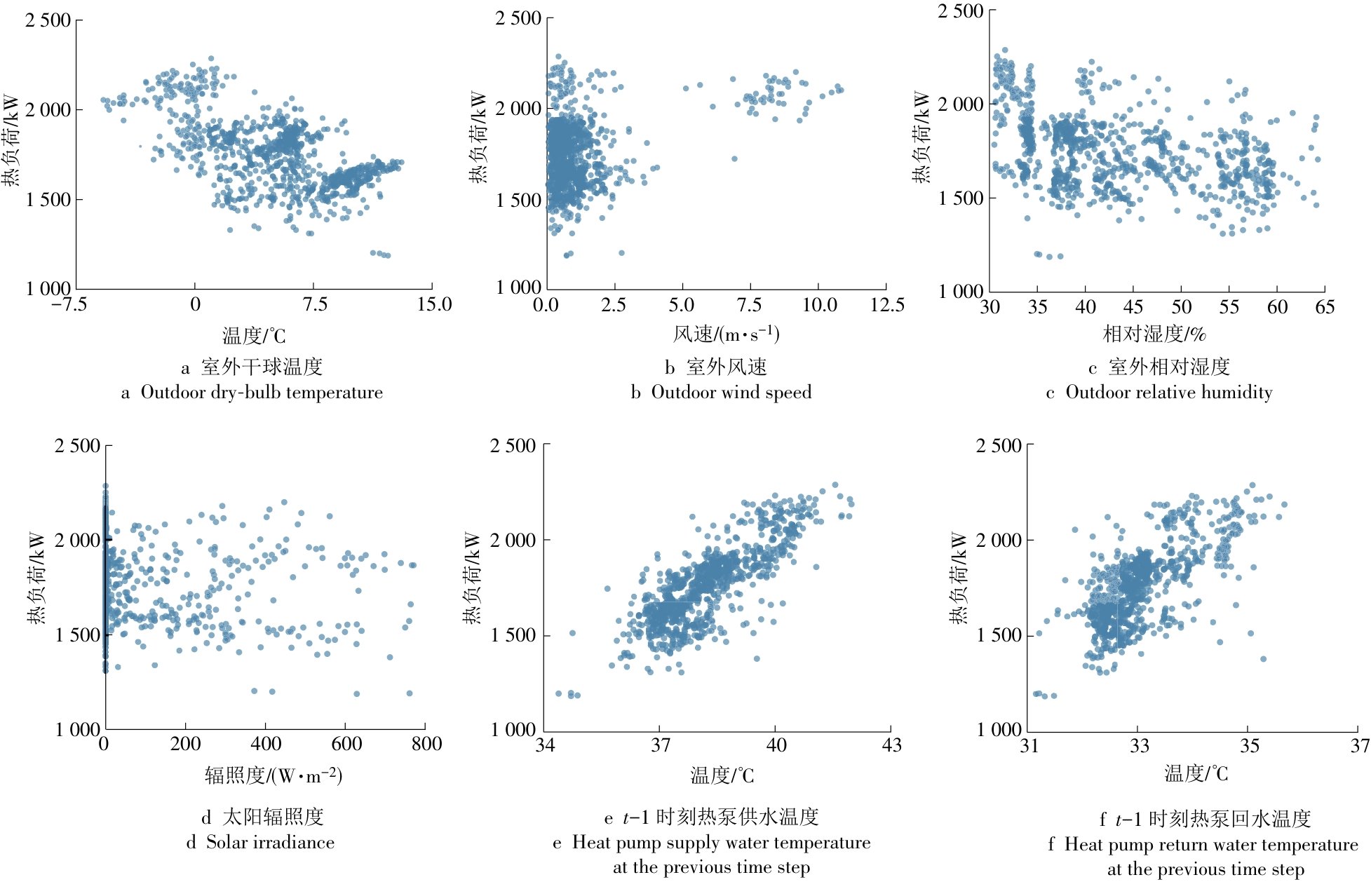
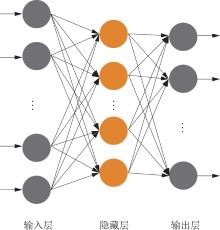
Fig.3
MLP model structure
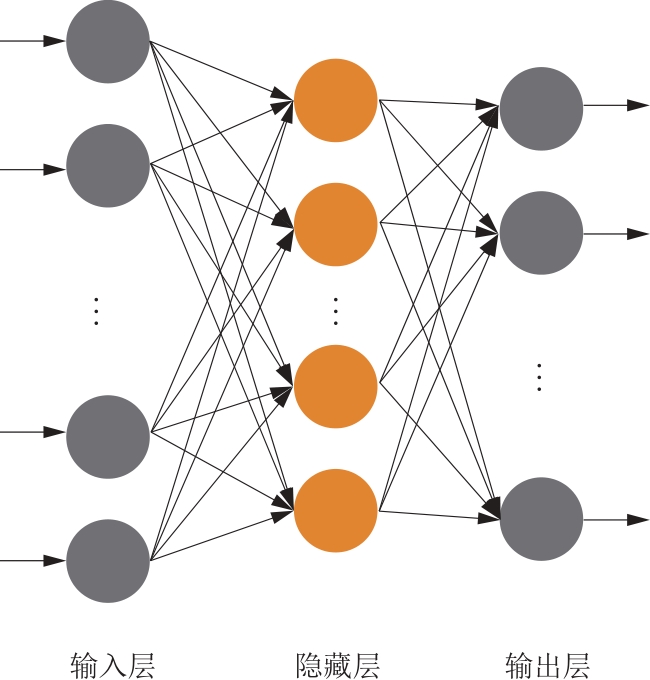
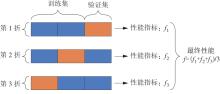
Fig.4
Principle of three-fold cross-validation
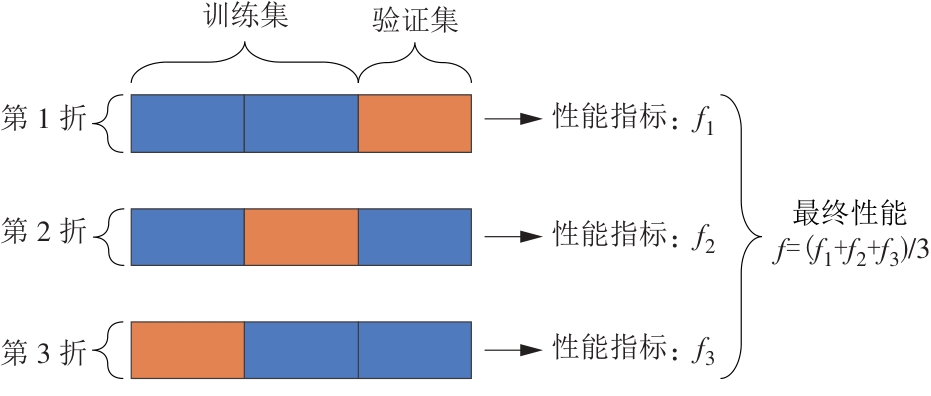
Table 2
Results of hyperparameter tuning for prediction models
| 模型 | 参数 |
|---|---|
| RFR | 决策树数量=400; 最小分割样本数=2; 叶节点最小样本数=1; 最大分割特征数='log2'; 树的最大深度=14 |
| ETR | 决策树数量=400; 最小分割样本数=3; 叶节点最小样本数=1; 最大分割特征数=None; 树的最大深度=13 |
| GBR | 决策树数量=400; 最小分割样本数=2; 叶节点最小样本数=1; 最大分割特征数='log2'; 树的最大深度=10; 学习率=0.01 |
| XGBR | 子采样率=0.8; 决策树数量=100; 最小叶子权重=5; 树的最大深度=10; 学习率=0.05; 分割阈值=0.1; 特征采样比例=0.5 |
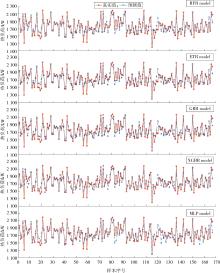
Fig.5
Comparison between the actual values and the predicted values on the test set
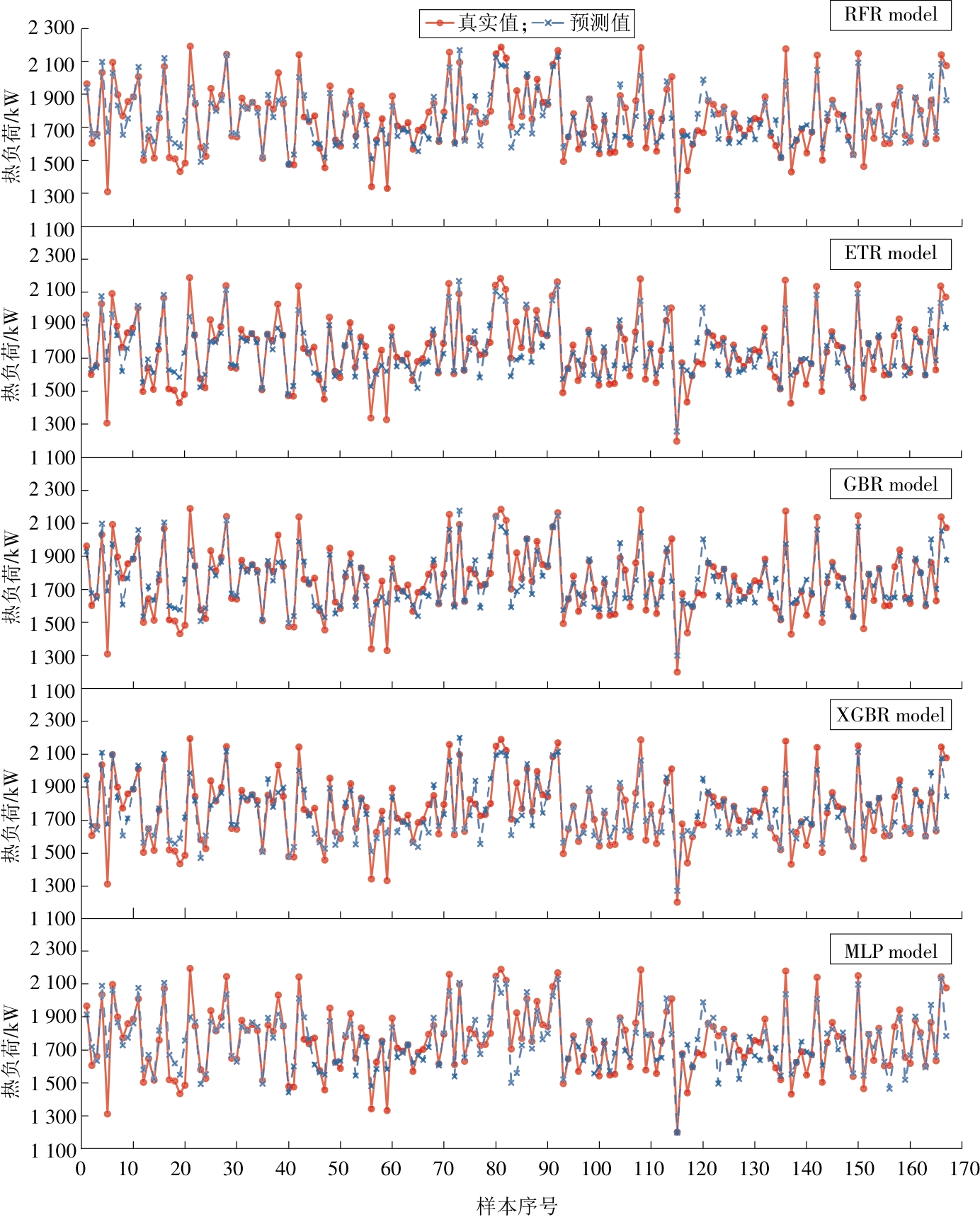
Table 3
The evaluation index results of the models
| 模型 | RMSE/kW | MAE/kW | MAPE/% | |
|---|---|---|---|---|
| RFR | 97.401 9 | 70.104 7 | 4.099 0 | 0.765 0 |
| ETR | 97.189 4 | 69.975 9 | 4.102 0 | 0.766 0 |
| GBR | 99.406 0 | 71.103 0 | 4.167 0 | 0.755 2 |
| XGBR | 97.800 3 | 69.967 1 | 4.086 0 | 0.763 1 |
| MLP | 103.872 6 | 73.294 7 | 4.271 0 | 0.732 7 |
| [1] | 杨子艺, 胡姗, 徐天昊, 等. 面向碳中和的各国建筑运行能耗与碳排放对比研究方法及应用[J]. 气候变化研究进展, 2023, 19(6): 749-760. |
| YANG Ziyi, HU Shan, XU Tianhao, et al. Method and application of global building operation energy use and carbon emissions comparison in the context of carbon neutrality[J]. Climate Change Research, 2023, 19(6): 749-760. | |
| [2] |
LIU R X, KUANG J, GONG Q, et al. Principal component regression analysis with SPSS[J]. Computer Methods and Programs in Biomedicine, 2003, 71(2): 141-147.
doi: 10.1016/s0169-2607(02)00058-5 pmid: 12758135 |
| [3] | 吕岩, 潘毅群, 刘海静, 等. 冷热负荷预测在区域供能项目中的应用: 以上海西虹桥1号能源站为例[J]. 全球能源互联网, 2021, 4(2): 197-203. |
| LYU Yan, PAN Yiqun, LIU Haijing, et al. Application of cooling and heating load prediction for district energy supply: A case in west Hongqiao 1# energy station[J]. Journal of Global Energy Interconnection, 2021, 4(2): 197-203. | |
| [4] | 庄惟敏, 刘加平, 王建国, 等. 建筑碳中和的关键前沿基础科学问题[J]. 中国科学基金, 2023, 37(3): 348-352. |
| ZHUANG Weimin, LIU Jiaping, WANG Jianguo, et al. Key frontier basic scientific issues in building carbon neutrality[J]. Bulletin of National Natural Science Foundation of China, 2023, 37(3): 348-352. | |
| [5] |
LU C J, LI S H, LU Z J. Building energy prediction using artificial neural networks: A literature survey[J]. Energy and Buildings, 2022, 262: 111718.
doi: 10.1016/j.enbuild.2021.111718 |
| [6] |
ZHANG L, WEN J, LI Y F, et al. A review of machine learning in building load prediction[J]. Applied Energy, 2021, 285: 116452.
doi: 10.1016/j.apenergy.2021.116452 |
| [7] |
FATHI S, SRINIVASAN R, FENNER A, et al. Machine learning applications in urban building energy performance forecasting: A systematic review[J]. Renewable and Sustainable Energy Reviews, 2020, 133: 110287.
doi: 10.1016/j.rser.2020.110287 |
| [8] |
徐聪, 胡永锋, 张爱平, 等. 基于特征筛选的综合能源系统多元负荷日前-日内预测[J]. 综合智慧能源, 2024, 46(3): 45-53.
doi: 10.3969/j.issn.2097-0706.2024.03.006 |
|
XU Cong, HU Yongfeng, ZHANG Aiping, et al. Multi-load day-ahead and intra-day forecasting for integrated energy systems based on feature screening[J]. Integrated Intelligent Energy, 2024, 46(3): 45-53.
doi: 10.3969/j.issn.2097-0706.2024.03.006 |
|
| [9] |
杨澜倩, 郭锦敏, 田慧丽, 等. 基于CNN-LSTM-Self attention的园区负荷多尺度预测研究[J]. 综合智慧能源, 2025, 47(2): 79-87.
doi: 10.3969/j.issn.2097-0706.2025.02.008 |
|
YANG Lanqian, GUO Jinmin, TIAN Huili, et al. Research on multi-scale load prediction in parks based on CNN-LSTM-Self attention[J]. Integrated Intelligent Energy, 2025, 47(2): 79-87.
doi: 10.3969/j.issn.2097-0706.2025.02.008 |
|
| [10] |
LU C J, LI S H, REDDY PENAKA S, et al. Automated machine learning-based framework of heating and cooling load prediction for quick residential building design[J]. Energy, 2023, 274: 127334.
doi: 10.1016/j.energy.2023.127334 |
| [11] |
WEI Z Q, ZHANG T W, YUE B, et al. Prediction of residential district heating load based on machine learning: A case study[J]. Energy, 2021, 231: 120950.
doi: 10.1016/j.energy.2021.120950 |
| [12] |
GAO T F, HAN X, WANG J, et al. Enhancing building energy efficiency: An integrated approach to predicting heating and cooling loads using machine learning and optimization algorithms[J]. Journal of Building Engineering, 2024, 98: 110759.
doi: 10.1016/j.jobe.2024.110759 |
| [13] |
GUO J X, YUN S N, MENG Y, et al. Prediction of heating and cooling loads based on light gradient boosting machine algorithms[J]. Building and Environment, 2023, 236: 110252.
doi: 10.1016/j.buildenv.2023.110252 |
| [14] |
BREIMAN L. Random forests[J]. Machine Learning, 2001, 45(1): 5-32.
doi: 10.1023/A:1010933404324 |
| [15] |
JIANG R, TANG W W, WU X B, et al. A random forest approach to the detection of epistatic interactions in case-control studies[J]. BMC Bioinformatics, 2009, 10(Suppl 1): S65.
doi: 10.1186/1471-2105-10-S1-S65 |
| [16] |
AHMAD M W, MOURSHED M, REZGUI Y. Tree-based ensemble methods for predicting PV power generation and their comparison with support vector regression[J]. Energy, 2018, 164: 465-474.
doi: 10.1016/j.energy.2018.08.207 |
| [17] |
MARANI A, NEHDI M L. Machine learning prediction of compressive strength for phase change materials integrated cementitious composites[J]. Construction and Building Materials, 2020, 265: 120286.
doi: 10.1016/j.conbuildmat.2020.120286 |
| [18] | JOHN V, LIU Z, GUO C Z, et al. Real-time lane estimation using deep features and extra trees regression[M]//Image and Video Technology. Cham: Springer International Publishing, 2016: 721-733. |
| [19] |
AHMAD M W, REYNOLDS J, REZGUI Y. Predictive modelling for solar thermal energy systems: A comparison of support vector regression, random forest, extra trees and regression trees[J]. Journal of Cleaner Production, 2018, 203: 810-821.
doi: 10.1016/j.jclepro.2018.08.207 |
| [20] |
ALAM M S, AL-ISMAIL F S, HOSSAIN M S, et al. Ensemble machine-learning models for accurate prediction of solar irradiation in Bangladesh[J]. Processes, 2023, 11(3): 908.
doi: 10.3390/pr11030908 |
| [21] |
GUELMAN L. Gradient boosting trees for auto insurance loss cost modeling and prediction[J]. Expert Systems with Applications, 2012, 39(3): 3659-3667.
doi: 10.1016/j.eswa.2011.09.058 |
| [22] |
CHANG Y C, CHANG K H, WU G J. Application of eXtreme gradient boosting trees in the construction of credit risk assessment models for financial institutions[J]. Applied Soft Computing, 2018, 73: 914-920.
doi: 10.1016/j.asoc.2018.09.029 |
| [23] |
YUDANTAKA K, KIM J S, SONG H, et al. Dual deep learning networks based load forecasting with partial real-time information and its application to system marginal price prediction[J]. Energies, 2019, 13(1): 1-15.
doi: 10.3390/en13010001 |
| [24] |
GARDNER M W, DORLING S R. Artificial neural networks (the multilayer perceptron): A review of applications in the atmospheric sciences[J]. Atmospheric Environment, 1998, 32(14/15): 2627-2636.
doi: 10.1016/S1352-2310(97)00447-0 |
| [25] |
XIE Y H, UEDA Y, SUGIYAMA M, et al. A two-stage short-term load forecasting method using long short-term memory and multilayer perceptron[J]. Energies, 2021, 14(18): 5873.
doi: 10.3390/en14185873 |
| [26] |
杨丽洁, 邓振宇, 陈作双, 等. 基于MSCNN-BiGRU-MLP模型的公共建筑非侵入式负荷辨识[J]. 综合智慧能源, 2025, 47(3): 23-31.
doi: 10.3969/j.issn.2097-0706.2025.03.003 |
|
YANG Lijie, DENG Zhenyu, CHEN Zuoshuang, et al. Non-intrusive load identification for public buildings based on MSCNN-BiGRU-MLP model[J]. Integrated Intelligent Energy, 2025, 47(3): 23-31.
doi: 10.3969/j.issn.2097-0706.2025.03.003 |
|
| [27] |
刘艺娴, 王玉彬, 杨强. 基于门控图神经网络的高容错配电网状态估计方法[J]. 综合智慧能源, 2023, 45(6): 1-8.
doi: 10.3969/j.issn.2097-0706.2023.06.001 |
|
YLIU Yixian, WANG Yubin, YANG Qiang. High fault-tolerant distribution network state estimation method based on gated graph neural network[J]. Integrated Intelligent Energy, 2023, 45(6): 1-8.
doi: 10.3969/j.issn.2097-0706.2023.06.001 |
|
| [28] |
ATTALI J G, PAGÈS G. Approximations of functions by a multilayer perceptron: A new approach[J]. Neural Networks, 1997, 10(6): 1069-1081.
pmid: 12662500 |
| [1] | HUANG Zishu, CAI Ye, SUN Rongzuo, TAN Yudong. Critical section identification and protection configuration for high-risk N-k faults in power systems [J]. Integrated Intelligent Energy, 2025, 47(9): 1-9. |
| [2] | LI Zhen, YANG Guohua, ZHANG Yuanxi, MA Xin, YANG Na, LIU Haorui, MA Longteng. Hybrid prediction of photovoltaic power generation based on modal secondary decomposition and OOA-CNN-BiLSTM-Attention [J]. Integrated Intelligent Energy, 2025, 47(9): 28-37. |
| [3] | HUANGFU Chenmeng, RUAN Hebin, XU Junjun. Power regression prediction for wind turbines in multi-meteorological scenarios based on CEEMDAN-CNN-LSTM integration [J]. Integrated Intelligent Energy, 2025, 47(9): 38-50. |
| [4] | DOU Xiang, LI Zhuoqun, ZHANG Zhe, WEN Xin, ZHAO Bo, HAN Yan, ZHONG Sheng. Load forecasting for integrated energy systems based on CNN-BiLSTM-RF-KDE [J]. Integrated Intelligent Energy, 2025, 47(9): 60-70. |
| [5] | YIN Linfei, ZHANG Yiling. Photovoltaic power output prediction based on variational mode decomposition and triple convolutional neural networks [J]. Integrated Intelligent Energy, 2025, 47(6): 11-19. |
| [6] | CHENG Xianlong, ZHANG Jie, LI Siying, YANG Yixia, YANG Cuifei. Short-term wind power prediction based on VMD-BP-BiLSTM [J]. Integrated Intelligent Energy, 2025, 47(6): 20-29. |
| [7] | ZHAN Guohua, ZHANG Xianyong, WEI Shengying, ZHANG Xiaoshun, LI Li. A prediction method for power grid carbon emission factor based on T-Graphormer [J]. Integrated Intelligent Energy, 2025, 47(6): 30-36. |
| [8] | JIANG Jian, DU Dongsheng, SU Lin. Remaining useful life prediction of proton exchange membrane fuel cells based on improved HHO-LSTM-Self-Attention [J]. Integrated Intelligent Energy, 2025, 47(6): 47-56. |
| [9] | BAN Fengchun, CHEN Xiaofeng, HUANG Zhijia. Residential photovoltaic power generation prediction model based on PSO-BP neural network [J]. Integrated Intelligent Energy, 2025, 47(6): 85-93. |
| [10] | HUANG Linjie, XIE Zhishan, LIAO Yongxing, YIN Linfei. Noise reduction optimization of wind farms considering fatigue damage using a multi-layer feedforward neural network-sequential quadratic programming approach [J]. Integrated Intelligent Energy, 2025, 47(4): 23-32. |
| [11] | LU Handong, FANG Ming, LIU Ganggang, ZHOU Yan. Research on cost analysis and prediction methods for power transmission and transformation projects based on propagation models and neural networks [J]. Integrated Intelligent Energy, 2025, 47(4): 33-40. |
| [12] | YIN Linfei, ZHANG Yiling. Photovoltaic output prediction based on multi-convolutional combined large model [J]. Integrated Intelligent Energy, 2025, 47(4): 63-72. |
| [13] | HUANG Wenxuan, ZENG Haozheng, LIN Yijin, YIN Linfei. Research on the loss of magnetic components based on a data-driven method [J]. Integrated Intelligent Energy, 2025, 47(4): 73-84. |
| [14] | YANG Lijie, DENG Zhenyu, CHEN Zuoshuang, HUANG Chao, JIANG Meihui, ZHU Hongyu. Non-intrusive load identification for public buildings based on MSCNN-BiGRU-MLP model [J]. Integrated Intelligent Energy, 2025, 47(3): 23-31. |
| [15] | ZHANG Dongdong, LI Fangning, LIU Tianhao. Key technologies for load forecasting in new power systems and their applications in diverse scenario [J]. Integrated Intelligent Energy, 2025, 47(3): 47-61. |
| Viewed | ||||||
|
Full text |
|
|||||
|
Abstract |
|
|||||