综合智慧能源 ›› 2026, Vol. 48 ›› Issue (1): 85-97.doi: 10.3969/j.issn.2097-0706.2026.01.009
• 电力系统智能控制与数据分析 • 上一篇
梁富光( ), 马忠强()
收稿日期:2025-04-16
修回日期:2025-09-30
出版日期:2026-01-25
作者简介:梁富光(1968),男,高级工程师,从事电力安全生产、基建、运检和经营管理方面的工作, lfg1_1968@126.com;基金资助:
LIANG Fuguang(), MA Zhongqiang()
Received:2025-04-16
Revised:2025-09-30
Published:2026-01-25
Supported by:摘要:
针对海岛微电网负荷的强非线性、非平稳性及多源耦合特性,提出一种基于评价因子重构的鲁棒经验模态分解(REMD)结合细节增强卷积网络(DECN)与双向门控循环单元(BiGRU)的负荷预测方法。通过REMD与评价因子重构,实现多尺度特征解耦;构建DECN-BiGRU混合架构,融合局部差异与全局依赖特征;引入多任务学习优化分量耦合关系。试验表明,模型较传统方法的平均绝对百分比误差降低 68.78%,较深度学习模型的平均绝对误差降低 68.97%,验证了多模态特征融合与双向建模的有效性。研究结果为海岛微电网的电力调度与储能配置提供了参考。
中图分类号:
梁富光, 马忠强. 基于评价因子重构与DECN-BiGRU的海岛微电网负荷预测[J]. 综合智慧能源, 2026, 48(1): 85-97.
LIANG Fuguang, MA Zhongqiang. Load prediction for island microgrids based on evaluation factor reconstruction and DECN-BiGRU[J]. Integrated Intelligent Energy, 2026, 48(1): 85-97.
表1
相关性分类标准
| 组合因子值 | [0,0.2) | [0.2,0.4) | [0.4,0.6) | [0.6,0.8) | [0.8,1.0] |
|---|---|---|---|---|---|
| 相关性 | 极低 | 低 | 中 | 高 | 极高 |
表2
组合因子判定标准
| 组合因子值 | [0,0.2) | [0.2,0.5) | [0.5,1.0] |
|---|---|---|---|
| 水平 | 弱 | 中 | 强 |
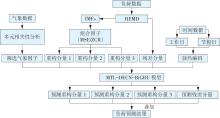
图1
负荷预测流程
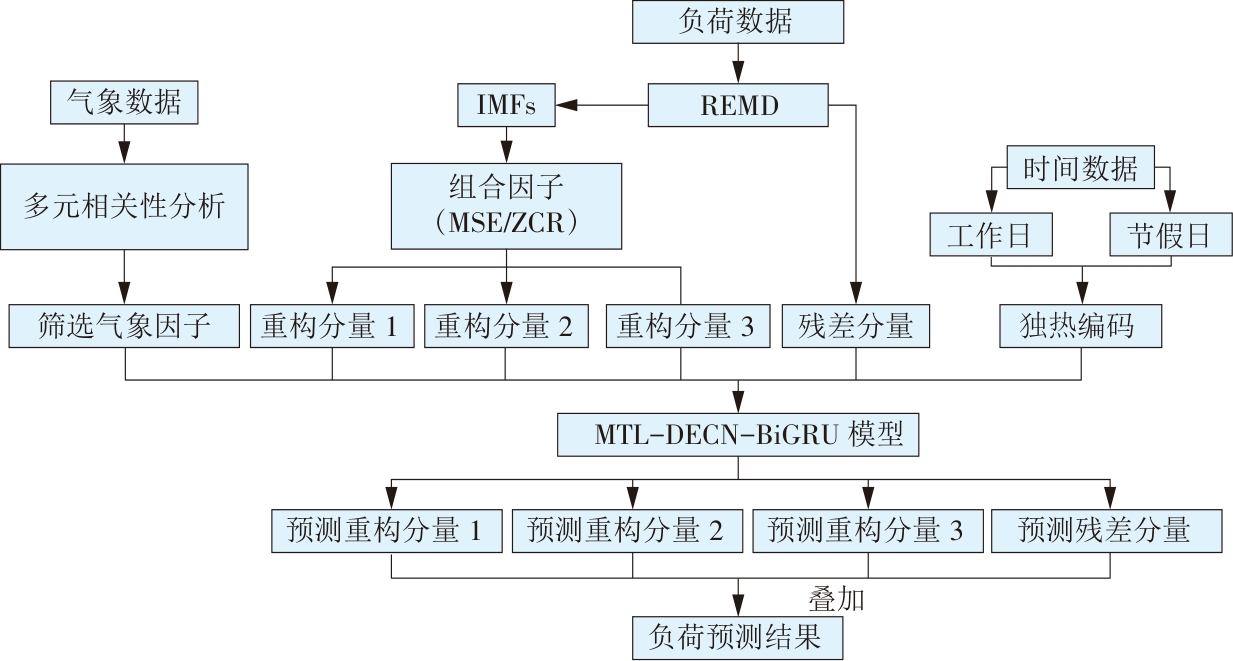
图2
DECN原理
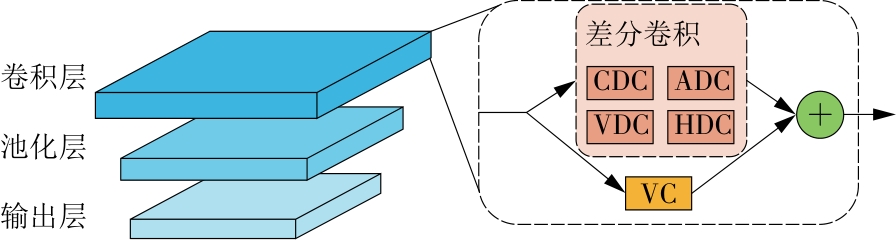
图3
BiGRU原理
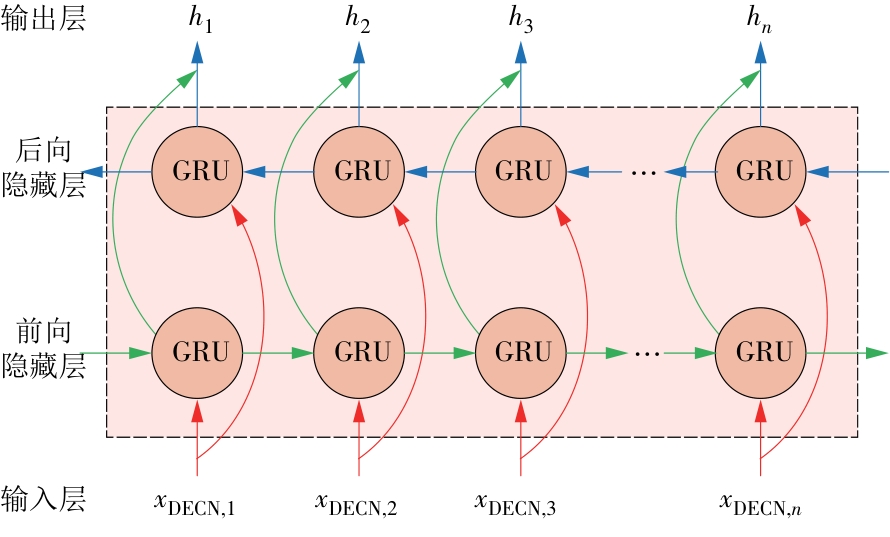
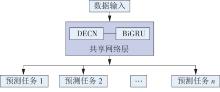
图4
基于硬共享的MTL框架
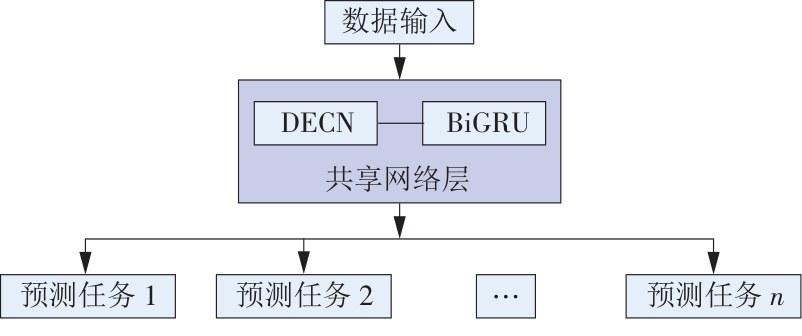
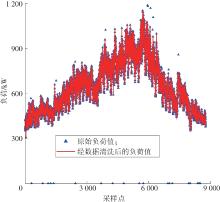
图5
2022年台山岛微电网项目用电量
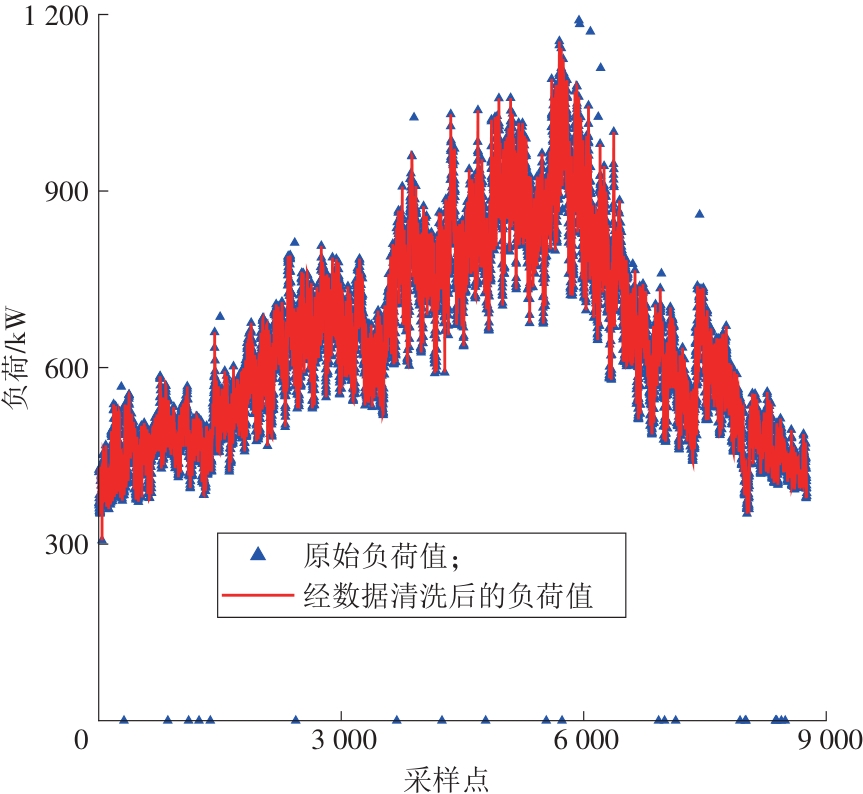
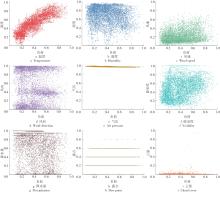
图6
负荷与气象因子散点
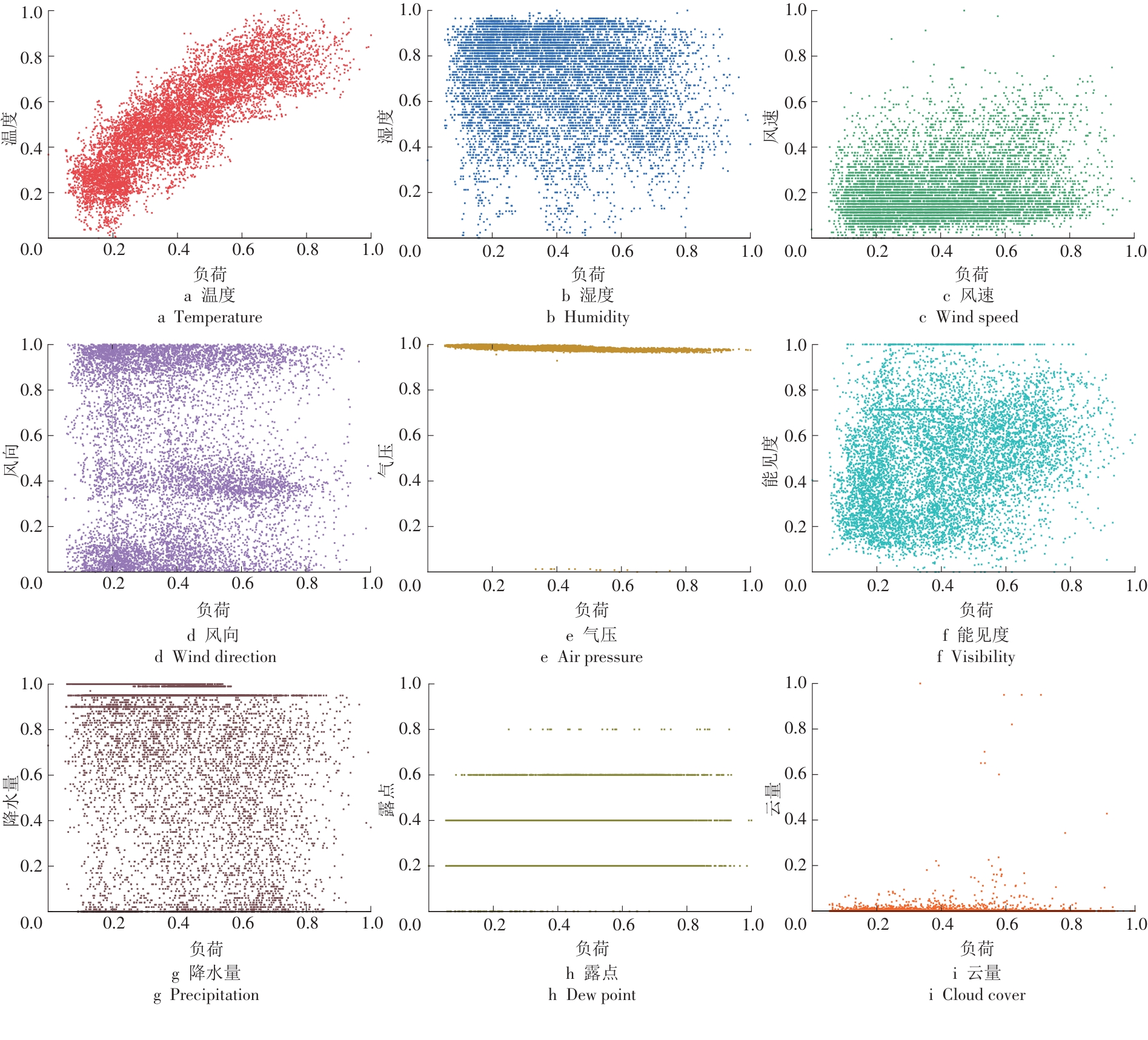
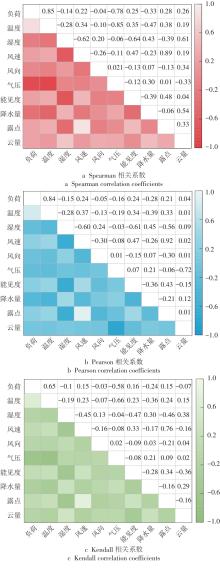
图7
相关性分析结果
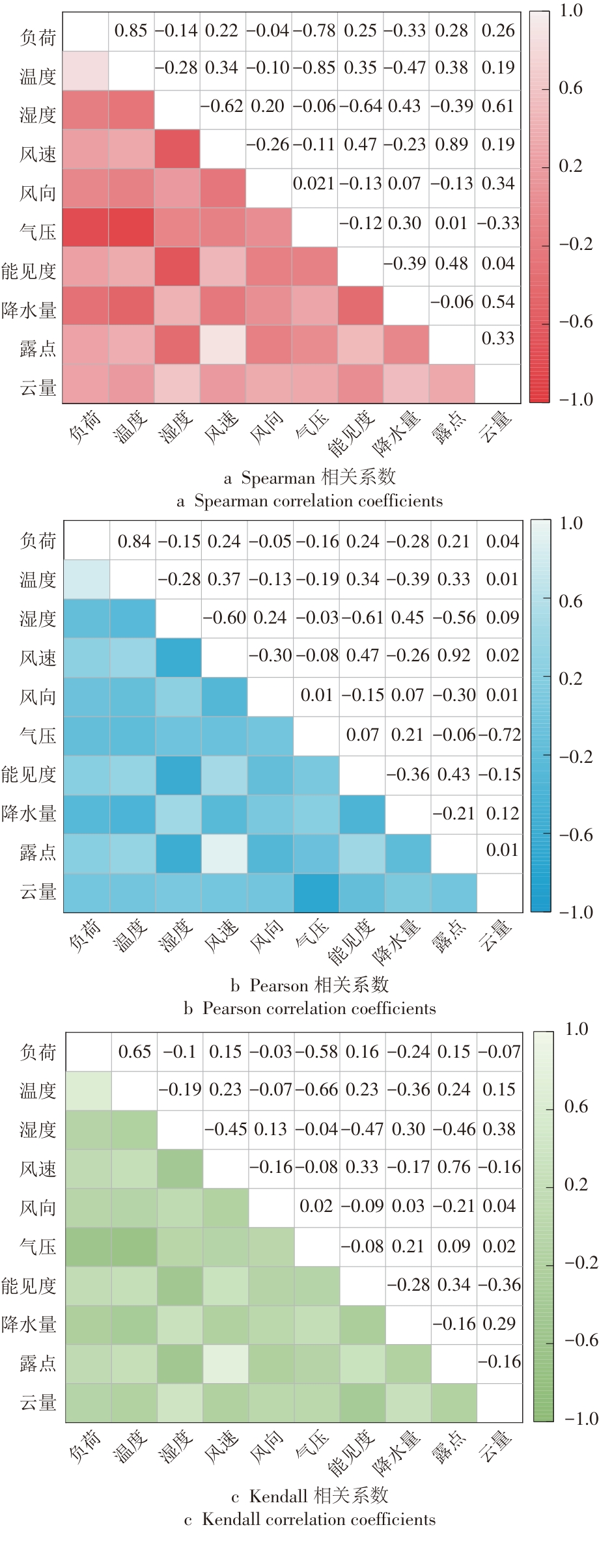
表3
超参数设置
| 超参数 | 数值 | 超参数 | 数值 |
|---|---|---|---|
| 训练轮次 | 200 | 批次大小 | 128 |
| 步长(窗口大小) | 24 | 学习率 | 0.001 |
| 优化器 | Adam | 损失函数 | RMSE |
| 卷积核 | 3×3 | DECN层数 | 1 |
| BiGRU层数 | 1 | BiGRU隐藏层大小 | 128 |
| 全连接层大小 | 128 | 随机失活(Dropout) | 0.2 |
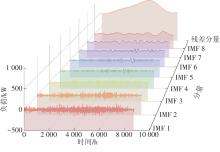
图8
基于REMD的负荷分解
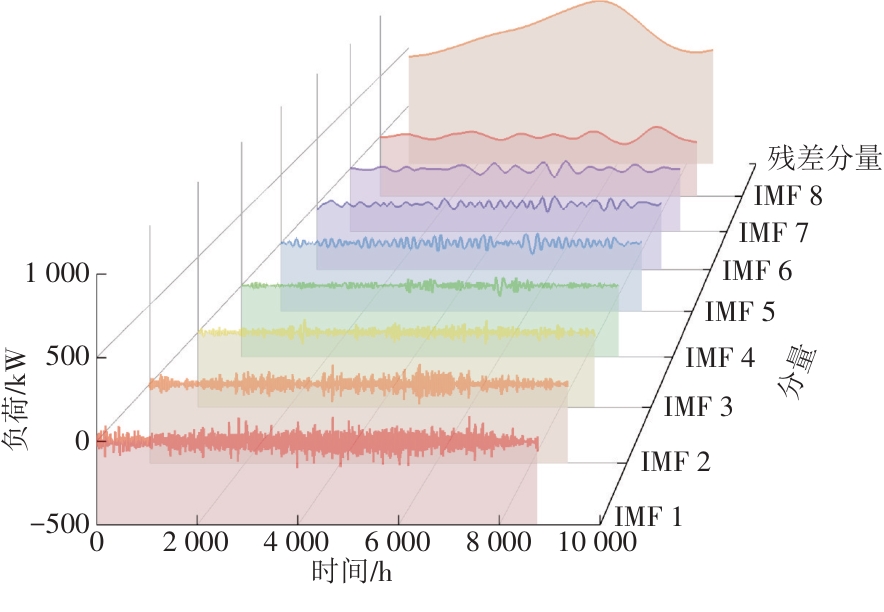
表4
组合因子计算结果
| 分量 | MSE | ZCR | 组合因子 |
|---|---|---|---|
| IMF 1 | 0.803 | 0.316 | 0.706 |
| IMF 2 | 0.690 | 0.116 | 0.575 |
| IMF3 | 0.750 | 0.059 | 0.612 |
| IMF 4 | 0.582 | 0.026 | 0.471 |
| IMF 5 | 0.442 | 0.013 | 0.356 |
| IMF 6 | 0.365 | 0.006 | 0.293 |
| IMF 7 | 0.198 | 0.003 | 0.159 |
| IMF 8 | 0.080 | 0.001 | 0.064 |
图9
基于评价因子的负荷重构结果
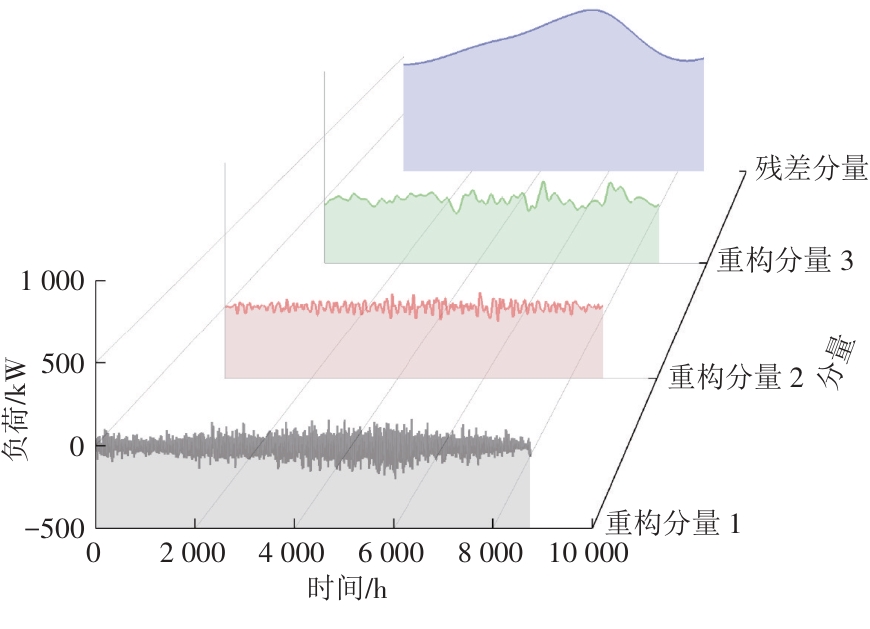
表5
重构分量MSE和ZCR计算结果
| 项目 | 重构分量1 | 重构分量2 | 重构分量3 |
|---|---|---|---|
| MSE | 1.090 | 0.665 | 0.215 |
| ZCR | 0.164 | 0.015 | 0.003 |
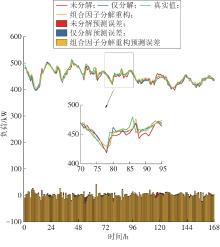
图10
不同分解重构方法的预测结果及误差
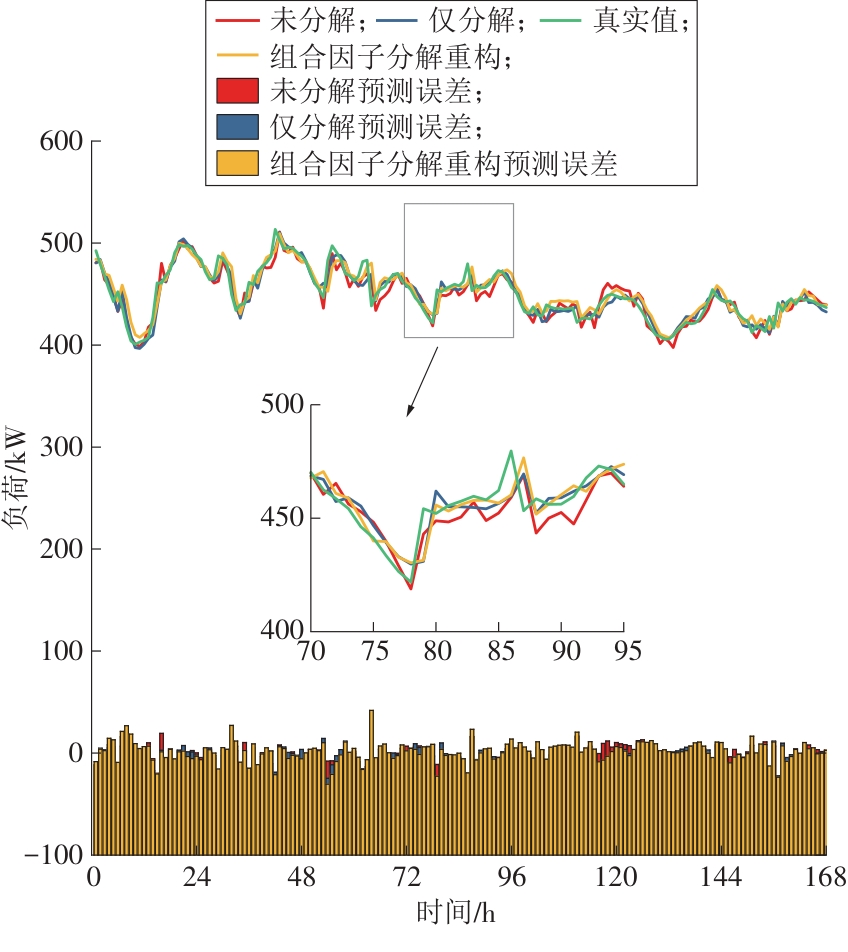
表6
不同分解重构方法的误差
| 分解重构方式 | MAPE/% | MAE/kW | RMSE/kW |
|---|---|---|---|
| 未分解 | 2.27 | 14.69 | 21.60 |
| 仅分解 | 1.80 | 11.55 | 16.77 |
| 组合因子分解重构 | 1.18 | 7.37 | 9.69 |
表7
不同预测模型的验证集误差指标对比
| 预测模型 | MAPE/% | MAE/kW | RMSE/kW |
|---|---|---|---|
| ARIMA | 3.78 | 23.75 | 30.64 |
| SVR | 3.16 | 20.07 | 27.06 |
| CNN-LSTM | 3.07 | 20.09 | 27.70 |
| DECN | 2.61 | 16.83 | 22.66 |
| BiGRU | 2.04 | 13.08 | 18.52 |
| DECN-BiGRU | 1.18 | 7.37 | 9.69 |
图11
不同分解重构方法的预测结果及误差分布
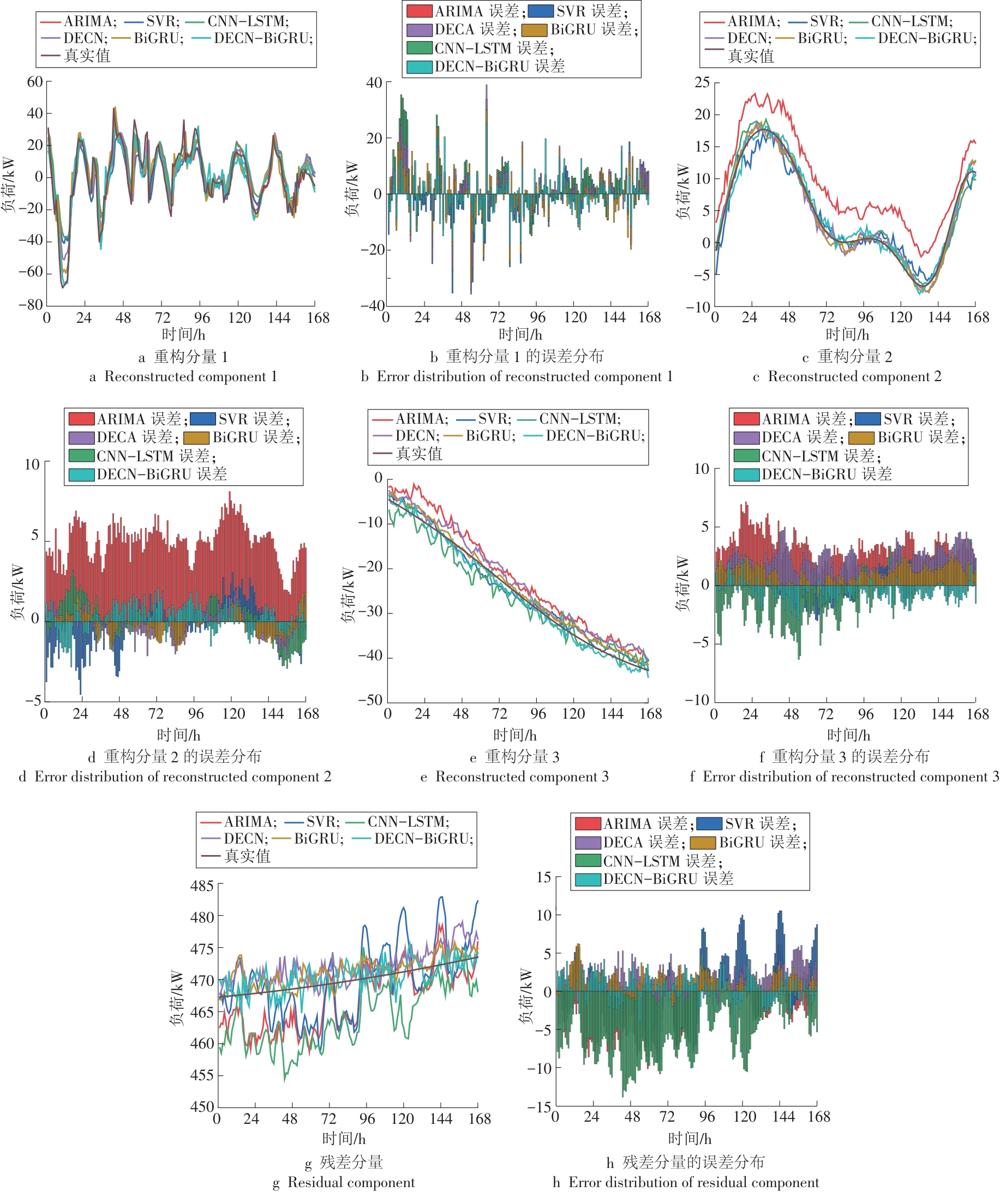
表8
DECN-BiGRU模型多折验证结果
| 项目 | 1折 | 2折 | 3折 | 4折 | 5折 | 均值 | 标准差 |
|---|---|---|---|---|---|---|---|
| MAPE/% | 1.10 | 1.21 | 1.18 | 1.11 | 1.15 | 1.15 | 0.05 |
| MAE/kW | 7.52 | 7.28 | 7.41 | 7.63 | 7.11 | 7.21 | 0.12 |
| RMSE/kW | 9.85 | 9.52 | 9.73 | 9.98 | 9.73 | 9.77 | 0.13 |
| [1] |
张冬冬, 单琳珂, 刘天皓. 人工智能技术在风力与光伏发电数据挖掘及功率预测中的应用综述[J]. 综合智慧能源, 2025, 47(3): 32-46.
doi: 10.3969/j.issn.2097-0706.2025.03.004 |
|
ZHANG Dongdong, SHAN Linke, LIU Tianhao. Review on the application of artificial intelligence in data mining and wind and photovoltaic power forecasting[J]. Integrated Intelligent Energy, 2025, 47(3): 32-46.
doi: 10.3969/j.issn.2097-0706.2025.03.004 |
|
| [2] |
WAZIRALI R, YAGHOUBI E, ABUJAZAR M S S, et al. State-of-the-art review on energy and load forecasting in microgrids using artificial neural networks,machine learning, and deep learning techniques[J]. Electric Power Systems Research, 2023, 225: 109792.
doi: 10.1016/j.epsr.2023.109792 |
| [3] |
MARIAM L, BASU M, CONLON M F. Microgrid: Architecture, policy and future trends[J]. Renewable and Sustainable Energy Reviews, 2016, 64: 477-489.
doi: 10.1016/j.rser.2016.06.037 |
| [4] | 侯媛媛, 曾君, 罗燕, 等. 社区微网主动能量管理协同与优化方法研究[J]. 电网技术, 2023, 47(4): 1548-1557. |
| HOU Yuanyuan, ZENG Jun, LUO Yan, et al. Research on collaborative and optimization methods of active energy management in community microgrid[J]. Power System Technology, 2023, 47(4): 1548-1557. | |
| [5] |
FERAHTIA S, HOUARI A, CIOARA T, et al. Recent advances on energy management and control of direct current microgrid for smart cities and industry: A Survey[J]. Applied Energy, 2024, 368: 123501.
doi: 10.1016/j.apenergy.2024.123501 |
| [6] | 茹传红, 卢姬, 秦建, 等. 充电用能约束下工业园区负荷管控的随机优化策略[J]. 中国电力, 2025, 58(8): 130-138. |
| RU Chuanhong, LU Ji, QIN Jian, et al. Stochastic optimization strategy for load management of industrial park under energy constraints[J]. Electric Power, 2025, 58(8): 130-138. | |
| [7] | 李宏仲, 李想, 蒋轶周. 计及台风天气影响的远洋海岛微电网群双层规划[J]. 电网技术, 2025, 49(2): 437-446. |
| LI Hongzhong, LI Xiang, JIANG Yizhou. Double-layer planning for pelagic island microgrid group considering typhoon weather effects[J]. Power System Technology, 2025, 49(2): 437-446. | |
| [8] | 李东东, 陈天旭, 沈运帷, 等. 基于联合虚拟储能系统的海岛微电网协同优化策略[J]. 中国电机工程学报, 2023, 43(20): 7842-7856. |
| LI Dongdong, CHEN Tianxu, SHEN Yunwei, et al. Collaborative optimization of island microgrid based on joint virtual energy storage system strategy[J]. Proceedings of the CSEE, 2023, 43(20): 7842-7856. | |
| [9] |
JIRDEHI M A, TABAR V S, GHASSEMZADEH S, et al. Different aspects of microgrid management: A comprehensive review[J]. Journal of Energy Storage, 2020, 30: 101457.
doi: 10.1016/j.est.2020.101457 |
| [10] |
ZHAO B, CHEN J, ZHANG L Q, et al. Three representative island microgrids in the East China Sea: Key technologies and experiences[J]. Renewable and Sustainable Energy Reviews, 2018, 96: 262-274.
doi: 10.1016/j.rser.2018.07.051 |
| [11] |
陈亮, 刘桂英, 粟时平, 等. 基于双层网络PER-MADDPG算法的综合能源系统协调优化调度[J]. 综合智慧能源, 2025, 47(7): 44-54.
doi: 10.3969/j.issn.2097-0706.2025.07.005 |
|
CHEN Liang, LIU Guiying, SU Shiping, et al. Coordinated optimization scheduling of integrated energy system based on PER-MADDPG algorithm with two-layer network[J]. Integrated Intelligent Energy, 2025, 47(7): 44-54.
doi: 10.3969/j.issn.2097-0706.2025.07.005 |
|
| [12] |
陈浩, 马刚, 钱达, 等. 绿证-碳交易机制下考虑阶梯需求响应的区域综合能源系统优化调度[J]. 综合智慧能源, 2025, 47(5): 21-30.
doi: 10.3969/j.issn.2097-0706.2025.05.003 |
|
CHEN Hao, MA Gang, QIAN Da, et al. Optimization of regional integrated energy systems under green certificate and carbontrading mechanism considering tiered demand response[J]. Integrated Intelligent Energy, 2025, 47(5): 21-30.
doi: 10.3969/j.issn.2097-0706.2025.05.003 |
|
| [13] |
KUANG Y H, ZHANG Y J, ZHOU B, et al. A review of renewable energy utilization in islands[J]. Renewable and Sustainable Energy Reviews, 2016, 59: 504-513.
doi: 10.1016/j.rser.2016.01.014 |
| [14] | MELE E. A review of machine learning algorithms used for load forecasting at microgrid level[C]// Proceedings of the International Scientific Conference,Sinteza 2019. Singidunum University, 2019: 452-458. |
| [15] |
ZHU J Z, DONG H J, ZHENG W Y, et al. Review and prospect of data-driven techniques for load forecasting in integrated energy systems[J]. Applied Energy, 2022, 321: 119269.
doi: 10.1016/j.apenergy.2022.119269 |
| [16] | 李科, 李龙胜, 肖钰皓. 基于时间序列分析的负荷高峰时段用电预测与削峰研究[J]. 光学与光电技术, 2022, 20(4): 153-159. |
| LI Ke, LI Longsheng, XIAO Yuhao. Research on power consumption forecasting and peak shaving during peak load period based on time series analysis[J]. Optics & Optoelectronic Technology, 2022, 20(4): 153-159. | |
| [17] |
WANG H, ZHANG N, DU E S, et al. A comprehensive review for wind,solar,and electrical load forecasting methods[J]. Global Energy Interconnection, 2022, 5(1): 9-30.
doi: 10.1016/j.gloei.2022.04.002 |
| [18] |
TRIVEDI R, PATRA S, KHADEM S. A data-driven short-term PV generation and load forecasting approach for microgrid applications[J]. IEEE Journal of Emerging and Selected Topics in Industrial Electronics, 2022, 3(4): 911-919.
doi: 10.1109/JESTIE.2022.3179961 |
| [19] |
李彬, 胡纯瑾, 王婧. 基于EEMD-BiLSTM的可调节负荷预测方法[J]. 综合智慧能源, 2022, 44(9): 33-39.
doi: 10.3969/j.issn.2097-0706.2022.09.005 |
|
LI Bin, HU Chunjin, WANG Jing. Prediction method for adjustable load based on EEMD-BiLSTM[J]. Integrated Intelligent Energy, 2022, 44(9): 33-39.
doi: 10.3969/j.issn.2097-0706.2022.09.005 |
|
| [20] | 马恒瑞, 袁傲添, 王波, 等. 基于深度学习的负荷预测研究综述与展望[J]. 高电压技术, 2025, 51(3):1233-1250. |
| MA Hengrui, YUAN Aotian, WANG Bo, et al. Review and prospect of load forecasting based on deep learning[J]. High Voltage Engineering, 2025, 51(3): 1233-1250. | |
| [21] |
MORADZADEH A, ZAKERI S, SHOARAN M, et al. Short-term load forecasting of microgrid via hybrid support vector regression and long short-term memory algorithms[J]. Sustainability, 2020, 12(17): 7076.
doi: 10.3390/su12177076 |
| [22] |
杨澜倩, 郭锦敏, 田慧丽, 等. 基于CNN-LSTM-Self attention的园区负荷多尺度预测研究[J]. 综合智慧能源, 2025, 47(2): 79-87.
doi: 10.3969/j.issn.2097-0706.2025.02.008 |
|
YANG Lanqian, GUO Jinmin, TIAN Huili, et al. Research on multi-scale load prediction in parks based on CNN-LSTM-Self attention[J]. Integrated Intelligent Energy, 2025, 47(2): 79-87.
doi: 10.3969/j.issn.2097-0706.2025.02.008 |
|
| [23] | 杨佳泽, 王灿, 王增平. 新型电力系统背景下的智能负荷预测算法研究综述[J]. 华北电力大学学报(自然科学版), 2025, 52(3): 54-67. |
| YANG Jiaze, WANG Can, WANG Zengping. Review on intelligent load forecasting algorithms for the new-type power system[J]. Journal of North China Electric Power University(Natural Science Edition), 2025, 52(3): 54-67. | |
| [24] |
封钰, 宋佑斌, 金晟, 等. 基于随机森林算法和粗糙集理论的改进型深度学习短期负荷预测模型[J]. 发电技术, 2023, 44(6): 889-895.
doi: 10.12096/j.2096-4528.pgt.23013 |
|
FENG Yu, SONG Youbin, JIN Sheng, et al. Improved deep learning model for forecasting short-term load based on random forest algorithm and rough set theory[J]. Power Generation Technology, 2023, 44(6): 889-895.
doi: 10.12096/j.2096-4528.pgt.23013 |
|
| [25] |
SHI J, TEH J. Load forecasting for regional integrated energy system based on complementary ensemble empirical mode decomposition and multi-model fusion[J]. Applied Energy, 2024, 353: 122146.
doi: 10.1016/j.apenergy.2023.122146 |
| [26] |
PENG D G, LIU Y, WANG D H, et al. Multi-energy load forecasting for integrated energy system based on sequence decomposition fusion and factors correlation analysis[J]. Energy, 2024, 308: 132796.
doi: 10.1016/j.energy.2024.132796 |
| [27] | 曾进辉, 苏旨音, 肖锋, 等. 基于生成对抗网络和EMD-ISSA-LSTM的短期电力负荷预测[J]. 电子测量技术, 2024, 47(20): 92-100. |
| ZENG Jinhui, SU Zhiyin, XIAO Feng, et al. Short-term power load forecasting based on generative adversarial networks and EMD-ISSA-LSTM[J]. Electronic Measurement Technology, 2024, 47(20): 92-100. | |
| [28] | 钟吴君, 李培强, 涂春鸣. 基于EEMD-CBAM-Bi LSTM的牵引负荷超短期预测[J]. 电工技术学报, 2024, 39(21): 6850-6864. |
| ZHONG Wujun, LI Peiqiang, TU Chunming. Traction load ultra-short-term forecasting framework based on EEMD-CBAM-BiLSTM[J]. Transactions of China Electrotechnical Society, 2024, 39(21): 6850-6864. | |
| [29] | 张恒, 郑建勇, 梅飞, 等. 基于VMD和辅助任务学习的短期负荷预测方法[J]. 电力系统保护与控制, 2025, 53(5): 104-112. |
| ZHANG Heng, ZHENG Jianyong, MEI Fei, et al. Short-term load forecasting method based on VMD and auxiliary task learning[J]. Power System Protection and Control, 2025, 53(5): 104-112. | |
| [30] | 段沁宇, 薛贵军, 谭全伟, 等. 基于SVMD的改进BWO-TimesNet短期热负荷预测模型[J]. 广西师范大学学报(自然科学版), 2024, 42(6): 101-116. |
| DUAN Qinyu, XUE Guijun, TAN Quanwei, et al. Improved BWO-TimesNet short-term heat load forecasting model based on SVMD[J]. Journal of Guangxi Normal University (Natural Science Edition), 2024, 42(6): 101-116. | |
| [31] |
LI K, MU Y C, YANG F, et al. A novel short-term multi-energy load forecasting method for integrated energy system based on feature separation-fusion technology and improved CNN[J]. Applied Energy, 2023, 351: 121823.
doi: 10.1016/j.apenergy.2023.121823 |
| [32] |
LIN Z Y, LIN T, LI J, et al. A novel short-term multi-energy load forecasting method for integrated energy system based on two-layer joint modal decomposition and dynamic optimal ensemble learning[J]. Applied Energy, 2025, 378: 124798.
doi: 10.1016/j.apenergy.2024.124798 |
| [33] |
SHI J Q, LI C X, YAN X H. Artificial intelligence for load forecasting: A stacking learning approach based on ensemble diversity regularization[J]. Energy, 2023, 262: 125295.
doi: 10.1016/j.energy.2022.125295 |
| [34] |
LIU Z L, PENG D D, ZUO M J, et al. Improved Hilbert-Huang transform with soft sifting stopping criterion and its application to fault diagnosis of wheelset bearings[J]. ISA Transactions, 2022, 125: 426-444.
doi: 10.1016/j.isatra.2021.07.011 |
| [35] |
CHEN Z X, HE Z W, LU Z M. DEA-net: Single image dehazing based on detail-enhanced convolution and content-guided attention[J]. IEEE Transactions on Image Processing, 2024, 33: 1002-1015.
doi: 10.1109/TIP.2024.3354108 pmid: 38252568 |
| [36] |
NIU D X, YU M, SUN L J, et al. Short-term multi-energy load forecasting for integrated energy systems based on CNN-BiGRU optimized by attention mechanism[J]. Applied Energy, 2022, 313: 118801.
doi: 10.1016/j.apenergy.2022.118801 |
| [37] |
SHALABI L, ZYAD S, KASASBEH B. Data mining:A preprocessing engine[J]. Journal of Computer Science, 2006, 2(9): 735-739.
doi: 10.3844/jcssp.2006.735.739 |
| [38] | ALI K. Spearman's correlation coefficient in statistical analysis[J]. International Journal of Nonlinear Analysis and Applications, 2022, 13(1): 3249-3255. |
| [39] | BENESTY J, CHEN J D, HUANG Y T, et al. Pearson correlation coefficient[M]// Noise Reduction in Speech Processing. Berlin, Heidelberg: Springer, 2009: 1-4. |
| [40] | ABDI H. The Kendall rank correlation coefficient[J]. Encyclopedia of measurement and statistics, 2007,2: 508-517. |
| [1] | 陈旭东, 卞礼杰, 马刚, 陈浩, 詹孝升, 彭乐瑶. 基于CEEMDAN-DBO-VMD-TCN-BiGRU的短期风电功率预测[J]. 综合智慧能源, 2026, 48(1): 13-22. |
| [2] | 潘雷, 丁云飞, 庞毅, 王宇璇, 陈建伟, 高瑞, 张立阳. 基于SC-SAC算法的REHMIS-IES优化调度策略[J]. 综合智慧能源, 2026, 48(1): 43-58. |
| [3] | 薛东, 徐静静, 江婷, 王晓海, 徐聪. 基于双重特征处理的园区综合能源系统供热负荷预测研究[J]. 综合智慧能源, 2026, 48(1): 59-66. |
| [4] | 窦翔, 李卓群, 张哲, 温鑫, 赵勃, 韩燕, 仲声. 基于CNN-BiLSTM-RF-KDE的综合能源系统负荷预测[J]. 综合智慧能源, 2025, 47(9): 60-70. |
| [5] | 张元曦, 杨国华, 马龙腾, 马鑫, 刘耀泽. 基于改进DE算法的园区微电网风光储优化配置[J]. 综合智慧能源, 2025, 47(9): 71-79. |
| [6] | 周凯, 吴炎喜, 黄宇翔, 杨景豪, 樊小朝, 李建伟, 魏志宗, 滕建, 陈历, 叶琴, 张浩, 姜军南. 大海拔高差地区固体流大规模重力储能技术[J]. 综合智慧能源, 2025, 47(8): 1-9. |
| [7] | 甄文喜, 马喜平, 戴跃洪, 牛炜, 陈柏旭, 曾桂. 基于中间层控制的风-储自同步调频策略研究[J]. 综合智慧能源, 2025, 47(8): 21-29. |
| [8] | 褚龙浩, 李笑竹. 共享储能参与下的多类型电能交易投标策略及价值分配机制[J]. 综合智慧能源, 2025, 47(8): 30-39. |
| [9] | 郑昊宇, 周家辉, 仝冰, 王海鸣, 徐钢, 张资悦. 配置压缩空气储能的绿氢系统容量配置和运行调度优化研究[J]. 综合智慧能源, 2025, 47(7): 64-70. |
| [10] | 张德斌, 林文野, 何梓轩, 岳心如, 宋文吉, 冯自平, FARID Mohammed Mehdi, USHAK DE GRAGEDA Svetlana Nikolaevna. 计及广义储能的建筑产消者社区综合能源系统日前调度优化[J]. 综合智慧能源, 2025, 47(7): 82-92. |
| [11] | 王成, 邵冲, 何欣, 董海鹰. 基于MOIBKA算法的电化学储能电站最优功率分配[J]. 综合智慧能源, 2025, 47(6): 74-84. |
| [12] | 张文博, 秦文萍, 刘佳昕, 陈玉梅, 刘博洋, 赵桉霆. 绿证-电-碳耦合市场下计及需求响应与租赁共享储能的VPP鲁棒优化调度策略[J]. 综合智慧能源, 2025, 47(5): 31-40. |
| [13] | 郝宁, 张天博, 蒋励. 考虑储能运营商的工业企业综合能源系统运行优化和利益分配研究[J]. 综合智慧能源, 2025, 47(4): 85-97. |
| [14] | 杨丽洁, 邓振宇, 陈作双, 黄超, 江美慧, 朱虹谕. 基于MSCNN-BiGRU-MLP模型的公共建筑非侵入式负荷辨识[J]. 综合智慧能源, 2025, 47(3): 23-31. |
| [15] | 张冬冬, 李芳凝, 刘天皓. 新型电力系统负荷预测关键技术及多元场景应用[J]. 综合智慧能源, 2025, 47(3): 47-61. |
| 阅读次数 | ||||||
|
全文 |
|
|||||
|
摘要 |
|
|||||