Integrated Intelligent Energy ›› 2026, Vol. 48 ›› Issue (3): 47-55.doi: 10.3969/j.issn.2097-0706.2026.03.005
• Low-carbon Optimization for Energy Systems • Previous Articles Next Articles
WANG Zixuan1( ), HAO Yu1,*(), LIU Xingchen1(), SUN Weinan1(), LIU Lin1(), ZHANG Yi2()
Received:2025-05-06
Revised:2025-06-23
Published:2026-03-25
Contact:
HAO Yu
E-mail:wangzxfairy98@163.com;987068078@qq.com;piao_hang@163.com;ziwang7777@gmail.com;850568158@qq.com;r95982388@163.com
Supported by:CLC Number:
WANG Zixuan, HAO Yu, LIU Xingchen, SUN Weinan, LIU Lin, ZHANG Yi. Distributed robust low-carbon optimization model for integrated energy systems driven by historical data[J]. Integrated Intelligent Energy, 2026, 48(3): 47-55.
Add to citation manager EndNote|Ris|BibTeX
URL: https://www.hdpower.net/EN/10.3969/j.issn.2097-0706.2026.03.005
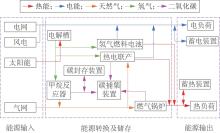
Fig.1
Scheduling process of an IES
Table 1
Parameters of the carbon emission model
| 耗电型模型参数 | 耗气型模型参数 | ||||
|---|---|---|---|---|---|
| a1 | b1 | c1 | a2 | b2 | c2 |
| 36 | -0.38 | 0.003 4 | 3 | -0.004 | 0.001 |
Table 2
Parameters of energy storage devices
| 设备 | 容量/kW | 容量下限/% | 容量上限/% | 爬坡约束/% |
|---|---|---|---|---|
| 储电 | 450 | 10 | 90 | 20 |
| 储热 | 500 | 10 | 90 | 20 |
| 储气 | 150 | 10 | 90 | 20 |
| 储氢 | 200 | 10 | 90 | 20 |
Table 3
Parameters of power converters
| 设备 | 容量/kW | 转换效率/% | 爬坡约束/% |
|---|---|---|---|
| EL | 500 | 87 | 20 |
| MR | 250 | 60 | 20 |
| HFC | 250 | 95 | 20 |
| GB | 800 | 95 | 20 |
| CHP系统 | 600 | 92 | 20 |
| CCS系统 | 250 | 60 | 20 |
Table 4
Stepped carbon trading mechanism and other mechanisms' daily benefits
| 参数 | 模式1 | 模式2 | 模式3 |
|---|---|---|---|
| 碳排放量/kg | 12 758 | 10 671 | 25 792 |
| 碳交易成本/元 | 6 379 | 4 953 | 16 197 |
| 购电成本/元 | 2 408 | 2 822 | 2 379 |
| 购气成本/元 | 7 740 | 7 538 | 9 410 |
| 弃风成本/元 | 0 | 0 | 0 |
| 弃光成本/元 | 0 | 0 | 0 |
| 碳捕集成本/元 | 512 | 502 | 0 |
| 总成本/元 | 17 039 | 15 815 | 27 986 |
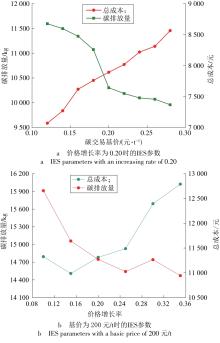
Fig.2
Impact of carbon trading mechanism parameters on IES
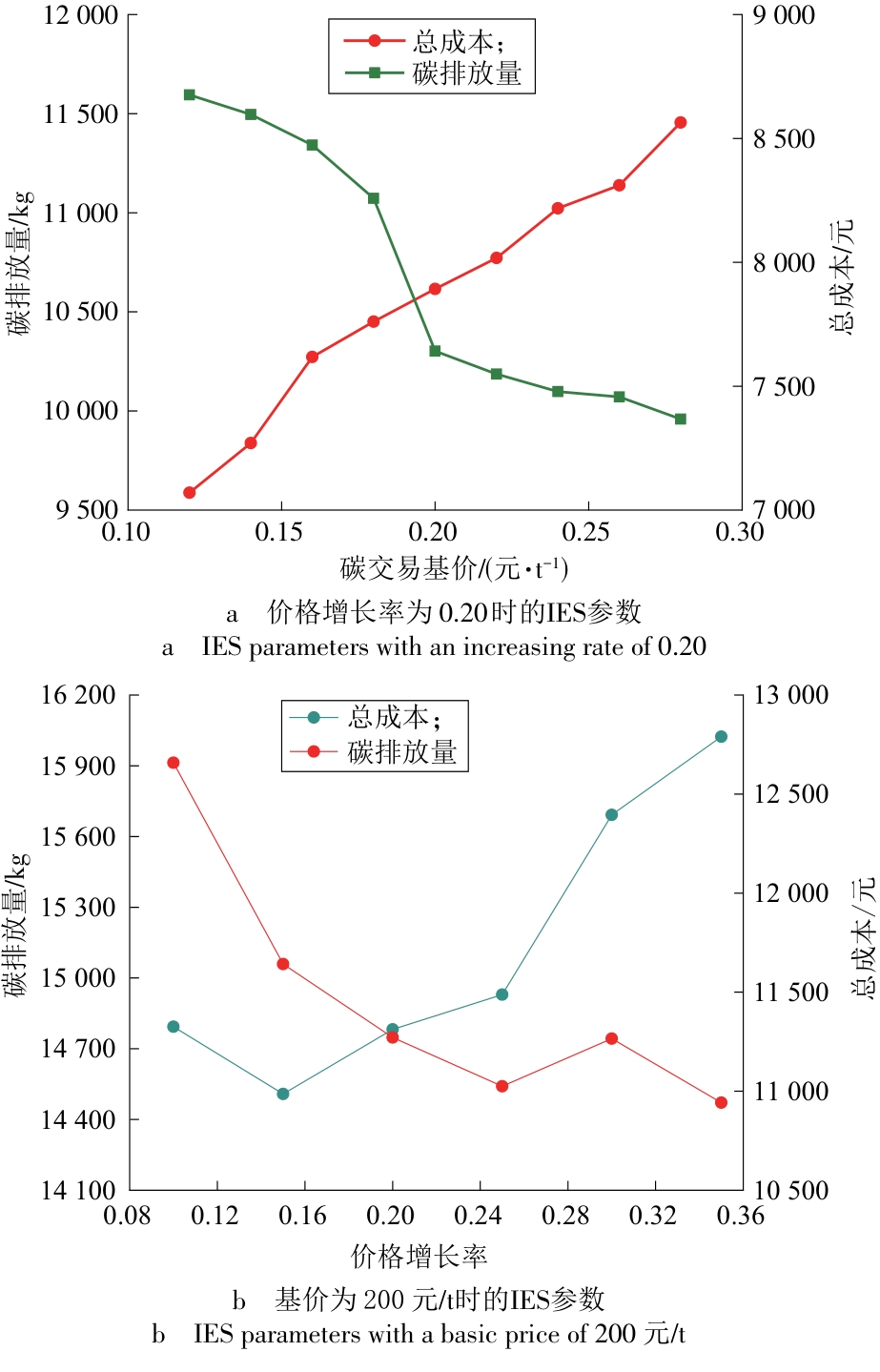
Fig.3
Variation of carbon emission parameters with interval number
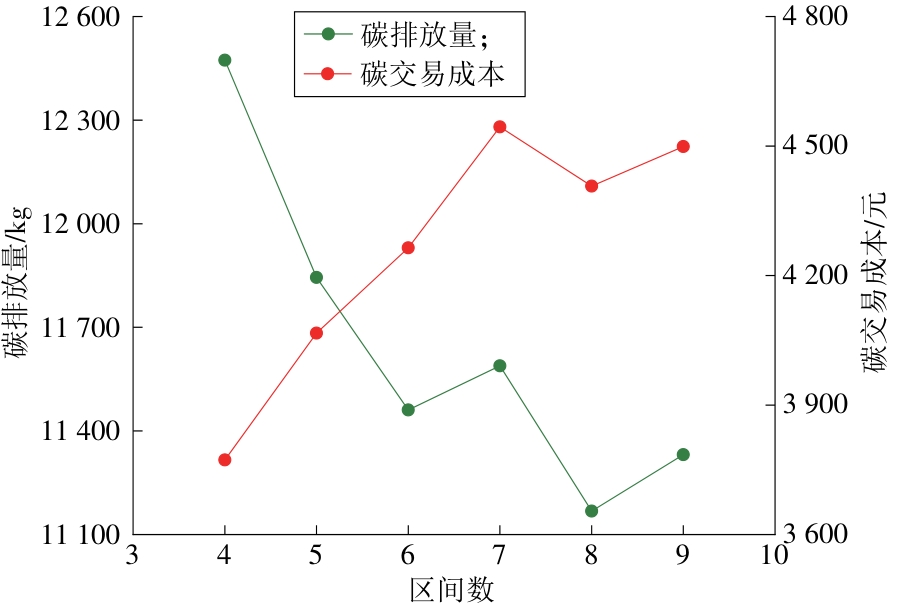
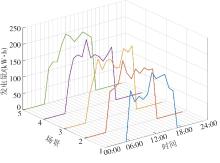
Fig.4
Wind power and PV output of a typical day
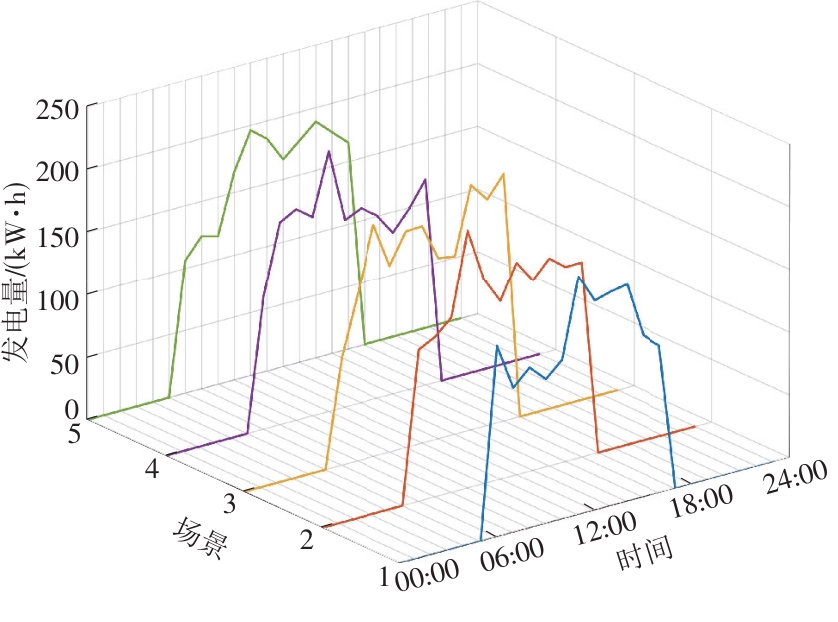
Table 5
Daily costs of the IES under different typical scenarios
| 场景 | 总成本 | ||
|---|---|---|---|
| 模式1 | 模式2 | 模式3 | |
| 1 | 17 652 | 15 659 | 28 698 |
| 2 | 17 571 | 15 818 | 28 532 |
| 3 | 18 128 | 15 777 | 28 508 |
| 4 | 17 924 | 15 749 | 29 148 |
| 5 | 17 300 | 15 024 | 28 012 |
Table 6
Carbon emissions under different typical output scenarios
| 场景 | 日碳排放总量 | ||
|---|---|---|---|
| 模式1 | 模式2 | 模式3 | |
| 1 | 13 271 | 11 662 | 26 746 |
| 2 | 13 065 | 11 816 | 26 002 |
| 3 | 13 587 | 12 000 | 26 048 |
| 4 | 13 432 | 11 846 | 26 712 |
| 5 | 12 680 | 11 123 | 26 598 |
Table 7
Comparison of daily scheduling costs between mixed norm and 1-norm
| ∞-范数的置信度 | 日调度成本 | |
|---|---|---|
| 1-范数 | 混合范数 | |
| 0.50 | 16 689 | 16 125 |
| 0.60 | 16 689 | 16 357 |
| 0.70 | 16 689 | 16 453 |
| 0.80 | 16 689 | 16 523 |
| 0.99 | 16 689 | 16 589 |
Table 8
Comparison of daily scheduling costs between mixed norm and ∞-norm
| 1-范数的置信度 | 日调度成本 | |
|---|---|---|
| ∞-范数 | 混合范数 | |
| 0.50 | 16 643 | 16 223 |
| 0.60 | 16 643 | 16 311 |
| 0.70 | 16 643 | 16 358 |
| 0.80 | 16 643 | 16 412 |
| 0.99 | 16 643 | 16 630 |
| [1] |
彭乐瑶, 马刚, 陈永华, 等. 考虑碳交易体系的微电网多阶段鲁棒优化运行[J]. 综合智慧能源, 2024, 46(9): 9-19.
doi: 10.3969/j.issn.2097-0706.2024.09.002 |
|
PENG Leyao, MA Gang, CHEN Yonghua, et al. Multi-stage robust optimization operation of microgrids considering carbon trading systems[J]. Integrated Intelligent Energy, 2024, 46(9): 9-19.
doi: 10.3969/j.issn.2097-0706.2024.09.002 |
|
| [2] |
WU Z N, LI Z X, YANG H. Day-ahead optimal scheduling for integrated energy system considering dynamic pipe network delay[J]. Electrical Engineering, 2024, 106(5): 6359-6372.
doi: 10.1007/s00202-024-02367-y |
| [3] |
季振亚, 郑帅帅, 许金星, 等. 计及碳-绿证联合交易的含需求响应的综合能源系统调度[J]. 综合智慧能源, 2025, 47(5): 41-50.
doi: 10.3969/j.issn.2097-0706.2025.05.005 |
|
JI Zhenya, ZHENG Shuaishuai, XU Jinxing, et al. Scheduling of integrated energy system with demand response considering carbon-green certificate joint trading[J]. Integrated Intelligent Energy, 2025, 47(5): 41-50.
doi: 10.3969/j.issn.2097-0706.2025.05.005 |
|
| [4] | SU B H, WANG R Q, WANG M, et al. Low-carbon economic dispatch of integrated energy systems in industrial parks considering comprehensive demand response and multi-hydrogen supply[J]. Applied Sciences-Basel, 2024, 14(6):14062381. |
| [5] |
张力, 金立, 任炬光, 等. 计及气象因素与分时电价影响的综合能源系统负荷调控策略研究[J]. 综合智慧能源, 2024, 46(1): 18-27.
doi: 10.3969/j.issn.2097-0706.2024.01.003 |
|
ZHANG Li, JIN Li, REN Juguang, et al. Research on load regulation strategy of integrated energy systems considering meteorological factors and time-of-use tariffs[J]. Integrated Intelligent Energy, 2024, 46(1): 18-27.
doi: 10.3969/j.issn.2097-0706.2024.01.003 |
|
| [6] | YU P, WANG S, WANG R, et al. Robust optimal scheduling of integrated energy system considering flexible load and uncertainty[C]//2024 9th International Conference on Intelligent Computing and Signal Processing (ICSP). IEEE, 2024:1414-1418. |
| [7] |
HOU H, GE X D, YAN Y L, et al. An integrated energy system "green-carbon" offset mechanism and optimization method with Stackelberg game[J]. Energy, 2024, 294:130617.
doi: 10.1016/j.energy.2024.130617 |
| [8] | 曾文帅, 谢经炜, 曾林俊, 等. 考虑阶梯负碳交易与生物质燃气的综合能源系统低碳优化[J]. 电力科学与工程, 2024, 40(10): 42-57. |
| ZENG Wenshuai, XIE Jingwei, ZENG Linjun, et al. Low carbon optimization of integrated energy system considering ladder-type negative carbon trading and biomass gas[J]. Electric Power Science and Engineering, 2024, 40(10): 42-57. | |
| [9] | 陈静, 盛铭真, 张岩, 等. 考虑源荷双侧需求响应和氢能多元利用的综合能源系统低碳经济优化[J]. 广东电力, 2025, 38(1): 18-31. |
| CHEN Jing, SHENG Mingzhen, ZHANG Yan, et al. Low carbon economic optimization of integrated energy systems considering dual demand response of source and load and multiple utilization of hydrogen energy[J]. Guangdong Electric Power, 2025, 38(1): 18-31. | |
| [10] | 封龙, 梁绍华, 邹磊, 等. 基于改进粒子群算法的变工况综合能源系统优化调度[J]. 电气自动化, 2025, 47(1): 16-19, 22. |
| FENG Long, LIANG Shaohua, ZOU Lei, et al. Optimized scheduling of variable condition integrated energy system based on improved particle swarm optimization algorithm[J]. Electrical Automation, 2025, 47(1): 16-19, 22. | |
| [11] | 江美慧, 许镇江, 张其朴, 等. 面向综合能源系统的综合需求响应策略及其建模技术[J]. 电力建设, 2024, 45(12): 65-82. |
| JIANG Meihui, XU Zhenjiang, ZHANG Qipu, et al. Integrated demand response strategy and modeling technology for integrated energy systems[J]. Electric Power Construction, 2024, 45(12): 65-82. | |
| [12] | 江训谱, 包哲静, 于淼, 等. 考虑源荷不确定性的园区综合能源系统鲁棒多阶段规划[J]. 电力建设, 2025, 46(4): 99-112. |
| JIANG Xunpu, BAO Zhejing, YU Miao, et al. Robust multi-stage planning of park-level integrated energy system considering source-load uncertainties[J]. Electric Power Construction, 2025, 46(4): 99-112. | |
| [13] | 徐睿婕, 任永峰, 祝荣, 等. 基于绿证-碳交易交互机制与合作博弈理论的IES系统低碳经济调度[J]. 太阳能学报, 2024, 45(9): 91-100. |
| XU Ruijie, REN Yongfeng, ZHU Rong, et al. Low carbon economic dispatch of IES based on green certificate-carbon trading interaction mechanism and cooperative game theory[J]. Acta Energiae Solaris Sinica, 2024, 45(9): 91-100. | |
| [14] | 李子晨, 夏杨红, 孙勇, 等. 考虑氢能长短周期储能特性的电氢综合能源系统容量配置方法[J]. 电网技术, 2025, 49(1): 12-21. |
| LI Zichen, XIA Yanghong, SUN Yong, et al. Optimal sizing of electricity-hydrogen integrated energy system considering multi-timescale operation of hydrogen storage system[J]. Power System Technology, 2025, 49(1): 12-21. | |
| [15] |
SABOORI H, HEMMATI R. Considering carbon capture and storage in electricity generation expansion planning[J]. IEEE Transactions on Sustainable Energy, 2016, 7(4): 1371-1378.
doi: 10.1109/TSTE.2016.2547911 |
| [16] | 李志伟, 赵雨泽, 吴培, 等. 基于制氢设备精细建模的综合能源系统绿氢蓝氢协调低碳优化策略[J]. 电网技术, 2024, 48(6): 2317-2326. |
| LI Zhiwei, ZHAO Yuze, WU Pei, et al. Low-carbon dispatching strategy of integrated energy system with coordination of green hydrogen and blue hydrogen based on fine modeling of hydrogen production equipment[J]. Power System Technology, 2024, 48(6): 2317-2326. | |
| [17] | 夏晓荣, 杨宇, 刘勇, 等. 电-气综合能源系统的分布式最优调度方法[J]. 电网与清洁能源, 2025, 41(2): 60-66, 74. |
| XIA Xiaorong, YANG Yu, LIU Yong, et al. A distributed optimal dispatch method for electricity-gas integrated energy systems[J]. Power System and Clean Energy, 2025, 41(2): 60-66, 74. | |
| [18] |
ZHANG J L, LIU Z Y. Low carbon economic scheduling model for a park integrated energy system considering integrated demand response, ladder-type carbon trading and fine utilization of hydrogen[J]. Energy, 2024, 290:130311.
doi: 10.1016/j.energy.2024.130311 |
| [19] | 王秀云, 崔本旺. 阶梯型碳交易机制下考虑垃圾焚烧参与的虚拟电厂协调优化调度[J]. 东北电力大学学报, 2024, 44(6): 101-111. |
| WANG Xiuyun, CUI Benwang. Coordinated optimal scheduling of virtual power plants considering waste incineration participation under stepped carbon trading mechanisms[J]. Journal of Northeast Electric Power University, 2024, 44(6): 101-111. | |
| [20] | 王利猛, 张逸, 曲洋. 基于阶梯式碳交易机制与细化电转气和碳循环综合能源系统优化调度[J]. 现代电力, 2024, 41(2): 335-343. |
| WANG Limeng, ZHANG Yi, QU Yang. Optimal dispatch of integrated energy system based on stepped carbon trading mechanism and refined electricity-to-gas and carbon cycle[J]. Modern Electric Power, 2024, 41(2): 335-343. | |
| [21] | MA Y H, HAN D, LU Z X. Optimal multi-timescale scheduling of integrated energy systems with hybrid energy storage system based on Lyapunov optimization[J]. Journal of Beijing Institute of Technology, 2024, 33(5): 465-480. |
| [22] | 李亚峰, 王维庆. 考虑阶梯碳交易机制的含混氢天然气综合能源系统容量配置[J]. 电力科学与技术学报, 2023, 38(6): 237-247. |
| LI Yafeng, WANG Weiqing. Capacity allocation of hydrogen-blended natural gas integrated energy system considering ladder carbon trading mechanism[J]. Journal of Electric Power Science and Technology, 2023, 38(6): 237-247. | |
| [23] |
赵振宇, 任旭. 考虑动态能价及碳证交易的综合能源系统零碳优化[J]. 电力建设, 2024, 45(8): 36-50.
doi: 10.12204/j.issn.1000-7229.2024.08.004 |
|
ZHAO Zhenyu, REN Xu. Zero-carbon optimization of integrated energy system considering dynamic energy prices and carbon certificate trading[J]. Electric Power Construction, 2024, 45(8): 36-50.
doi: 10.12204/j.issn.1000-7229.2024.08.004 |
|
| [24] | 束娜, 江山, 刘春伶, 等. 计及灵活性资源多时间尺度协调互济的电-气-热综合能源系统优化调度[J]. 电力建设, 2024, 45(12): 3-15. |
| SHU Na, JIANG Shan, LIU Chunling, et al. Optimal scheduling of electricity-gas-heat integrated energy system with flexible resources in multiple time scales[J]. Electric Power Construction, 2024, 45(12): 3-15. | |
| [25] | 夏佳伟, 张一帆, 雷浩, 等. 考虑高效氢能利用和碳捕集的综合能源系统低碳优化调度[J]. 电力建设, 2024, 45(12): 100-111. |
| XIA Jiawei, ZHANG Yifan, LEI Hao, et al. Low-carbon economic dispatch of integrated energy system considering efficient hydrogen utilization and carbon capture equipment[J]. Electric Power Construction, 2024, 45(12): 100-111. | |
| [26] | PAN Y, WANG M S, YUAN X D, et al. Optimal operation method for electricity-heat integrated energy system considering vulnerability prevention[J]. Journal of Energy Engineering, 2023, 149(6): 4886. |
| [27] | 郝浩伟, 周博文, 张馨文. 计及碳交易与需求响应的综合能源系统优化研究[J]. 东北电力技术, 2022, 43(10):32-37. |
| HAO Haowei, ZHOU Bowen, ZHANG Xinwen. Research of integrated energy system optimization considering carbon trading and demand response[J]. Northeast Electric Power Technology, 2022, 43(10):32-37. |
| [1] | DING Xinyu, ZHOU Qingcai, CHI Yaodan, ZHANG Yao, WANG Junxi, WANG Chao, JIA Hongdan, LIN Guoxiong. Research progress on modeling, control, and source-load prediction of new-type power systems [J]. Integrated Intelligent Energy, 2026, 48(3): 1-14. |
| [2] | CHEN Feng, LU Xiaomin, LI Mengyang, ZHANG Tao, YANG Fan. Optimization operation of multi-energy complementary system based on multi-agent reinforcement learning [J]. Integrated Intelligent Energy, 2026, 48(3): 15-26. |
| [3] | MU Yutong, WANG Wei. Low-carbon optimal scheduling of wind-solar-thermal-storage combined power generation systems based on APO-PSO [J]. Integrated Intelligent Energy, 2026, 48(3): 37-46. |
| [4] | ZHANG Yang, TAO Shenghu, LIU Qi. Carbon pathway analysis and integrated energy management strategy considering rural energy consumption diversity [J]. Integrated Intelligent Energy, 2026, 48(3): 56-64. |
| [5] | ZHENG Yang, SHI Long, LU Ye, HAO Guangdong. Post-disaster restoration scheduling of distribution networks coordinating fault repair and topology reconfiguration [J]. Integrated Intelligent Energy, 2026, 48(2): 96-105. |
| [6] | XU Cong, XU Jingjing, JIANG Ting, XUE Dong, YAN Lichen. Research on data-driven operation optimization of integrated energy systems [J]. Integrated Intelligent Energy, 2026, 48(1): 34-42. |
| [7] | PAN Lei, DING Yunfei, PANG Yi, WANG Yuxuan, CHEN Jianwei, GAO Rui, ZHANG Liyang. Optimal scheduling strategy for REHMIS-IES based on SC-SAC algorithm [J]. Integrated Intelligent Energy, 2026, 48(1): 43-58. |
| [8] | XUE Dong, XU Jingjing, JIANG Ting, WANG Xiaohai, XU Cong. Research on heat load prediction of integrated energy systems in parks based on dual feature processing [J]. Integrated Intelligent Energy, 2026, 48(1): 59-66. |
| [9] | HONG Liu, LYU Daoxin, YANG Zhongtao, MA Shaowu, JIANG Xue. Linearized calculation method of critical inertia in energy power systems with renewable energy and its application [J]. Integrated Intelligent Energy, 2025, 47(9): 10-17. |
| [10] | DOU Xiang, LI Zhuoqun, ZHANG Zhe, WEN Xin, ZHAO Bo, HAN Yan, ZHONG Sheng. Load forecasting for integrated energy systems based on CNN-BiLSTM-RF-KDE [J]. Integrated Intelligent Energy, 2025, 47(9): 60-70. |
| [11] | CHU Longhao, LI Xiaozhu. Bidding strategies and value allocation mechanism for multi-type electric energy trading with participation of shared energy storage [J]. Integrated Intelligent Energy, 2025, 47(8): 30-39. |
| [12] | ZHAI Shuo, ZHANG Zhiyuan, WANG Weisheng, TIAN Runduo, ZHANG Weizhi, WANG Rui. Vehicle-vehicle energy mutual aid control strategy for electric vehicles [J]. Integrated Intelligent Energy, 2025, 47(8): 40-48. |
| [13] | TAN Jiaqun, LYU Ruxuan, JU Hongjin, HONG Chunxue, XIAO Haiping, LEI Jing, HAN Zhenxing. Research on optimal scheduling strategy of wind-photovoltaic-thermal-storage integrated energy system based on IBES [J]. Integrated Intelligent Energy, 2025, 47(8): 68-76. |
| [14] | SONG Kun, GU Wenbo. Research progress on modeling and optimization of integrated energy systems considering uncertainty [J]. Integrated Intelligent Energy, 2025, 47(7): 32-43. |
| [15] | CHEN Liang, LIU Guiying, SU Shiping, TANG Changjiu, WANG Chenhao, GUO Sitong. Coordinated optimization scheduling of integrated energy system based on PER-MADDPG algorithm with two-layer network [J]. Integrated Intelligent Energy, 2025, 47(7): 44-54. |
| Viewed | ||||||
|
Full text |
|
|||||
|
Abstract |
|
|||||