Integrated Intelligent Energy ›› 2026, Vol. 48 ›› Issue (3): 65-75.doi: 10.3969/j.issn.2097-0706.2026.03.007
• Low-carbon Technical Economy • Previous Articles Next Articles
XIA Xiaoping1( ), YAO Dehua1(), SONG Zongtao1(), WANG Yueyue1(), TAN Yifan2,3(), FANG Yiming2,3(), ZHANG Jun2,3,*()
Received:2025-12-04
Revised:2026-01-15
Published:2026-03-25
Contact:
ZHANG Jun
E-mail:xiaxp@csg.cn;yaodh@csg.cn;songzt@csg.cn;wangyueyue@csg.cn;tanyifans@stilb.cn;fym@stlib.cn;zhangjun@mail.whlib.ac.cn
Supported by:CLC Number:
XIA Xiaoping, YAO Dehua, SONG Zongtao, WANG Yueyue, TAN Yifan, FANG Yiming, ZHANG Jun. Research on construction pathways for zero-carbon parks driven by data flywheel[J]. Integrated Intelligent Energy, 2026, 48(3): 65-75.
Add to citation manager EndNote|Ris|BibTeX
URL: https://www.hdpower.net/EN/10.3969/j.issn.2097-0706.2026.03.007
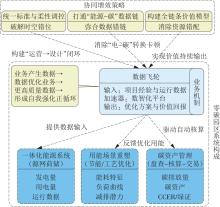
Fig.1
Construction pathways for integrated energy systems in zero-carbon parks
Table 1
Quantitative comparative analysis of key indicators for typical zero-carbon parks
| 案例名称 | 建设规模 | 技术指标 | 经济效应 |
|---|---|---|---|
| 厦门ABB工业中心[ | 项目建10万㎡屋顶光伏,全年发电量约11.41 GW∙h,搭建智能能源调控平台、新能源发电和储能系统 | 实现AI预测“源-网-荷-储”; 年减碳量1.13万t,年减碳1.34万t; 清洁能源利用率50%; 光伏自发自用率84.4% | 全年节省电费140万元; 园区“源-网-荷-储“互动实施后,中心年度用电量减少5%,能源成本降低22%,投资收益率超8%[ |
| 深圳虚拟电厂管理中心[ | 接入容量3 800 MW,可调资源6万余个,涵盖充电桩、空调、光伏等9类资源,61家运营商,最大调节能力1 200 MW | 2023年以来累计调节次数超100次,调节电量超5 603 MW∙h; 年减碳量约4 681.2 t; 实现毫秒级/秒级/分钟级响应能力,调节精度96.6% | 调节运营商经济收益约1 820万元,创造直接经济效益达1.7亿元; 带动百余家企业进入虚拟电厂产业链 |
| 博鳌东屿岛零碳示范区[ | 光伏投资超1亿元,总装机23.8 MW,全年生产电量32 GW∙h | 绿电自给率100%; 年均节约标准煤8 912 t、减少二氧化碳排放约2.3万t[ | 该项目将余电15 GW·h上网销售,通过绿电交易获得0.2元/(kW·h)的市场溢价,并获环保税减免 |
Table 2
Construction pathways for zero-carbon parks driven by data flywheel
| 阶段 | 具体内容 |
|---|---|
| 获取 | 新建设备兼容开放通信协议; 存量设备实施边缘网关改造; 统一元数据标准; 园区准入和绿色认证要求 |
| 存储 | 建立数据产权制度; 实施分级分类存储; 应用隐私计算技术; 构建数据要素交易机制 |
| 进入 | 建立业务与性能指标关联映射; 基于场景需求训练和微调AI模型; 促进数据驱动业务决策; 构建数据驱动的绩效评价体系 |
| 加速 | “价值发现—价值创造—价值分配”闭环数据产品超市 |
| 适应 | 实现“政府-企业-平台-用户”协同; 推动全国零碳园区技术标准统一; 实现园区内部产业链能源数据共享 |
| [1] | 清华大学环境学院. 中国工业园区绿色低碳发展报告(2023)[EB/OL].(2023-08-31)[2025-12-03]. https://www.env.tsinghua.edu.cn/info/1129/8369.htm. |
| [2] | 国家发展改革委, 工业和信息化部, 国家能源局. 关于开展零碳园区建设的通知(发改环资〔2025〕910号)[EB/OL]. (2025-06-30)[2025-12-03]. https://zfxxgk.ndrc.gov.cn/web/iteminfo.jspid=20523. |
| [3] | 张灿, 张明震. 中国新型公路交通能源综合系统发展对策研究[J]. 南方能源建设, 2024, 11(5): 95-104. |
| ZHANG Can, ZHANG Mingzhen. Countermeasures for the development of China's new highway transportation energy integrated system[J]. Southern Energy Construction, 2024, 11(5): 95-104. | |
| [4] | 胥德玉, 黄媛, 唐志远, 等. 面向配电网分布式光伏消纳和可靠性提高的构网型储能优化配置[J/OL]. 电力建设: 1-16(2025-06-06)[2025-12-03]. https://link.cnki.net/urlid/11.2583.tm.20250605.1446.002. |
| XU Deyu, HUANG Yuan, TANG Zhiyuan, et al. Research on grid-forming energy storage configuration for distributed photovoltaic consumption and reliability improvement of distribution network[J/OL]. Electric Power Construction: 1-16(2025-06-06)[2025-12-03]. https://link.cnki.net/urlid/11.2583.tm.20250605.1446.002. | |
| [5] | 王永利, 张思文, 郭璐, 等. 面向碳市场交易的(近)零碳园区综合能源系统配置优化方法[J]. 煤炭经济研究, 2024, 44(2): 83-91. |
| WANG Yongli, ZHANG Siwen, GUO Lu, et al. Research on optimization method of integrated energy system allocation in(near)zero-carbon parks for carbon market trading[J]. Coal Economic Research, 2024, 44(2): 83-91. | |
| [6] | 段海涛, 贾博程, 赵海生, 等. 中国零碳园区建设实践与挑战[J]. 国际石油经济, 2025, 33(8): 105-111. |
| DUAN Haitao, JIA Bocheng, ZHAO Haisheng, et al. The practice and challenges of zero-carbon industrial park construction in China[J]. International Petroleum Economics, 2025, 33(8): 105-111. | |
| [7] | T/CIECCPA031—2023:零碳园区评价通则[S]. 北京: 中国工业节能与清洁生产协会, 2023. |
| [8] | 马彤兵, 李镜. 零碳智慧园区构建途径与策略研究[J]. 内蒙古科技与经济, 2023(5): 23-26. |
| MA Tongbing, LI Jing. Study on the approaches and strategies of construction zero-carbon smart parks[J]. Inner Mongolia Science Technology & Economy, 2023(5): 23-26. | |
| [9] | T/AIAC002—2023:零碳园区评价标准[S]. 北京: 中国投资协会, 2023. |
| [10] | 蒋庆哲, 刘杨, 蒲欣宇, 等. 零碳园区建设的系统路径、发展模式及治理生态[J]. 中国人口·资源与环境, 2025, 35(5): 13-23. |
| JIANG Qingzhe, LIU Yang, PU Xinyu, et al. Systematic pathways, development models, and governance ecosystem of zero carbon emission park construction[J]. China Population, Resources and Environment, 2025, 35(5): 13-23. | |
| [11] |
GE L, LI Y, YAN J, et al. Short-term load prediction of integrated energy system with wavelet neural network model based on improved particle swarm optimization and chaos optimization algorithm[J]. Journal of Modern Power Systems and Clean Energy, 2021, 9(6): 1490-1499.
doi: 10.35833/MPCE.2020.000647 |
| [12] | 薛东, 徐静静, 江婷, 等. 基于双重特征处理的园区综合能源系统供热负荷预测研究[J/OL]. 综合智慧能源: 1-9(2025-10-27)[2025-12-03]. https://link.cnki.net/urlid/41.1461.TK.20251024.1320.004. |
| Xue Dong, Xu Jingjing, Jiang Ting, et al. Research on heat load prediction of integrated energy systems in parks based on dual feature processing[J/OL]. Integrated Intelligent Enerey: 1-9(2025-10-27)[2025-12-03]. https://link.cnki.net/urlid/41.1461.TK.20251024.1320.004. | |
| [13] |
杨澜倩, 郭锦敏, 田慧丽, 等. 基于CNN-LSTM-Self attention的园区负荷多尺度预测研究[J]. 综合智慧能源, 2025, 47(2): 79-87.
doi: 10.3969/j.issn.2097-0706.2025.02.008 |
|
YANG Lanqian, GUO Jinmin, TIAN Huili, et al. Research on multi-scale load prediction in parks based on CNN-LSTM-Self attention[J]. Integrated Intelligent Energy, 2025, 47(2): 79-87.
doi: 10.3969/j.issn.2097-0706.2025.02.008 |
|
| [14] |
张元曦, 杨国华, 马龙腾, 等. 基于改进DE算法的园区微电网风光储优化配置[J]. 综合智慧能源, 2025, 47(9): 71-79.
doi: 10.3969/j.issn.2097-0706.2025.09.008 |
|
ZHANG Yuanxi, YANG Guohua, MA Longteng, et al. Optimized wind-solar-storage configuration of industrial park microgrids based on improved differential evolution algorithm[J]. Integrated Intelligent Energy, 2025, 47(9): 71-79.
doi: 10.3969/j.issn.2097-0706.2025.09.008 |
|
| [15] |
刘媛媛, 刘芳芳, 贾天翔, 等. 商住园区综合能源供暖(冷)系统的方案设计及运行经济性研究[J]. 综合智慧能源, 2023, 45(12): 20-28.
doi: 10.3969/j.issn.2097-0706.2023.12.003 |
|
LIU Yuanyuan, LIU Fangfang, JIA Tianxiang, et al. Design of the integrated energy heating(cooling)system for a commercial and residential park and its economy analysis[J]. Integrated Intelligent Energy, 2023, 45(12): 20-28.
doi: 10.3969/j.issn.2097-0706.2023.12.003 |
|
| [16] |
王俊, 田浩, 赵二岗, 等. 计及电动汽车共享储能特性的园区柔性资源低碳运行控制方法[J]. 综合智慧能源, 2024, 46(6): 16-26.
doi: 10.3969/j.issn.2097-0706.2024.06.003 |
|
WANG Jun, TIAN Hao, ZHAO Ergang, et al. Low-carbon operation control on park-level integrated energy systems considering shared energy storage devices for electric vehicles[J]. Integrated Intelligent Energy, 2024, 46(6): 16-26.
doi: 10.3969/j.issn.2097-0706.2024.06.003 |
|
| [17] |
孔慧超, 黄学劲, 王文钟, 等. 园区受端新型电力系统电力电量再平衡方法[J]. 综合智慧能源, 2024, 46(2): 68-74.
doi: 10.3969/j.issn.2097-0706.2024.02.009 |
|
KONG Huichao, HUANG Xuejin, WANG Wenzhong, et al. Electric power and energy rebalancing method for new power systems at receiving ends of industrial parks[J]. Integrated Intelligent Energy, 2024, 46(2): 68-74.
doi: 10.3969/j.issn.2097-0706.2024.02.009 |
|
| [18] |
谢典, 高亚静, 芦新波, 等. 能耗“双控”向碳排放“双控”转变的实施路径研究[J]. 综合智慧能源, 2022, 44(7): 73-80.
doi: 10.3969/j.issn.2097-0706.2022.07.009 |
|
XIE Dian, GAO Yajing, LU Xinbo, et al. Research on the implementation path of the transition from dual control on energy consumption to dual control on carbon emission[J]. Integrated Intelligent Energy, 2022, 44(7): 73-80.
doi: 10.3969/j.issn.2097-0706.2022.07.009 |
|
| [19] |
赵丹, 朱丽敏, 胡珅, 等. 基于模糊实物期权的企业碳资产估值模型构建[J]. 综合智慧能源, 2024, 46(8): 28-35.
doi: 10.3969/j.issn.2097-0706.2024.08.004 |
|
ZHAO Dan, ZHU Limin, HU Shen, et al. Construction of an enterprise carbon asset valuation model based on fuzzy real options[J]. Integrated Intelligent Energy, 2024, 46(8): 28-35.
doi: 10.3969/j.issn.2097-0706.2024.08.004 |
|
| [20] | 陈婧, 王佳睿, 朱佳盈, 等. “双碳”目标下电力大数据碳资产管理方法研究[J]. 电气技术与经济, 2025(10): 236-238, 242. |
| CHEN Jing, WANG Jiarui, ZHU Jiaying, et al. Research on carbon asset management method of power big data under the goal of "double carbon"[J]. Electrical Equipment and Economy, 2025(10): 236-238, 242. | |
| [21] | 朱国栋, 罗浩, 刘洋, 等. “双碳”目标下零碳园区碳资产管理体系构建研究——基于产业园区电力数据的分析[J/OL]. 价格理论与实践: 1-8(2025-07-16)[2025-12-03]. https://doi.org/10.19851/j.cnki.CN11-1010/F.2025.10.351. |
| Zhu Guodong, Luo Hao, Liu Yang, et al. Research on the establishment of carbon asset management system for zero-carbon parks under the dual carbon goals——Based on the analysis of power data in industrial parks[J/OL]. Price: Theory & Practice: 1-8(2025-07-16)[2025-12-03]. https://doi.org/10.19851/j.cnki.CN11-1010/F.2025.10.351. | |
| [22] | 蒋月红, 王豪, 叶飞宇. 智慧管控一体化系统在综合能源工程的应用[J]. 能源研究与管理, 2021, 13(4): 123-127. |
| JIANG Yuehong, WANG Hao, YE Feiyu. Application of intelligent management and control system in integrated energy project[J]. Energy Research and Management, 2021, 13(4): 123-127. | |
| [23] | 国家能源局. 能源绿色低碳转型典型案例发布[EB/OL]. (2024-05-19) [2025-12-03]. https://www.nea.gov.cn/2024-05/19/c_1310775206.htm. |
| [24] | 陶春华. 碳资产: 生态环保的新理念——概念、意义与实施路径研究[J]. 学术论坛, 2016, 39(6): 64-67. |
| TAO Chunhua. Carbon assets: A new concept of eco-environmental protection—Research on concept, significance and implementation path[J]. Academic Forum, 2016, 39(6): 64-67. | |
| [25] | 赵蓉英, 刘卓著, 王君领. 知识转化模型SECI的再思考及改进[J]. 情报杂志, 2020, 39(11): 173-180. |
| ZHAO Rongying, LIU Zhuozhu, WANG Junling. Rethinking and improvement of knowledge transformation model SECI[J]. Journal of Intelligence, 2020, 39(11): 173-180. | |
| [26] | 赵士英, 洪晓楠. 显性知识与隐性知识的辩证关系[J]. 自然辩证法研究, 2001, 17(10): 20-23, 33. |
| ZHAO Shiying, HONG Xiaonan. The dialectical relationship between explicit knowledge and tacit knowledge[J]. Studies in Dialectics of Nature, 2001, 17(10): 20-23, 33. | |
| [27] | 胡超凡. 生成式人工智能重塑企业微创新的机制——基于隐性知识和组织学习边界的视角[J/OL]. 企业科技与发展: 1-29(2025-07-16)[2025-12-03]. https://doi.org/10.20137/j.qykjyfz.45-1359/t.20250715.001. |
| HU Chaofan. Generative artificial intelligence reshaping micro-innovation mechanisms in enterprises: A perspective based on tacit knowledge and organizational learning boundaries[J/OL]. Enterprise Science and Technology Development: 1-29(2025-07-16)[2025-12-03]. https://doi.org/10.20137/j.qykjyfz.45-1359/t.20250715.001. | |
| [28] | 王文京, 吕本富, 刘颖. “数据飞轮”驱动“企业互联网化”[J]. 中国经济周刊, 2015(22): 78-79. |
| WANG Wenjing, LYU Benfu, LIU Ying. "Data flywheel" drives "enterprise internetization"[J]. China Economic Weekly, 2015(22): 78-79. | |
| [29] | 王子阳, 朱武祥, 李浩然, 等. AI时代如何构建数据飞轮[J]. 清华管理评论, 2024(4): 59-65. |
| WANG Ziyang, ZHU Wuxiang, LI Haoran, et al. How to build a data flywheel in AI era[J]. Tsinghua Business Review, 2024(4): 59-65. | |
| [30] | 电力规划设计总院. 深度解读“十四五”现代能源体系规划之我国能源区域布局的变与不变[EB/OL]. (2022-09-05)[2025-12-03]. https://m.bjx.com.cn/mnews/20220905/1253208.shtml. |
| [31] | 郭雪伟, 曲昌盛, 徐东耀. 双碳背景下碳排放核算体系现状与展望[J]. 环境工程技术学报, 2025, 15(3): 819-832. |
| GUO Xuewei, QU Changsheng, XU Dongyao. Current status and prospects of carbon emission accounting system under the "dual carbon" background[J]. Journal of Environmental Engineering Technology, 2025, 15(3): 819-832. | |
| [32] |
BREMER L, DEN NIJS S, DE GROOT H L F. The energy efficiency gap and barriers to investments: Evidence from a firm survey in the Netherlands[J]. Energy Economics, 2024, 133: 107498.
doi: 10.1016/j.eneco.2024.107498 |
| [33] | 林露虹. 跨国企业ABB在厦门火炬高新区30多年的成长故事——一场双向奔赴解锁“高新密码”[N]. 厦门日报, 2023-12-14(A02). |
| [34] | 深圳市人民政府. 深圳虚拟电厂总容量快速增长[EB/OL]. (2024-09-10) [2025-12-03]. https://www.sz.gov.cn/cn/xxgk/zfxxgj/zwdt/content/post_11547654.html. |
| [35] | 郭卫华. 从东屿岛到世界:博鳌零碳示范区交出“中国答案”[EB/OL]. (2025-05-05)[2025-12-03]. https://paper.people.com.cn/zgnyb/pc/content/202505/05/content_30072197.html. |
| [36] | 王晓斌, 朱滢琳, 陈明帆. 博鳌东屿岛零碳示范园区入选2025全球能源互联网“十大引领工程”[EB/OL]. (2025-09-10)[2025-12-03]. https://m.chinanews.com/wap/detail/zw/cj/2025/09-10/10366661.shtml. |
| [37] | 刘艳, 郭芷祎. “数据大脑”助工业园区绿色转型获2024年全国一等奖[EB/OL]. (2024-11-21)[2025-12-03].https://www.xmnn.cn/xmwb/20241121/202411/t20241121_30072197.htm. |
| [38] | IEA. Digitalisation and energy[R]. Paris: IEA, 2017. |
| [39] | 严红, 穆志勇, 李明哲, 等. 元数据标准化发展研究[J]. 信息技术与标准化, 2023(9): 25-29, 53. |
| YAN Hong, MU Zhiyong, LI Mingzhe, et al. Research on the development of metadata standardardization[J]. Information Technology & Standardization, 2023(9): 25-29, 53. | |
| [40] | 隐私计算联盟, 中国信息通信研究院. 隐私计算白皮书(2023年)[R]. 北京: 中国信息通信研究院, 2023. |
| [41] | 中国移动通信有限公司研究院, 中国质量认证中心, 中国信息通信研究院, 等. 区块链赋能“碳达峰碳中和”白皮书(2022版)[R]. 北京: 中国信息通信研究院, 2022. |
| [42] | 中国信息通信研究院. 云计算白皮书(2024年)[R]. 北京: 中国信息通信研究院, 2024. |
| [43] | 李文超. 区块链技术在版权纠纷诉源治理中的应用研究[J]. 中国版权, 2021(2): 91-97. |
| LI Wenchao. Research on the application of blockchain technology in the source management of copyright disputes[J]. China Copyright, 2021(2): 91-97. | |
| [44] |
YU W, PATROS P, YOUNG B, et al. Energy digital twin technology for industrial energy management: Classification, challenges and future[J]. Renewable and Sustainable Energy Reviews, 2022, 161: 112407.
doi: 10.1016/j.rser.2022.112407 |
| [45] |
GUO J C, WU H, MA T, et al. Scenario-adaptive hierarchical optimisation framework for design in hybrid energy storage systems[J]. Nature Communications, 2025, 17(1): 1-19.
doi: 10.1038/s41467-025-65774-0 |
| [1] | CHEN Feng, LU Xiaomin, LI Mengyang, ZHANG Tao, YANG Fan. Optimization operation of multi-energy complementary system based on multi-agent reinforcement learning [J]. Integrated Intelligent Energy, 2026, 48(3): 15-26. |
| [2] | WANG Zixuan, HAO Yu, LIU Xingchen, SUN Weinan, LIU Lin, ZHANG Yi. Distributed robust low-carbon optimization model for integrated energy systems driven by historical data [J]. Integrated Intelligent Energy, 2026, 48(3): 47-55. |
| [3] | ZHANG Yang, TAO Shenghu, LIU Qi. Carbon pathway analysis and integrated energy management strategy considering rural energy consumption diversity [J]. Integrated Intelligent Energy, 2026, 48(3): 56-64. |
| [4] | XU Cong, XU Jingjing, JIANG Ting, XUE Dong, YAN Lichen. Research on data-driven operation optimization of integrated energy systems [J]. Integrated Intelligent Energy, 2026, 48(1): 34-42. |
| [5] | PAN Lei, DING Yunfei, PANG Yi, WANG Yuxuan, CHEN Jianwei, GAO Rui, ZHANG Liyang. Optimal scheduling strategy for REHMIS-IES based on SC-SAC algorithm [J]. Integrated Intelligent Energy, 2026, 48(1): 43-58. |
| [6] | XUE Dong, XU Jingjing, JIANG Ting, WANG Xiaohai, XU Cong. Research on heat load prediction of integrated energy systems in parks based on dual feature processing [J]. Integrated Intelligent Energy, 2026, 48(1): 59-66. |
| [7] | DOU Xiang, LI Zhuoqun, ZHANG Zhe, WEN Xin, ZHAO Bo, HAN Yan, ZHONG Sheng. Load forecasting for integrated energy systems based on CNN-BiLSTM-RF-KDE [J]. Integrated Intelligent Energy, 2025, 47(9): 60-70. |
| [8] | TAN Jiaqun, LYU Ruxuan, JU Hongjin, HONG Chunxue, XIAO Haiping, LEI Jing, HAN Zhenxing. Research on optimal scheduling strategy of wind-photovoltaic-thermal-storage integrated energy system based on IBES [J]. Integrated Intelligent Energy, 2025, 47(8): 68-76. |
| [9] | HONG Chunxue, XIAO Haiping, TAN Jiaqun, LYU Ruxuan, CHEN Yanpeng, JU Xing. Multi-objective optimal schedule of a wind-photovoltaic-thermal-storage energy base considering capacity tariffs [J]. Integrated Intelligent Energy, 2025, 47(7): 1-11. |
| [10] | SONG Kun, GU Wenbo. Research progress on modeling and optimization of integrated energy systems considering uncertainty [J]. Integrated Intelligent Energy, 2025, 47(7): 32-43. |
| [11] | CHEN Liang, LIU Guiying, SU Shiping, TANG Changjiu, WANG Chenhao, GUO Sitong. Coordinated optimization scheduling of integrated energy system based on PER-MADDPG algorithm with two-layer network [J]. Integrated Intelligent Energy, 2025, 47(7): 44-54. |
| [12] | XING Zuoxia, ZHAO Ziyi, SUN Hao, ZHANG Pengfei, FU Qitong. Research on low-carbon economic operation optimization of integrated energy systems based on multi-level utilization of hydrogen production from electricity [J]. Integrated Intelligent Energy, 2025, 47(7): 71-81. |
| [13] | ZHANG Debin, LIN Wenye, HE Zixuan, YUE Xinru, SONG Wenji, FENG Ziping, FARID Mohammed Mehdi, USHAK DE GRAGEDA Svetlana Nikolaevna. Day-ahead dispatch optimization for integrated energy system in building prosumer community using generalized energy storage [J]. Integrated Intelligent Energy, 2025, 47(7): 82-92. |
| [14] | CHEN Hao, MA Gang, QIAN Da, MA Jian, PENG Leyao. Optimization of regional integrated energy systems under green certificate and carbon trading mechanism considering tiered demand response [J]. Integrated Intelligent Energy, 2025, 47(5): 21-30. |
| [15] | JI Zhenya, ZHENG Shuaishuai, XU Jinxing, LIU Xiaofeng, BAO Yuqing. Scheduling of integrated energy system with demand response considering carbon-green certificate joint trading [J]. Integrated Intelligent Energy, 2025, 47(5): 41-50. |
| Viewed | ||||||
|
Full text |
|
|||||
|
Abstract |
|
|||||