Integrated Intelligent Energy ›› 2025, Vol. 47 ›› Issue (10): 34-44.doi: 10.3969/j.issn.2097-0706.2025.10.004
• Electrochemical Energy Storage • Previous Articles Next Articles
QIU Wenting1( ), DONG Jiale1(), WU Di1(), SU Wenjing1,*(), ZONG Yi2()
Received:2024-11-06
Revised:2024-12-06
Published:2025-01-21
Contact:
SU Wenjing
E-mail:22203010142@stu.wit.edu.cn;1464338590@qq.com;956807493@qq.com;04004037@wit.edu.cn;yizo@dtu.dk
Supported by:CLC Number:
QIU Wenting, DONG Jiale, WU Di, SU Wenjing, ZONG Yi. Economic and low-carbon coordinated optimization scheduling of hydrogen-integrated multi-energy system based on NSGA-Ⅱ[J]. Integrated Intelligent Energy, 2025, 47(10): 34-44.
Add to citation manager EndNote|Ris|BibTeX
URL: https://www.hdpower.net/EN/10.3969/j.issn.2097-0706.2025.10.004
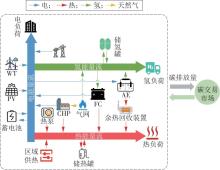
Fig.1
Schematic diagram of electricity-heat-hydrogen MES
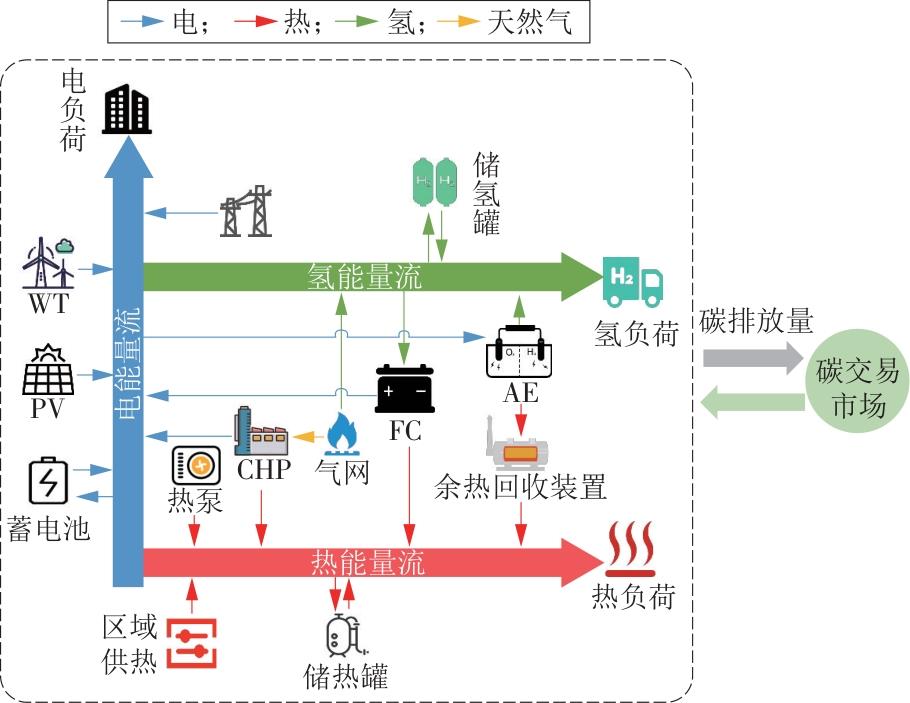
Table 1
Key component parameters of the system
| 项目 | 数值 | 项目 | 数值 | ||
|---|---|---|---|---|---|
| AE | 安装容量/kW | 500 | 储氢罐额定容量/(kW·h) | 200 | |
| 单堆额定功率/kW | 26.6 | FC | 安装容量/kW | 250 | |
| 最大功率/kW | 400 | 产电效率 | 0.85 | ||
| 最小功率/kW | 40 | 产热效率 | 1.2 | ||
| 爬坡约束 | 0.2 | 蓄电池/储热罐额定容量/(kW·h) | 400 | ||
| 氢的高热值/[kW·h·kg-1] | 39.4 | ||||
| 氢密度/(kg·m-3) | 7.8 | 热泵 | 安装容量/kW | 400 | |
| 最高堆叠温度/℃ | 80 | 效率 | 4.4 | ||
| 最低堆叠温度/℃ | 60 | ||||
| 余热装置效率 | 0.8 | ||||
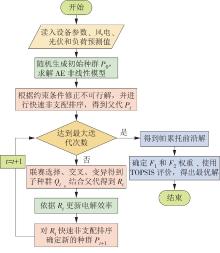
Fig.2
Optimization algorithm process of MES based on NSGA-Ⅱ
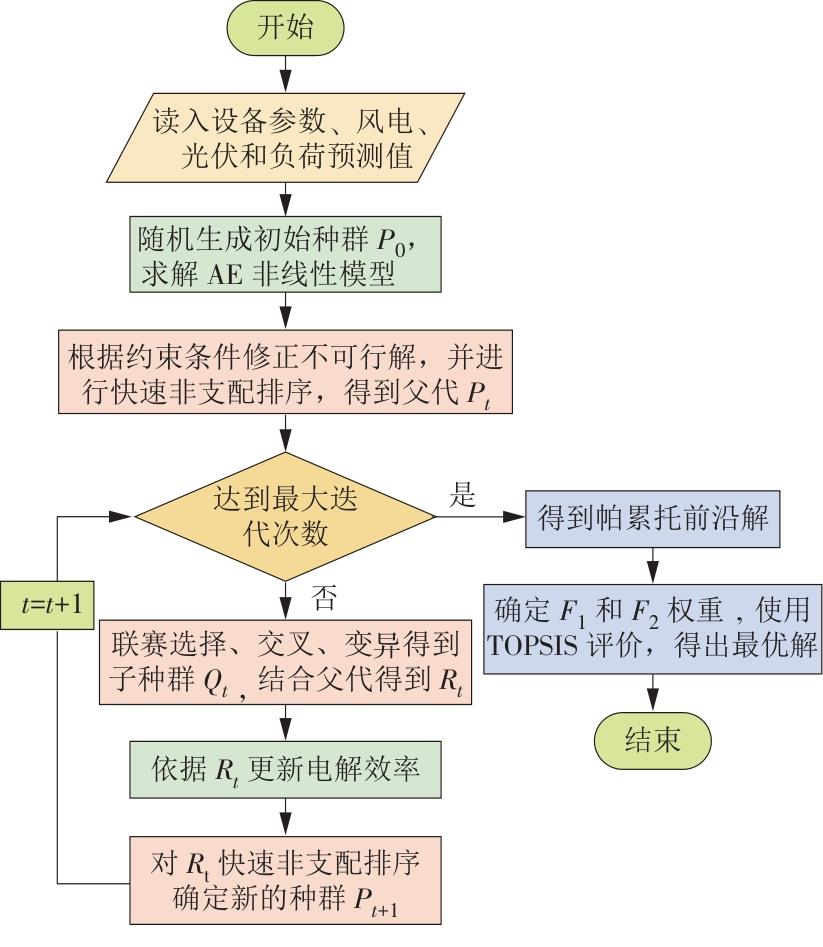
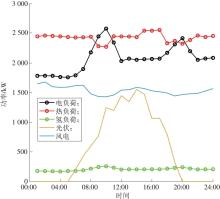
Fig.3
Curves of day-ahead load and wind-solar power generation
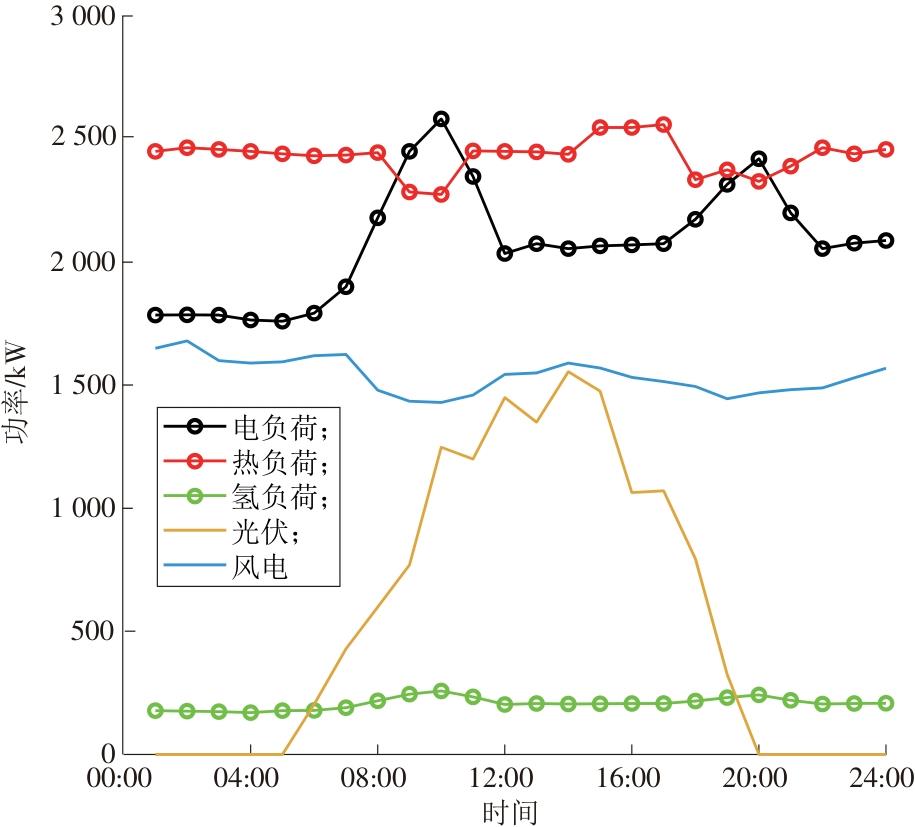
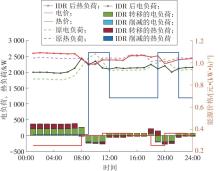
Fig.4
Composition of electric and heat loads with integrated demand response
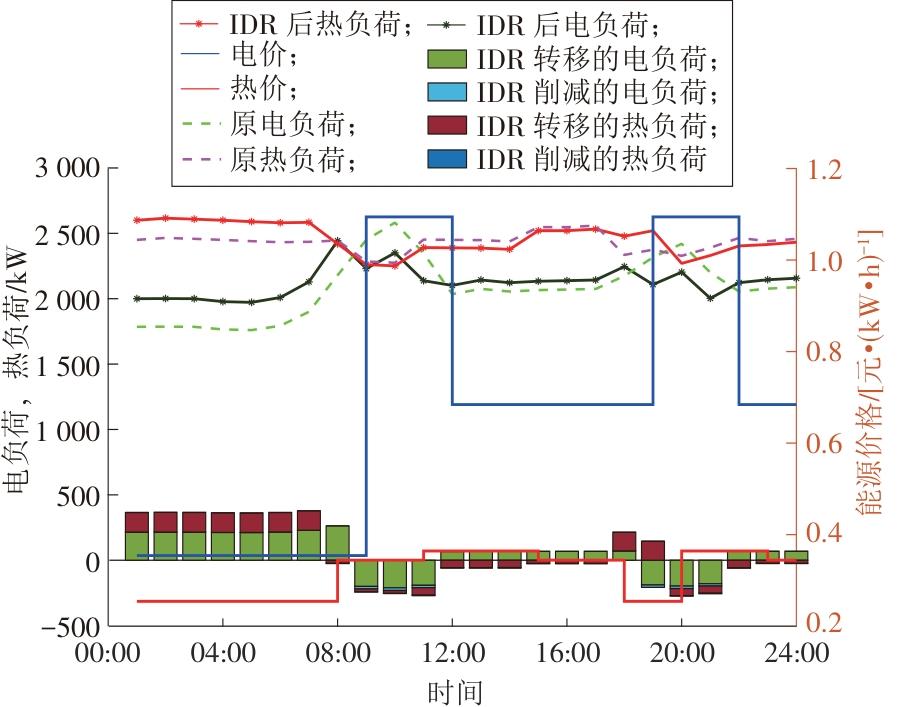
Table 2
Operation results with and without considering integrated demand response and carbon trading mechanisms
| 项目 | 总运行成本/元 | 碳排放量/t |
|---|---|---|
| 未考虑IDR和碳交易机制 | 42 507.224 | 19.862 |
| 仅考虑IDR | 39 838.417 | 18.899 |
| 考虑IDR和碳交易机制 | 38 736.349 | 17.597 |
Table 3
Operation results under three scenarios
| 项目 | 情景1 | 情景2 | 情景3 |
|---|---|---|---|
| 总运行成本/元 | 38 736.349 | 25 921.737 | 25 766.618 |
| 购能成本/元 | 36 956.368 | 22 356.315 | 21 911.388 |
| 碳交易成本/元 | 242.661 | 217.152 | 178.738 |
| 碳排放量/t | 17.597 | 8.164 | 7.451 |
Table 4
Optimal operation results with different electrolysis efficiencies
| 情景 | 电解效率 | 总运行成本/元 | 日产氢量/m3 |
|---|---|---|---|
| 2 | 0.67 | 31 102.822 | 5.429 |
| 0.69 | 25 921.737 | 6.701 | |
| 0.71 | 23 029.549 | 8.316 | |
| 3 | 时变 | 25 766.618 | 8.414 |
Fig.5
Electrolysis efficiencies of the optimal solution in scenario 3
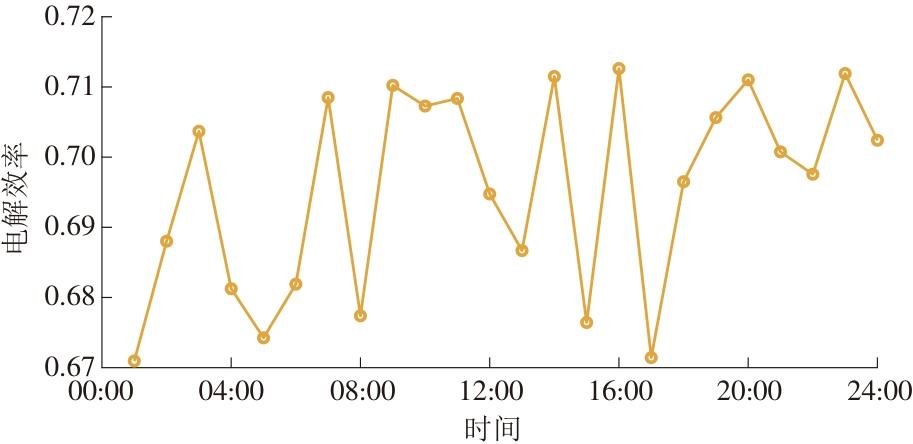
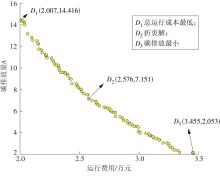
Fig.6
Pareto front solutions for scenario 3
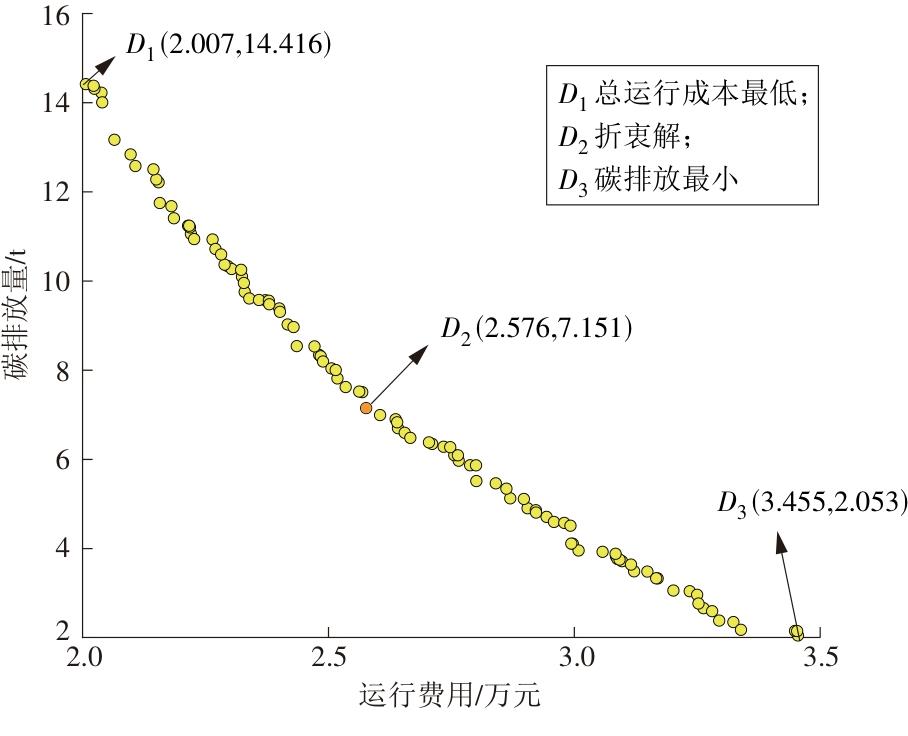
Fig.7
Electricity-hydrogen-heat energy balance in scenario 1
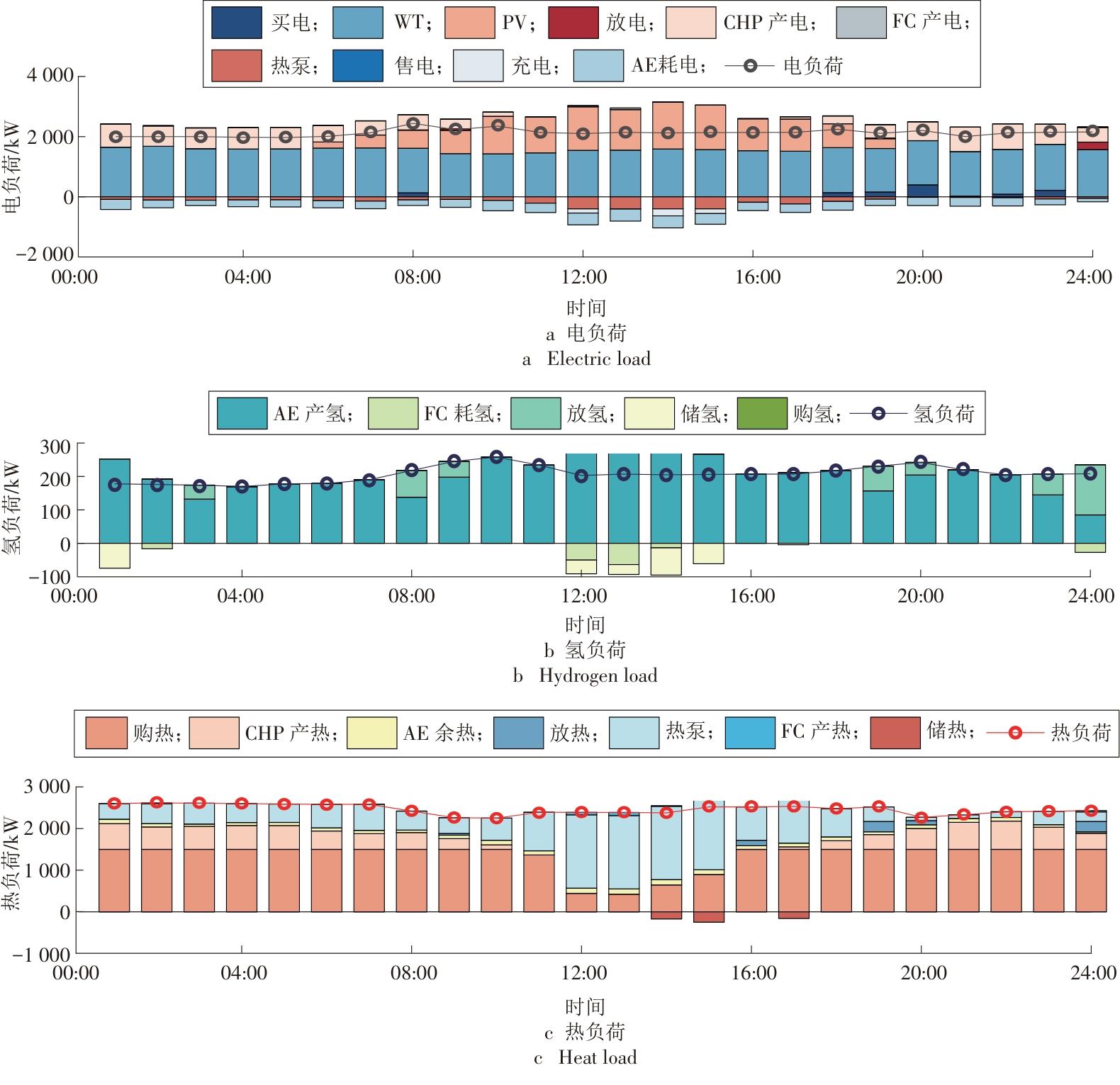
Fig.8
Electric load balance diagram of the optimal solution in scenario 3
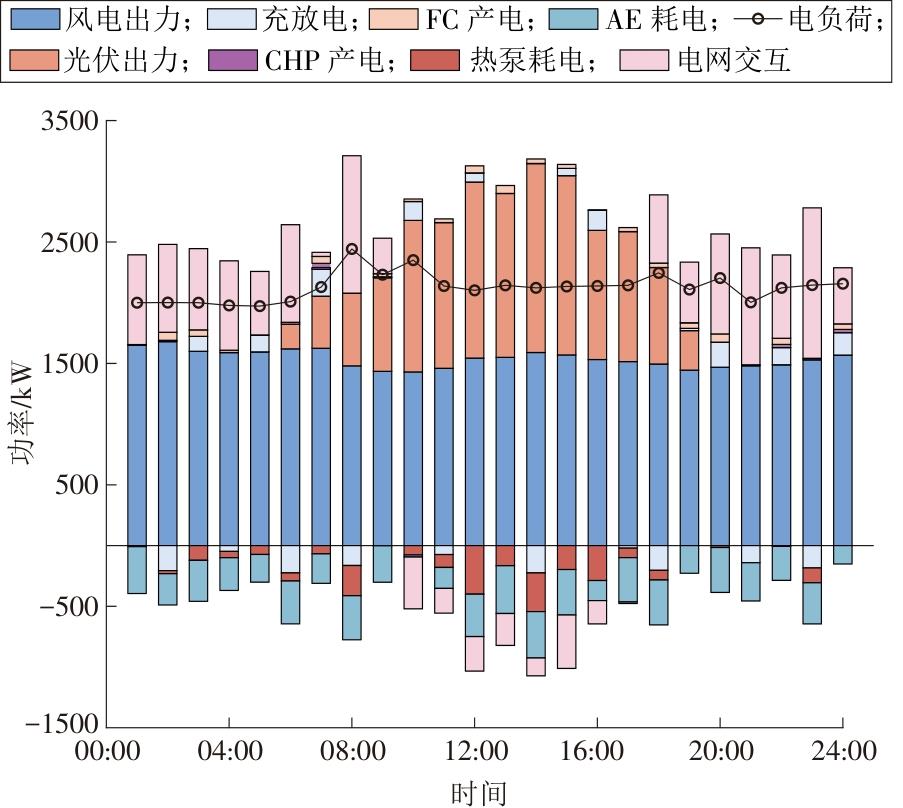
Fig.9
Heat load balance diagram of the optimal solution in scenario 3
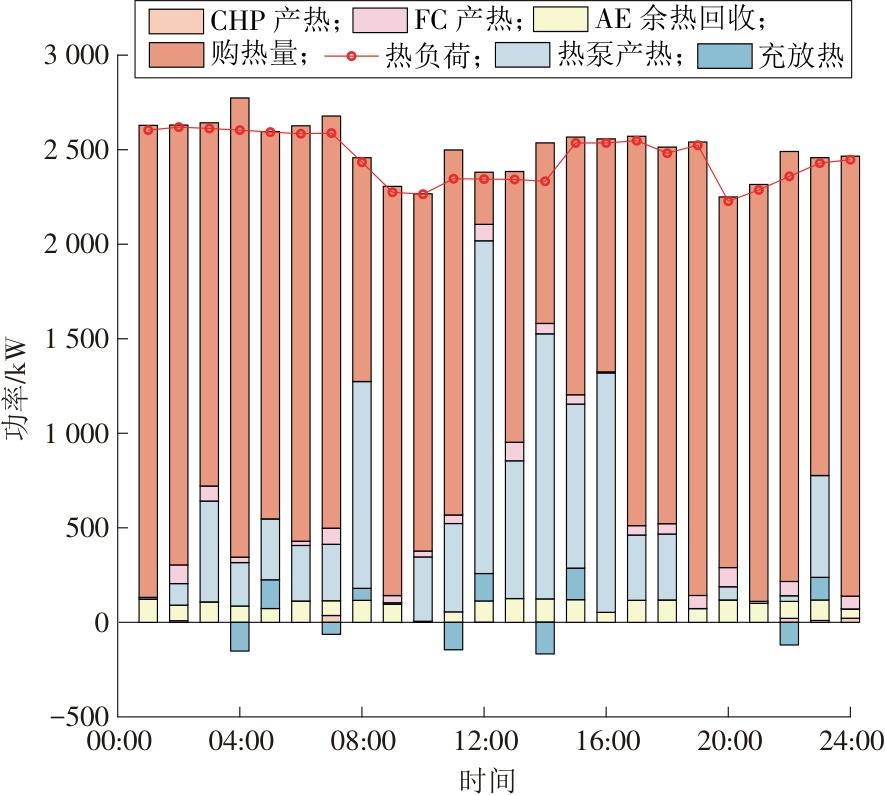
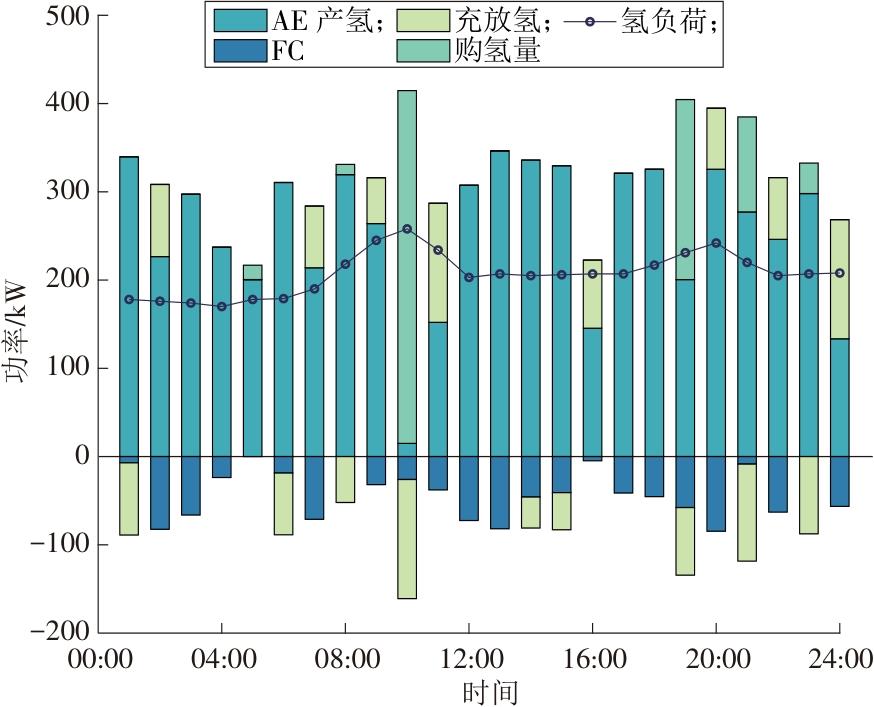
Fig.10
Hydrogen load balance diagram of the optimal solution in scenario 3
| [1] | KAKOULAKI G, KOUGIAS I, TAYLOR N, et al. Green hydrogen in Europe—A regional assessment: Substituting existing production with electrolysis powered by renewables[J]. Energy Conversion and Management, 2021, 228: 113649. |
| [2] | GÖTZ M, LEFEBVRE J, MÖRS F, et al. Renewable power-to-gas: A technological and economic review[J]. Renewable Energy, 2016, 85: 1371-1390. |
| [3] | TENG Y, WANG Z D, LI Y, et al. Multi-energy storage system model based on electricity heat and hydrogen coordinated optimization for power grid flexibility[J]. CSEE Journal of Power and Energy Systems, 2019, 5(2): 266-274. |
| [4] | CHENG Y, LIU M B, CHEN H L, et al. Optimization of multi-carrier energy system based on new operation mechanism modelling of power-to-gas integrated with CO2-based electrothermal energy storage[J]. Energy, 2021, 216: 119269. |
| [5] | DING X Y, SUN W, HARRISON G P, et al. Multi-objective optimization for an integrated renewable, power-to-gas and solid oxide fuel cell/gas turbine hybrid system in microgrid[J]. Energy, 2020, 213: 118804. |
| [6] | WANG Y L, LIU C, QIN Y M, et al. Synergistic planning of an integrated energy system containing hydrogen storage with the coupled use of electric-thermal energy[J]. International Journal of Hydrogen Energy, 2023, 48(40): 15154-15178. |
| [7] | 刘敦楠, 徐尔丰, 刘明光, 等. 面向分布式电源就地消纳的园区分时电价定价方法[J]. 电力系统自动化, 2020, 44(20): 19-28. |
| LIU Dunnan, XU Erfeng, LIU Mingguang, et al. TOU pricing method for park considering local consumption of distributed generator[J]. Automation of Electric Power Systems, 2020, 44(20): 19-28. | |
| [8] | 张伊宁, 何宇斌, 晏鸣宇, 等. 计及需求响应与动态气潮流的电-气综合能源系统优化调度[J]. 电力系统自动化, 2018, 42(20): 1-8. |
| ZHANG Yining, HE Yubin, YAN Mingyu, et al. Optimal dispatch of integrated electricity-natural gas system considering demand response and dynamic natural gas flow[J]. Automation of Electric Power Systems, 2018, 42(20): 1-8. | |
| [9] | PONOĆKO J, MILANOVIĆ J V. Multi-objective demand side management at distribution network level in support of transmission network operation[J]. IEEE Transactions on Power Systems, 2020, 35(3): 1822-1833. |
| [10] | ZHANG Y N, HE Y B, YAN M Y, et al. Linearized stochastic scheduling of interconnected energy hubs considering integrated demand response and wind uncertainty[J]. Energies, 2018, 11(9): 2448. |
| [11] | 王仕炬, 刘天琪, 何川, 等. 基于舒适度的需求响应与碳交易的园区综合能源经济调度[J]. 电测与仪表, 2022, 59(11):1-7. |
| WANG Shiju, LIU Tianqi, HE Chuan, et al. Comfort demand response and carbon trading based comprehensive energy economic dispatching in industrial parks[J]. Electrical Measurement & Instrumentation, 2022, 59(11): 1-7. | |
| [12] |
葛磊蛟, 于惟坤, 朱若源, 等. 考虑改进阶梯式碳交易机制与需求响应的综合能源系统优化调度[J]. 综合智慧能源, 2023, 45(7):97-106.
doi: 10.3969/j.issn.2097-0706.2023.07.011 |
|
GE Leijiao, YU Weikun, ZHU Ruoyuan, et al. Integrated energy system optimization scheduling considering improved stepped carbon trading mechanism and demand responses[J]. Integrated Intelligent Energy, 2023, 45(7): 97-106.
doi: 10.3969/j.issn.2097-0706.2023.07.011 |
|
| [13] | TROTTER P, TOTH F. The impact of EU ETS on energy system optimization: Insights from integrated assessment models[J]. Energy Economics, 2015, 52: 103-115. |
| [14] | BELLORA C, FONTAGNÉ L. EU in search of a carbon border adjustment mechanism[J]. Energy Economics, 2023, 123: 106673. |
| [15] | AMBEC S. The European Union's carbon border adjustment mechanism: Challenges and perspectives[R]. TSE Working Paper,2022: 1-27. |
| [16] | 崔杨, 曾鹏, 仲悟之, 等. 考虑阶梯式碳交易的电-气-热综合能源系统低碳经济调度[J]. 电力自动化设备, 2021, 41(3): 10-17. |
| CUI Yang, ZENG Peng, ZHONG Wuzhi, et al. Low-carbon economic dispatch of electricity-gas-heat integrated energy system based on ladder-type carbon trading[J]. Electric Power Automation Equipment, 2021, 41(3): 10-17. | |
| [17] | GUO R, YE H W, ZHAO Y. Low carbon dispatch of electricity-gas-thermal-storage integrated energy system based on stepped carbon trading[J]. Energy Reports, 2022, 8: 449-455. |
| [18] | 陈志, 胡志坚, 翁菖宏, 等. 基于阶梯碳交易机制的园区综合能源系统多阶段规划[J]. 电力自动化设备, 2021, 41(9): 148-155. |
| CHEN Zhi, HUZhijian, WENG Changhong, et al. Multi-stage planning of park-level integrated energy system based on ladder-type carbon trading mechanism[J]. Electric Power Automation Equipment, 2021, 41(9): 148-155. | |
| [19] | 陈锦鹏, 胡志坚, 陈颖光, 等. 考虑阶梯式碳交易机制与电制氢的综合能源系统热电优化[J]. 电力自动化设备, 2021, 41(9): 48-55. |
| CHEN Jinpeng, HU Zhijian, CHEN Yingguang, et al. Thermoelectric optimization of integrated energy system considering ladder-type carbon trading mechanism and electric hydrogen production[J]. Electric Power Automation Equipment, 2021, 41(9): 48-55. | |
| [20] | SUN H B, SUN X M, KOU L, et al. Optimal scheduling of park-level integrated energy system considering ladder-type carbon trading mechanism and flexible load[J]. Energy Reports, 2023, 9:3417-3430. |
| [21] | 陈浩, 马刚, 钱达, 等. 绿证-碳交易机制下考虑阶梯需求响应的区域综合能源系统优化调度[J/OL]. 综合智慧能源,1-12(2024-11-19)[2024-12-05]. http://kns.cnki.net/kcms/detail/41.1461.tk.20241118.1910.003.html. |
| CHEN Hao, MA Gang, QIAN Da, et al. Optimized dispatch of integrated regional energy system considering stepped demand response under green certificate-carbon trading mechanisms[J/OL]. Integrated Intelligent Energy,1-12(2024-11-19)[2024-12-05]. http://kns.cnki.net/kcms/detail/41.1461.tk.20241118.1910.003.html. | |
| [22] | ULLEBERG Ø. Modeling of advanced alkaline electrolyzers: A system simulation approach[J]. Hydrogen Energy, 2003; 28:21-33. |
| [23] | FU C, LIN J, SONG Y H, et al. Optimal operation of an integrated energy system incorporated with HCNG distribution networks[J]. IEEE Transactions on Sustainable Energy, 2020, 11(4): 2141-2151. |
| [24] | Ursúa A, Sanchis P. Static-dynamic modelling of the electrical behaviour of a commercial advanced alkaline water electrolyse[J]. International Journal of Hydrogen Energy, 2012, 37(24): 18598-18614. |
| [25] | HUANG C J, ZONG Y, YOU S et al. Economic model predictive control for multi-energy system considering hydrogen-thermal-electric dynamics and waste heat recovery of MW-level alkaline electrolyzer[J]. Energy Conversion and Management, 2022, 265: 115697. |
| [26] | 陈朝旭, 张亚超, 朱蜀, 等. 考虑多电解槽多工况组合运行的电-氢-热综合能源系统优化调度[J/OL]. 电网技术,1-10(2024-01-11)[2024-11-05]. https://doi.org/10.13335/j.1000-3673.pst.2023.2140. |
| CHEN Zhaoxu, ZHANG Yachao, ZHU Shu, et al. Optimal scheduling of electricity-hydrogen-heat lntegrated energy system considering combined operation of multi-electrolyzers under multiple conditions[J/OL]. Power Grid Technology,1-10(2024-01-11)[2024-11-05]. https://doi.org/10.13335/j.1000-3673.pst.2023.2140. | |
| [27] | 叶幸, 邱辰, 艾琳, 等. “双碳”目标下可再生能源绿色电力证书与碳交易衔接机制的思考[J/OL]. 综合智慧能源, 1-9(2024-09-05)[2024-11-05].http://kns.cnki.net/kcms/detail/41.1461.TK.20240904.1056.006.html. |
| YE Xing, QIU Chen, AI Lin, et al. Connection mechanism between green electricity certificates and carbon tradingmechanism under the "double carbon" target[J/OL]. Integrated Intelligent Energy,1-9(2024-09-05)[2024-11-05].http://kns.cnki.net/kcms/detail/41.1461.TK.20240904.1056.006.html. | |
| [28] | 生态环境部办公厅. 企业温室气体排放核算方法与报告指南:发电设施[R]. 北京: 生态环境部办公厅, 2022. |
| [29] | QIU W T, SU W J, ZONG Y. Energy price-driven integrated demand response for optimal operation of multi-carrier energy systems with hydrogen facility[C]// Proceedings of 2023 3rd Power System and Green Energy Conference (PSGEC),IEEE, 2023: 599-603. |
| [30] | DEB K, AGRAWAL S, PRATAP A, et al. A fast elitist non-dominated sorting genetic algorithm for multi-objective optimization: NSGA-Ⅱ[M]// Parallel Problem Solving from Nature PPSN VI. Heidelberg: Springer Berlin Heidelberg, 2000: 849-858. |
| [31] | 张晓捷. 基于熵权TOPSIS法的长租公寓财务风险评价及防范研究:以青客公寓为例[D]. 南宁: 广西大学, 2022. |
| ZHANG Xiaojie. Research on financial risk evaluation and preventive measures of long-time rental apartments based on entropy weight TOPSIS method[D]. Nanning: Guangxi University, 2022. |
| [1] | ZHENG Haoyu, ZHOU Jiahui, TONG Bin, WANG Haiming, XU Gang, ZHANG Ziyue. Research on capacity allocation and operation scheduling optimization of green hydrogen system with compressed air energy storage [J]. Integrated Intelligent Energy, 2025, 47(7): 64-70. |
| [2] | XING Zuoxia, ZHAO Ziyi, SUN Hao, ZHANG Pengfei, FU Qitong. Research on low-carbon economic operation optimization of integrated energy systems based on multi-level utilization of hydrogen production from electricity [J]. Integrated Intelligent Energy, 2025, 47(7): 71-81. |
| [3] | CHENG Xianlong, MA Yun, HAN Junfeng, MO Ying, GAO Yan. Research on economic scheduling of power systems with wind farms based on improved African vulture optimization algorithm [J]. Integrated Intelligent Energy, 2025, 47(6): 37-46. |
| [4] | LI Xiaoning, SUN Na, HUANG Amin, DONG Haiying. Fuzzy active disturbance rejection control of PEMFC air intake unit based on snake optimization algorithm [J]. Integrated Intelligent Energy, 2025, 47(6): 57-73. |
| [5] | WANG Cheng, SHAO Chong, HE Xin, DONG Haiying. Optimal power allocation for electrochemical energy storage power stations based on MOIBKA algorithm [J]. Integrated Intelligent Energy, 2025, 47(6): 74-84. |
| [6] | JIANG Meihui, XU Zhenjiang, NIU Tongke, ZHU Hongyu, LI Xiang. Intra-day multi-time scale rolling optimization scheduling of mine integrated energy system considering integrated demand response [J]. Integrated Intelligent Energy, 2025, 47(3): 73-83. |
| [7] | ZHUANG Fuhao, WU Jun, ZHU Ruijin, WU Hongmei, TIAN Run, XUE Yurun. Current status and prospects of key technologies in green hydrogen production industry [J]. Integrated Intelligent Energy, 2025, 47(10): 1-9. |
| [8] | MING Chuanwang, ZHAO Yuhao, LYU Youjun, LI Yihang. Research progress and opportunities in ammonia-fueled solid oxide fuel cells [J]. Integrated Intelligent Energy, 2025, 47(10): 10-25. |
| [9] | LIU Kaicheng, WANG Songcen, HE Guixiong, JIA Xiaoqiang, LI Jiaxin, WANG Jin, XU Hong. Energy management strategy and configuration optimization of fuel cell combined heat and power system for household consumers [J]. Integrated Intelligent Energy, 2025, 47(10): 77-87. |
| [10] | FAN Yanbo, XIONG Yaxuan, LI Xiang, TIAN Xi, YANG Yang. Advancement in multi-objective optimization for building energy use based on genetic algorithms [J]. Integrated Intelligent Energy, 2024, 46(9): 69-85. |
| [11] | WANG Jun, TIAN Hao, ZHAO Ergang, SHU Zhan, WAN Zijing. Low-carbon operation control on park-level integrated energy systems considering shared energy storage devices for electric vehicles [J]. Integrated Intelligent Energy, 2024, 46(6): 16-26. |
| [12] | CHEN Yong, XIAO Leiming, WANG Jingnan, WU Jian. Capacity planning method with high reliability for integrated energy systems with low-carbon emissions based on scenario expansion [J]. Integrated Intelligent Energy, 2024, 46(4): 24-33. |
| [13] | TANG Zihan, WANG Shuaijie, JU Zhenhe, LEI Zhiqi. Performance optimization of photovoltaic/thermal systems coupled with air source heat pumps [J]. Integrated Intelligent Energy, 2024, 46(4): 34-41. |
| [14] | SUN Jian, ZHANG Yunfan, CAI Xiaolong, LIU Dingqun. Optimal scheduling of HVAC systems based on predicted loads [J]. Integrated Intelligent Energy, 2024, 46(3): 12-19. |
| [15] | LU Wentian. Increment-exchange-based decentralized multi-objective optimal power flow algorithm for active distribution grids [J]. Integrated Intelligent Energy, 2024, 46(2): 43-48. |
| Viewed | ||||||
|
Full text |
|
|||||
|
Abstract |
|
|||||