Integrated Intelligent Energy ›› 2026, Vol. 48 ›› Issue (5): 56-63.doi: 10.3969/j.issn.2097-0706.2026.05.006
• Optimization of Hydrogen Production Systems • Previous Articles Next Articles
SUN Haoran1( ), LIN Guangwei2(), TANG Jifei2(), OUYANG Yanchao1(), WANG Zhimin1(), ZHU Qiao2(), YANG Jin1,*()
Received:2025-07-21
Revised:2025-11-10
Published:2026-05-25
Contact:
YANG Jin
E-mail:sunhr@dbc.com.cn;lingw97@my.swjtu.edu.cn;17855120061@163.com;ouyangyc7314@dongfang.com;wangzm8537@dongfang.com;zhuqiao@home.swjtu.edu.cn;yangj@dbc.com.cn
Supported by:CLC Number:
SUN Haoran, LIN Guangwei, TANG Jifei, OUYANG Yanchao, WANG Zhimin, ZHU Qiao, YANG Jin. Research on two-layer nested configuration optimization strategy for off-grid wind-solar complementary hydrogen production system considering electrolyzer lifetime[J]. Integrated Intelligent Energy, 2026, 48(5): 56-63.
Add to citation manager EndNote|Ris|BibTeX
URL: https://www.hdpower.net/EN/10.3969/j.issn.2097-0706.2026.05.006
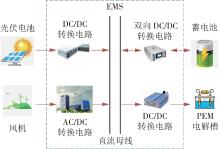
Fig.1
Off-grid DC bus wind-solar complementary hydrogen production system
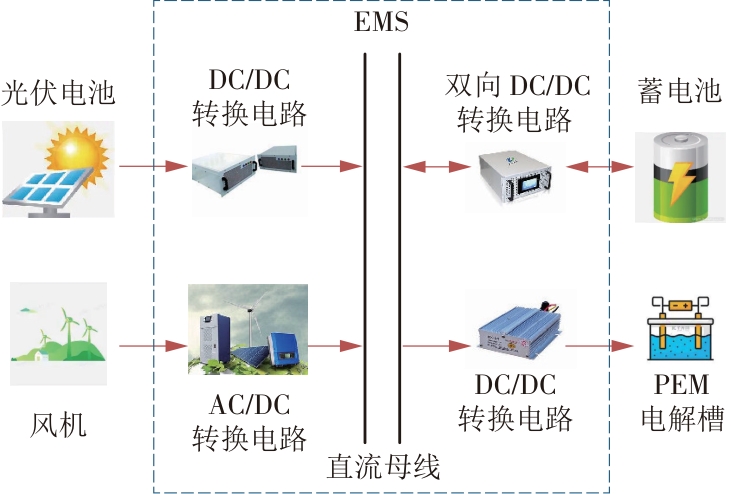
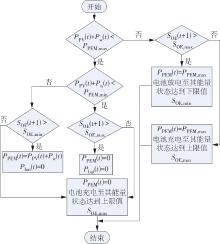
Fig.2
Rule-based energy management method for wind-solar complementary hydrogen production system
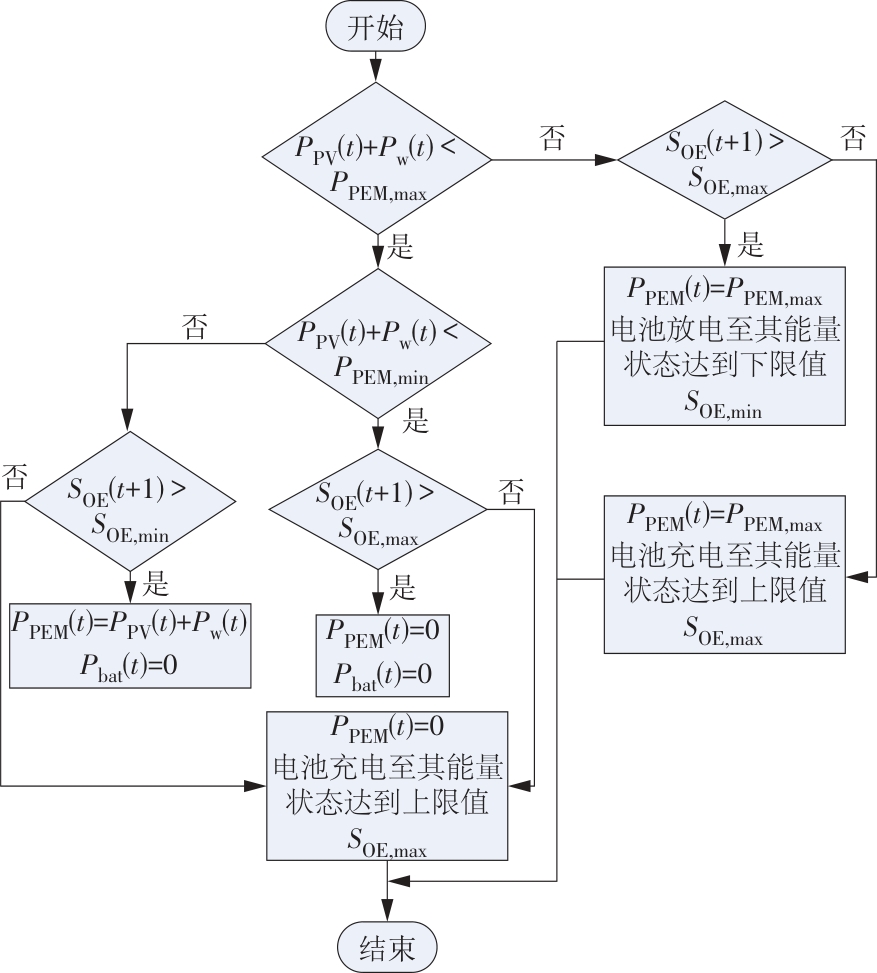
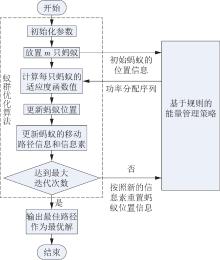
Fig. 3
Two-layer nested configuration optimization strategy
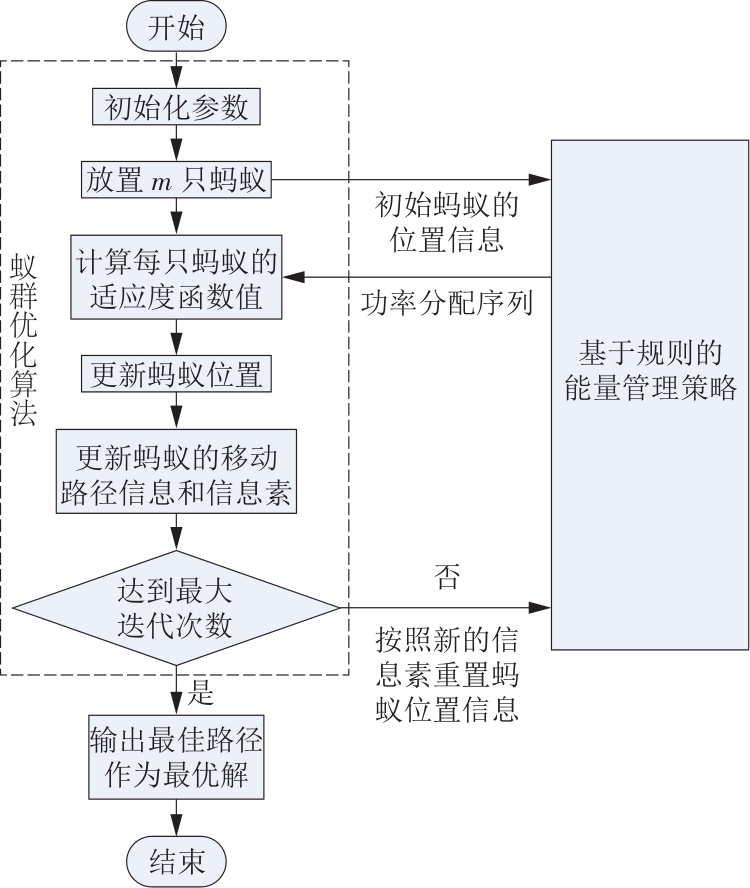
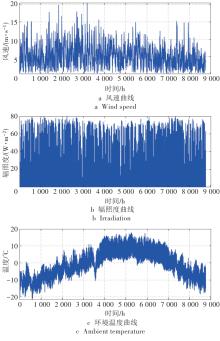
Fig.4
Environmental data curves of Baxoi, Tibet(screenshot)
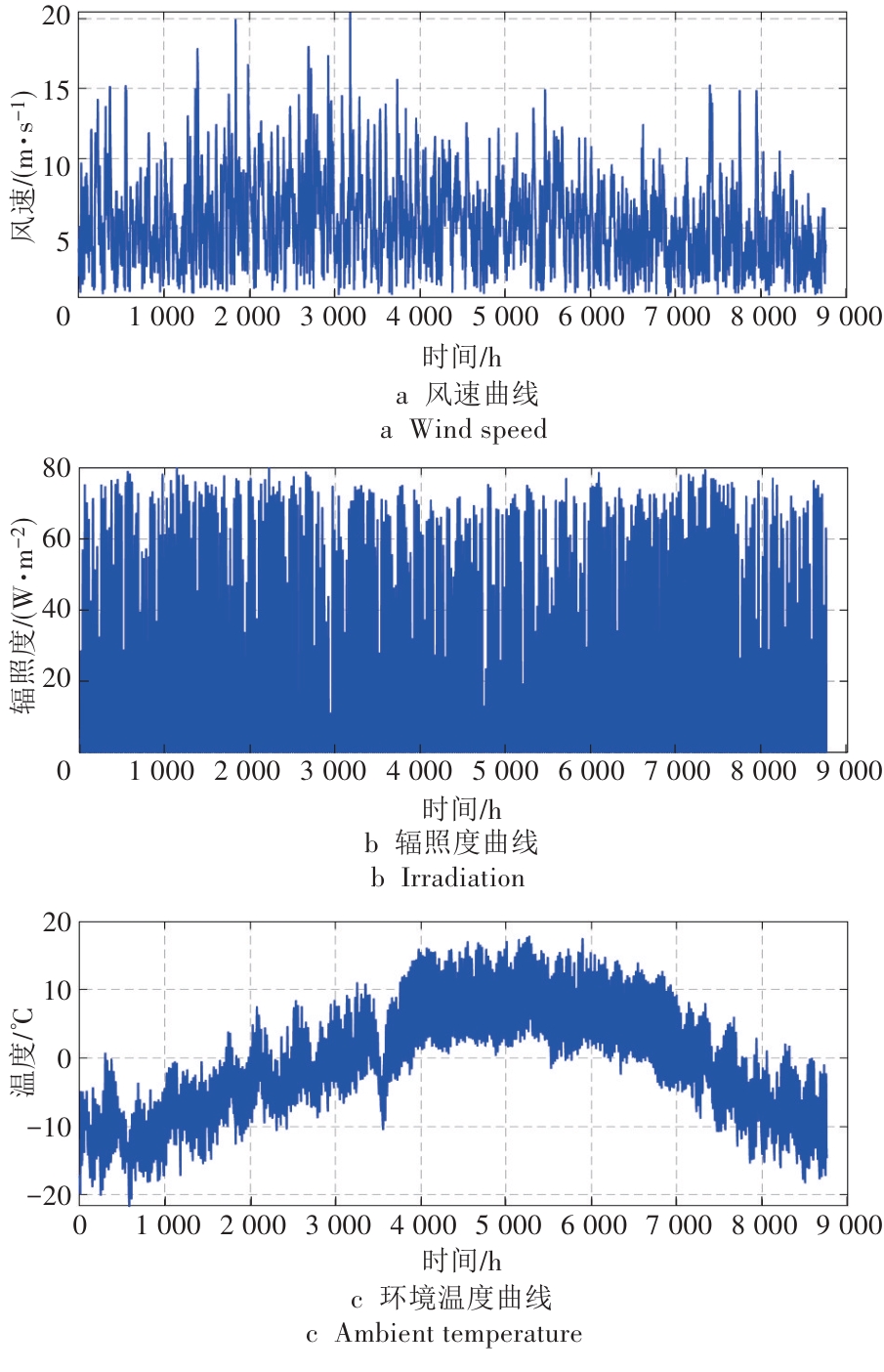
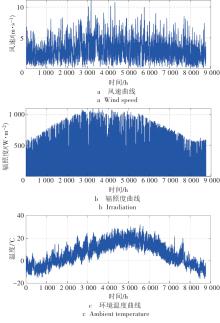
Fig.5
Environmental data curves of Golmud, Qinghai(screenshot)
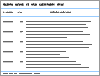
Table 1
Configuration optimization results based on ACO algorithm in Baxoi and Golmud
| 地区 | 风机容量/MW | 光伏容量/MW | PEM电解槽容量/MW | 蓄电池容量/ | 综合制氢成本/ |
|---|---|---|---|---|---|
| 西藏八宿 | 2.137 0 | 12.644 3 | 4.772 7 | 0 | 1.198 |
| 青海格尔木 | 0.021 7 | 17.792 6 | 5.269 9 | 0 | 1.320 |
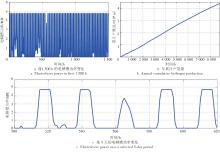
Fig.6
Power variation curves of electrolyzer in Baxoi, Tibet(screenshot)
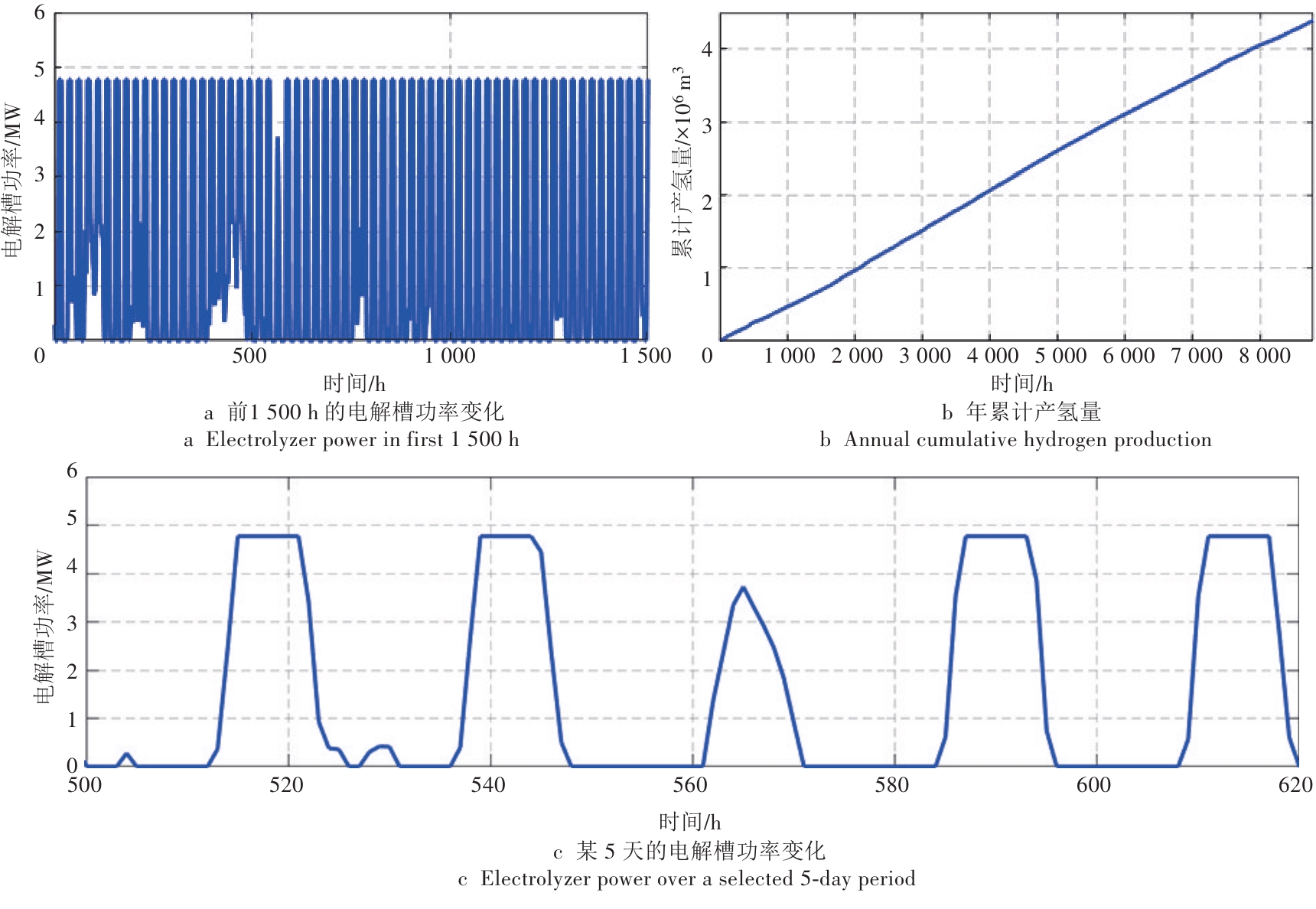
Fig.7
Power variation curves of electrolyzer in Golmud, Qinghai(screenshot)
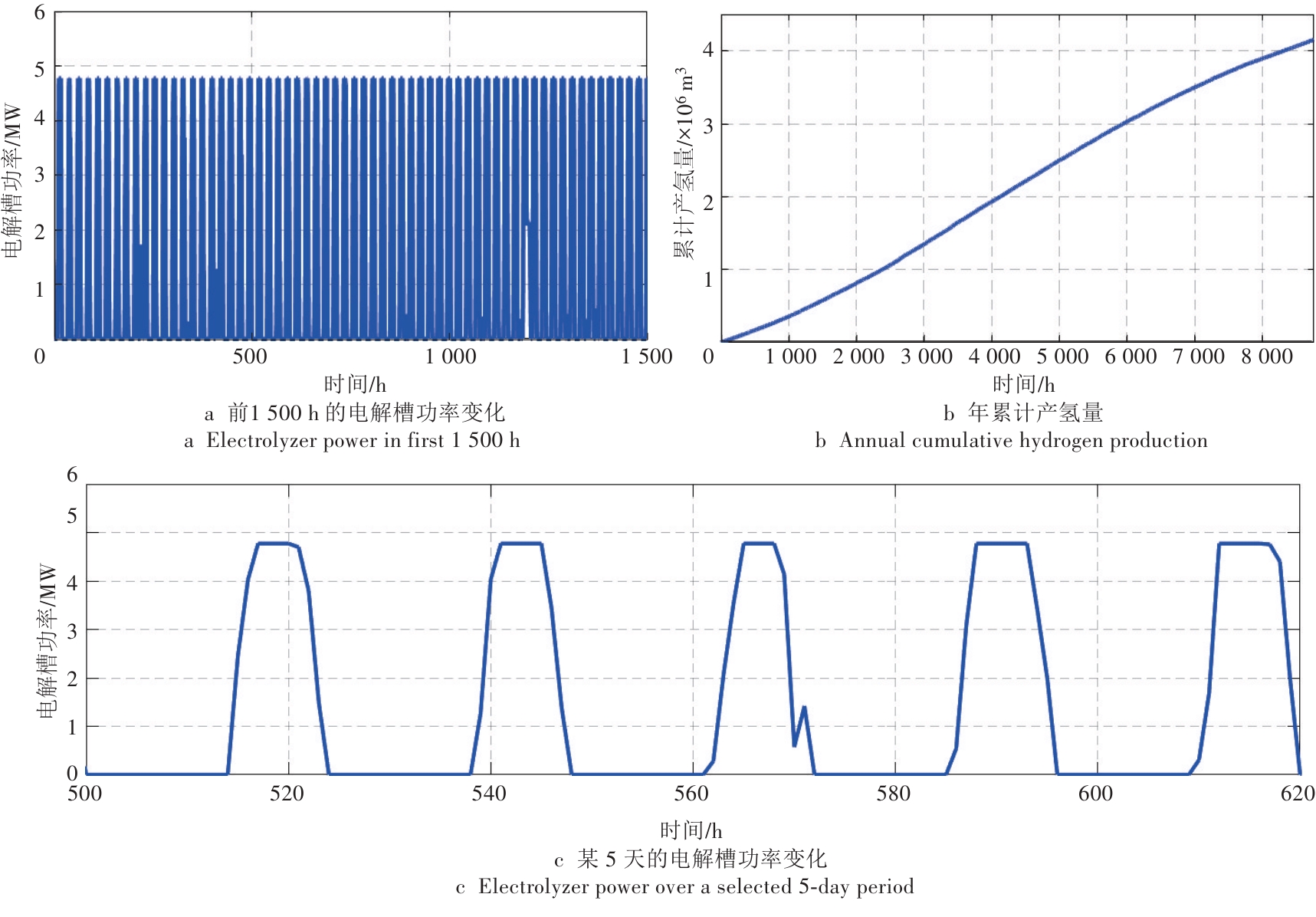
Table 2
Influence of lifetime model on configuration optimization results
| 寿命模型 | 风机容量/MW | 光伏容量/MW | PEM电解槽容量/MW | 蓄电池容量 | 综合制氢成本/ |
|---|---|---|---|---|---|
| 固定数值 | 0 | 16.368 2 | 4.383 2 | 0 | 1.286 |
| 动态寿命 | 2.137 | 12.644 3 | 4.772 7 | 0 | 1.198 |
Table 3
Configuration optimization results in Baxoi
| 蓄电池采购成本/ [元∙(kW∙h)-1] | 风机容量/MW | 光伏容量/MW | PEM电解槽容量/MW | 蓄电池容量 | 综合制氢成本/ |
|---|---|---|---|---|---|
| 500 | 0 | 12.627 6 | 4.536 4 | 0 | 1.192 0 |
| 100 | 0 | 12.584 2 | 4.302 8 | 0.671 | 1.185 3 |
| [1] |
INCER-VALVERDE J, PATIÑO-ARÉVALO L J, TSATSARONIS G, et al. Hydrogen-driven Power-to-X: State of the art and multicriteria evaluation of a study case[J]. Energy Conversion and Management, 2022, 266: 115814.
doi: 10.1016/j.enconman.2022.115814 |
| [2] |
XU Y K, LIU Z Y, CONG W H, et al. Application and progress of confinement synthesis strategy in electrochemical energy storage[J]. Transactions of Tianjin University, 2023, 29: 151-187.
doi: 10.1007/s12209-022-00353-8 |
| [3] | 许龙虎, 刘少鹏, 卢皓天. 基于改进多目标灰狼优化算法的光伏制氢储能系统配置优化[J]. 内蒙古电力技术, 2025, 43(1): 39-48. |
| XU Longhu, LIU Shaopeng, LU Haotian. Optimization method for photovoltaic hydrogen energy storage system configuration based on multi-objective improved grey wolf optimization algorithm[J]. Inner Mongolia Electric Power, 2025, 43(1): 39-48. | |
| [4] |
NIVOLIANITI E, KARNAVAS Y L, CHARPENTIER J F. Energy management of shipboard microgrids integrating energy storage systems: A review[J]. Renewable and Sustainable Energy Reviews, 2024, 189: 114012.
doi: 10.1016/j.rser.2023.114012 |
| [5] |
MAROCCO P, FERRERO D, LANZINI A, et al. Optimal design of stand-alone solutions based on RES plus hydrogen storage feeding off-grid communities[J]. Energy Conversion and Management, 2021, 238: 114147.
doi: 10.1016/j.enconman.2021.114147 |
| [6] |
LIU L T, ZHAI R R, XU Y, et al. Comprehensive sustainability assessment and multi-objective optimization of a novel renewable energy driven multi-energy supply system[J]. Applied Thermal Engineering, 2024, 236: 121461.
doi: 10.1016/j.applthermaleng.2023.121461 |
| [7] |
MANDAL P K. A review of classical methods and nature-inspired algorithms(nias) for optimization problems[J]. Results in Control and Optimization, 2023, 13: 100315.
doi: 10.1016/j.rico.2023.100315 |
| [8] |
DAI R, MESBAHI M. Optimal power generation and load management for off-grid hybrid power systems with renewable sources via mixed-integer programming[J]. Energy Conversion and Management, 2013, 73: 234-244.
doi: 10.1016/j.enconman.2013.04.039 |
| [9] |
SMAOUI M, ABDELKAFI A, KRICHEN L. Optimal sizing of stand-alone photovoltaic/wind/hydrogen hybrid system supplying a desalination unit[J]. Solar Energy, 2015, 120: 263-276.
doi: 10.1016/j.solener.2015.07.032 |
| [10] |
GARJAN M, DING Y W, PAU G, et al. Multi-objective capacity optimization configuration of independent wind-photovoltaic-hydrogen-battery system based on improved MOSSA algorithm[J]. Frontiers in Energy Research, 2023, 10: 1077462.
doi: 10.3389/fenrg.2022.1077462 |
| [11] |
CHEN K, PENG H W, GAO Z X, et al. Day-ahead operation analysis of wind and solar power generation coupled with hydrogen energy storage system based on adaptive simulated annealing particle swarm algorithm[J]. Energies, 2022, 15(24): 9581.
doi: 10.3390/en15249581 |
| [12] |
白章, 郝文杰, 李琦, 等. 基于全生命周期评价的风光制氢综合系统容量配置优化研究[J]. 综合智慧能源, 2024, 46(10): 1-11.
doi: 10.3969/j.issn.2097-0706.2024.10.001 |
|
BAI Zhang, HAO Wenjie, LI Qi, et al. Capacity configuration optimization of wind-solar hydrogen production based on life cycle assessment[J]. Integrated Intelligent Energy, 2024, 46(10): 1-11.
doi: 10.3969/j.issn.2097-0706.2024.10.001 |
|
| [13] |
周成伟, 李鹏, 俞斌, 等. 风光储微电网储能系统容量优化配置[J]. 综合智慧能源, 2022, 44(12): 56-61.
doi: 10.3969/j.issn.2097-0706.2022.12.008 |
|
ZHOU Chengwei, LI Peng, YU Bin, et al. Optimal configuration for energy storage system capacity of wind-solar-storage microgrid[J]. Integrated Intelligent Energy, 2022, 44(12): 56-61.
doi: 10.3969/j.issn.2097-0706.2022.12.008 |
|
| [14] |
FENG Q, YUAN X Z, LIU G Y, et al. A review of proton exchange membrane water electrolysis on degradation mechanisms and mitigation strategies[J]. Journal of Power Sources, 2017, 366: 33-55.
doi: 10.1016/j.jpowsour.2017.09.006 |
| [15] |
PHAN T T, KIM S K, ISLAM J, et al. Degradation analysis of polymer electrolyte membrane water electrolyzer with different membrane thicknesses[J]. International Journal of Hydrogen Energy, 2024, 49: 875-885.
doi: 10.1016/j.ijhydene.2023.09.274 |
| [16] |
姚芳, 杨晓娜, 葛磊蛟, 等. 风-光-氢能源系统容量优化配置研究[J]. 综合智慧能源, 2022, 44(5): 56-63.
doi: 10.3969/j.issn.2097-0706.2022.05.006 |
|
YAO Fang, YANG Xiaona, GE Leijiao, et al. Optimization of capacity allocation scheme for wind-solar-hydrogen energy system[J]. Integrated Intelligent Energy, 2022, 44(5): 56-63.
doi: 10.3969/j.issn.2097-0706.2022.05.006 |
|
| [17] |
BAO X Y, CHEN L P, LOPES A M, et al. Joint estimation of state-of-charge and state-of-energy of lithium-ion batteries at different ambient temperatures based on domain adaptation and unscented Kalman filter[J]. Electric Power Systems Research, 2024, 231: 110284.
doi: 10.1016/j.epsr.2024.110284 |
| [18] |
SCHNUELLE C, WASSERMANN T, FUHRLAENDER D, et al. Dynamic hydrogen production from PV & wind direct electricity supply—Modeling and techno-economic assessment[J]. International Journal of Hydrogen Energy, 2020, 45(55): 29938-29952.
doi: 10.1016/j.ijhydene.2020.08.044 |
| [19] |
王海鸣, 张润之, 周家辉, 等. 离网式风光互补制氢合成绿氨系统容量配置优化分析[J]. 综合智慧能源, 2024, 46(11): 73-82.
doi: 10.3969/j.issn.2097-0706.2024.11.009 |
|
WANG Haiming, ZHANG Runzhi, ZHOU Jiahui, et al. Optimal capacity configuration of off-grid wind-solar hybrid hydrogen production and green ammonia synthesis system[J]. Integrated Intelligent Energy, 2024, 46(11): 73-82.
doi: 10.3969/j.issn.2097-0706.2024.11.009 |
|
| [20] |
WU Y, AZIZ S M, HAQUE M H. Vehicle-to-home operation and multi-location charging of electric vehicles for energy cost optimisation of households with photovoltaic system and battery energy storage[J]. Renewable Energy, 2024, 221: 119729.
doi: 10.1016/j.renene.2023.119729 |
| [21] | ALTHANI M, MAHERI A. An ant colony algorithm for hres size and configuration optimisation[C]. 2021 6th International Symposium on Environment-Friendly Energies and Applications (EFEA). IEEE, 2021: 1-6. |
| [22] |
ZHANG J, XIAO F, MA F, et al. Capacity optimization allocation method for off-grid RES-H2 microgrid system considering the load-follow-source mechanism[J]. Electric Power Systems Research, 2024, 231: 110378.
doi: 10.1016/j.epsr.2024.110378 |
| [1] | JING Linru, TAN Chaodong, CHEN Peiyao, FENG Gang, WANG Jun, LIU Bin. Capacity configuration optimization of wind-solar-storage systems for oil well groups at drilling sites [J]. Integrated Intelligent Energy, 2026, 48(5): 1-9. |
| [2] | DING Xinyu, ZHOU Qingcai, CHI Yaodan, ZHANG Yao, WANG Junxi, WANG Chao, JIA Hongdan, LIN Guoxiong. Research progress on modeling, control, and source-load prediction of new-type power systems [J]. Integrated Intelligent Energy, 2026, 48(3): 1-14. |
| [3] | WU Guoliang, ZHENG Wen, HE Ling, WANG Lei, HUANG Yuan, LIU Junyong. Energy management strategy for smart commercial buildings considering electric vehicle charging patterns and building thermal inertia [J]. Integrated Intelligent Energy, 2025, 47(7): 12-22. |
| [4] | YANG Lijie, DENG Zhenyu, CHEN Zuoshuang, HUANG Chao, JIANG Meihui, ZHU Hongyu. Non-intrusive load identification for public buildings based on MSCNN-BiGRU-MLP model [J]. Integrated Intelligent Energy, 2025, 47(3): 23-31. |
| [5] | LIU Ziteng, ZHAO Jianli, TAO Weijian, SHEN Cong, AI Qian. Distributed energy management strategy for smart buildings based on V2B technology [J]. Integrated Intelligent Energy, 2025, 47(11): 24-35. |
| [6] | LIU Kaicheng, WANG Songcen, HE Guixiong, JIA Xiaoqiang, LI Jiaxin, WANG Jin, XU Hong. Energy management strategy and configuration optimization of fuel cell combined heat and power system for household consumers [J]. Integrated Intelligent Energy, 2025, 47(10): 77-87. |
| [7] | QU Qi, TENG Fei, GUO Yuxin, ZHANG Linxue. Distributed energy management of port integrated energy system considering computing power demands [J]. Integrated Intelligent Energy, 2025, 47(1): 42-50. |
| [8] | NIE Xueying, CHENG Maosong, ZUO Xiandi, DAI Zhimin. Capacity optimization of wind-solar-nuclear-energy storage hybrid system considering wind and solar energy consumption [J]. Integrated Intelligent Energy, 2025, 47(1): 51-61. |
| [9] | HU Kaiyong, ZHAO Peiyu, WANG Zhiming. Modeling of photovoltaic-PEM hydrogen production system and comparative performance analysis of different coupling methods [J]. Integrated Intelligent Energy, 2024, 46(9): 37-44. |
| [10] | ZOU Fenghua, ZHU Xingyang, YIN Junping, MENG Shiyu, JIANG Haiyan, CHEN Aikang, LIU Lan. Development trend analysis on building energy systems under "dual carbon" target [J]. Integrated Intelligent Energy, 2024, 46(8): 36-40. |
| [11] | YUAN Shuguang, ZHANG Yuting, WANG Feng, YUAN Guangzhen. Business operation modes and risk analysis of large-scale energy storage in western Inner Mongolia [J]. Integrated Intelligent Energy, 2024, 46(3): 63-71. |
| [12] | LYU Yongsheng, ZHANG Xiaoyu, WANG Xirong, GUO Peiqian. Application and prospect of federated learning in new power systems [J]. Integrated Intelligent Energy, 2024, 46(11): 54-64. |
| [13] | FANG Gang, WANG Jing, ZHANG Bobo, WANG Junzhe. Research on optimization algorithm of industrial park microgrid configuration based on Pareto solution set [J]. Integrated Intelligent Energy, 2024, 46(1): 49-55. |
| [14] | BAO Yixin, XU Luoyun, YANG Qiang. Optimized control method for flexible load of a building complex based on MADDPG reinforcement learning [J]. Integrated Intelligent Energy, 2023, 45(7): 61-69. |
| [15] | CAO Zilin, WANG Wenjing, ZHAO Wei, KANG Ligai, GAO Xiaofeng, YANG Yang, WANG Jinzhu. Research on optimal scheduling of distributed integrated energy systems in load-intensive areas considering demand response [J]. Integrated Intelligent Energy, 2023, 45(7): 11-21. |
| Viewed | ||||||
|
Full text |
|
|||||
|
Abstract |
|
|||||